Onshore vs nearshore vs offshore software development: how to choose
Where your development team sits shapes cost, communication, contracts and compliance. Here is a plain comparison of onshore, nearshore and offshore software development for US, Canadian, UK and Middle East companies, plus the blended model, how to run a distributed team well and a step-by-step way to decide.
Short answer
Onshore teams share your country and working hours at the highest relative cost, nearshore teams sit in nearby time zones at moderate cost, and offshore teams are farthest away and usually least expensive. Choose by how much live collaboration, legal proximity and compliance control you need, and consider a blended model with a local accountable lead and a distributed team.
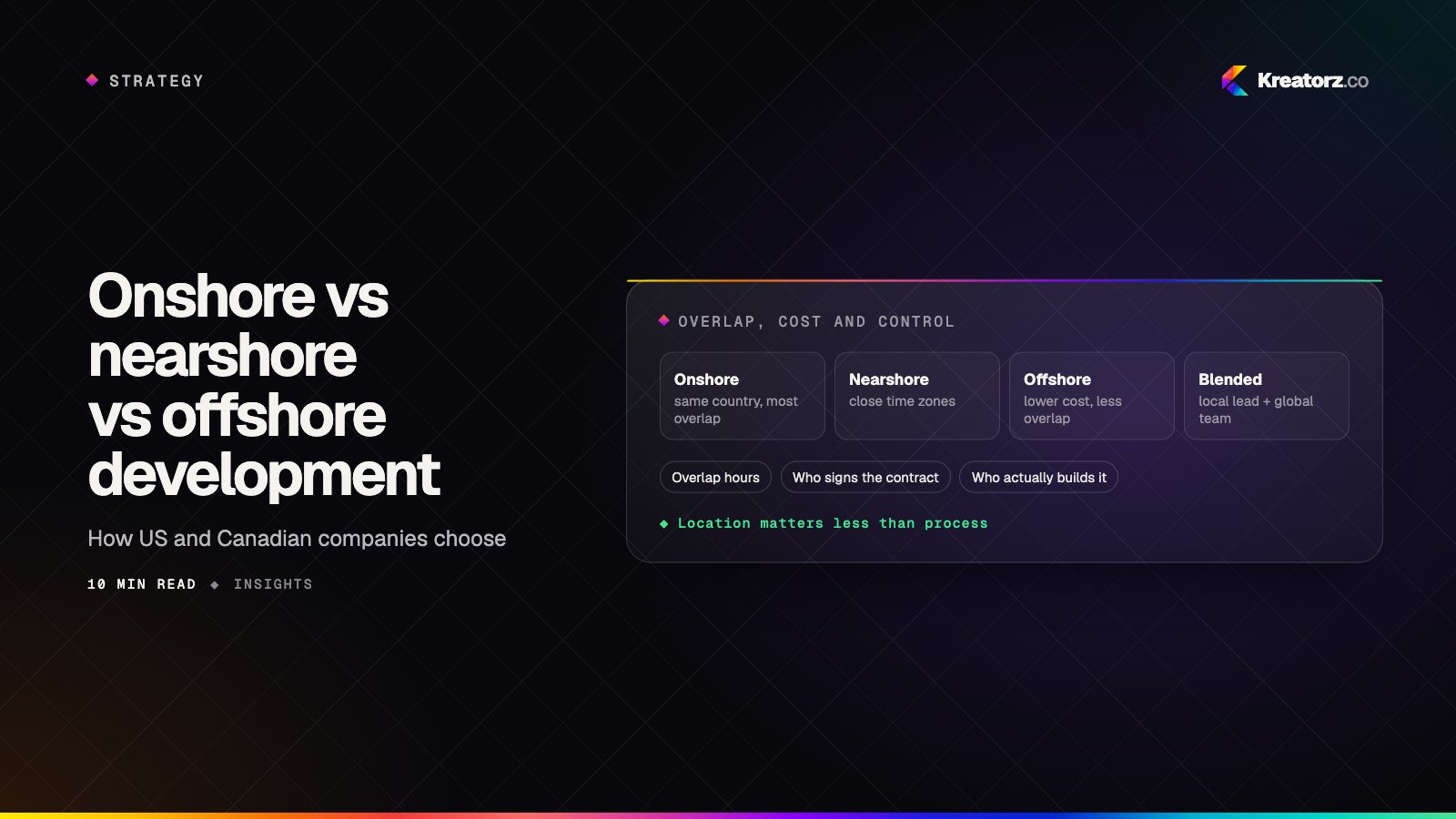
Once you decide to bring in an outside team to build your product, one of the first questions is where that team should be. Every vendor will explain why their location is the right one.
Each model can work well or badly. Location changes the trade-offs: hours you share each day, which country's law governs the contract, how your data moves and what the work costs. It does not decide whether the software is any good.
This guide is written mainly for US and Canadian companies, with notes for UK and Middle East buyers. If you are already comparing specific firms, our location guides go deeper: how to choose a software development company in the USA, how to hire an app development company in Canada and how to choose a software house in Lahore.
What onshore, nearshore and offshore actually mean
All three terms are relative to you, the buyer. The same team in Toronto is onshore for a Canadian company, nearshore for a US company and offshore for a company in Dubai.
- Onshore software development means the team works in your own country. For a US company, that is a US team; for a Canadian company, a Canadian team; for a UK company, a UK team.
- Nearshore software development means the team is in a nearby country, usually within a few time zones of you. For US companies, that often means Canada or Latin America. For Canadian companies, it often means the US or Latin America, and nearshore software development in Canada is a common choice for American buyers who want close working hours and familiar business norms. For UK companies, nearshore typically means continental Europe.
- Offshore software development means the team is in a more distant region with a larger time-zone gap, such as South Asia, Southeast Asia or Eastern Europe for North American buyers. For a company in the Gulf, South Asia is fairly close in time zone.
Two further points matter. First, many vendors are a mix: a legal entity in one country, leadership in another and engineers in several. Second, the label on the website often describes the sales office, not where the people writing your code are located. Always ask.
Onshore vs nearshore vs offshore: a side-by-side comparison
The table below compares the three models from the buyer's point of view. Costs are relative, because rates vary widely by seniority and vendor.
| Factor | Onshore | Nearshore | Offshore |
|---|---|---|---|
| Time-zone overlap | Full overlap with your working day | Strong overlap, often most of the day | Limited overlap; needs planned shared hours |
| Communication | Same language and business norms, easy live calls | Usually smooth, with some differences in language or style | Works well with strong written habits; harder if the team relies on live calls |
| Cost profile | Highest relative cost | Moderate; usually below onshore | Usually the lowest relative cost |
| Talent availability | Strong but competitive; senior specialists can be hard to secure | Growing pools in many regions | Large pools, with wide variation in quality |
| Legal and contract jurisdiction | Your own country's law and courts | Often a foreign entity unless the vendor has a local one | Usually a foreign entity unless the vendor has a local one; check enforceability |
| Data and compliance | Simplest for data residency and regulatory reviews | Depends on the country; may need cross-border transfer terms | Needs clear rules on data access, transfers and environments |
| Travel and in-person meetings | Easy, often same-day | Practical with some planning | Possible, but longer and less frequent |
| Cultural and working-style fit | Most familiar | Often close | Varies most; depends heavily on the specific team |
No column wins on every row.
Pros and cons of each model
Onshore
Pros: full overlap for quick decisions, the simplest contract and compliance picture, easy workshops and site visits, and shared assumptions about how business is done.
Cons: the highest relative cost, so the same budget buys less engineering time. Senior people can be in short supply, and a high price does not guarantee a senior team.
Onshore fits heavy regulatory exposure, frequent in-person collaboration, or buyers who cannot work outside their own legal system.
Nearshore
Pros: a good balance of overlap and cost, travel that is practical, and working styles that are often close to yours. For US companies, nearshore software development in Canada adds familiar legal and business norms and shared time zones with major US cities.
Cons: costs are usually higher than offshore, talent pools in a given city can be thinner, and you still need to confirm which entity you are contracting with and how cross-border data rules apply.
Nearshore fits fast-moving products that need daily live collaboration without fully onshore costs.
Offshore
Pros: usually the lowest relative cost, access to large talent pools, and the possibility of work continuing while your own team is offline.
Cons: limited overlap means slower back-and-forth unless the process is built for it. Quality varies widely between firms, and if the contracting entity is abroad, enforcing the contract and protecting IP can be harder.
Offshore fits well-defined work and steady roadmaps. A good offshore software development company makes the process easy; a weak one expects you to manage everything.
The blended or hybrid model
Many companies end up with neither pure model. In a blended setup, you contract with an entity in your own country or a nearshore one, a senior lead works in or near your time zone, and the engineering team is distributed across one or more lower-cost locations.
Done well, this gives you:
- Local accountability. A contract under familiar law with an entity you can hold responsible.
- Overlap where it counts. Your lead joins planning, decisions and demos in your working hours.
- Cost efficiency in delivery. Much of the engineering happens where relative costs are lower.
- Continuity. Work can progress across time zones, with handoffs at the start and end of each day.
The blended model works best when the same senior people stay involved from sales through delivery, when the distributed team is one integrated team rather than a subcontractor hidden behind a front office, and when the process relies on written specs, regular demos and shared tools. It works badly when a polished local sales team hands your project to people you never meet.
How to run a distributed team well
Whatever model you choose, if any part of the team is in another time zone, these habits decide whether it works.
- Agree on overlap hours. Fix a daily window when everyone is available for questions, standups and decisions. Protect it.
- Write things down. Clear specs, acceptance criteria and decision logs replace the hallway conversation. Our guide to writing an app requirements document is a good starting point.
- See working software often. Regular demos of real builds, not status slides, are the most reliable way to know where a project stands.
- Share the same tools. One issue tracker, one code repository, one chat workspace and one design file, all owned by your company.
- Have one accountable lead. A single person who owns delivery, answers for the timeline and is reachable in your working hours.
- Default to asynchronous work. Recorded walkthroughs and handoff notes keep work moving without waiting for a call.
- Meet in person when it matters. A kickoff workshop or a planning session in person can pay off for months, even on a fully remote team.
Questions to ask any software development outsourcing vendor
Location and contracting
- Which legal entity will sign the contract, where is it registered, and which law governs the agreement?
- Where is each person on my project located, and what hours do they work?
- How many hours of overlap will we have each day, and who is available in my time zone?
Who works on the project
- Who exactly will work on my project, and can I meet them before signing?
- Are they employees or subcontractors? Will any part of the work be passed to another company?
- Will the senior people I meet in sales stay involved during delivery?
- What happens if a key person leaves?
Security and data
- Who will have access to production systems and user data, and from where?
- How are devices, accounts and credentials secured?
- How do you handle cross-border data transfers and the privacy laws that apply to my users?
- Have you worked under requirements like HIPAA, PIPEDA, UK GDPR or regional data residency rules?
IP and ownership
- Will my company own all code, designs and documentation outright?
- Will repositories, cloud accounts and app store accounts be in my company's name from day one?
- What will you hand over if we part ways, and how quickly?
For a broader checklist covering discovery, process and team quality, see our guide to choosing a software development partner.
Red flags to watch for
- Vague answers about location. If a vendor cannot tell you where each team member works, assume you will not know later either.
- A bait-and-switch team. Senior people in the sales calls, unnamed juniors in delivery.
- Hidden subcontracting. Your project quietly passed to another firm you have never vetted.
- No overlap plan. "We are flexible" is not a schedule.
- Accounts in the vendor's name. Repositories, cloud services or app store listings you do not control.
- Price as the main pitch. The lowest rate rarely means the lowest total cost.
- Resistance to a small paid start. A confident team is happy to prove itself on a short discovery or first milestone.
A step-by-step decision guide
- Write a short brief. Describe the problem, users, first release, constraints and who decides on your side.
- List your non-negotiables. Regulatory rules, data residency, contract jurisdiction and any requirement for in-person work. If these demand a local entity or local data handling, that narrows your options immediately.
- Decide how much live collaboration you need. Products with fast-changing requirements and many stakeholders need more overlap. Well-defined work needs less.
- Set a realistic budget range. Think in total cost to a working product, not hourly rates. A cheaper team that needs more rework is not cheaper.
- Pick one or two models to explore. For example, nearshore and blended, or onshore and blended.
- Shortlist three to five vendors. Use live products, references and how well they engage with your brief.
- Ask the questions above. Compare answers side by side.
- Start small. A paid discovery phase or a first milestone tests communication, overlap and quality before you commit to a full build.
- Review and adjust. After the first few weeks, check whether the overlap, demos and decision-making are working, and change the setup if not.
Notes for UK and Middle East buyers
For UK companies, continental Europe is the usual nearshore option, and the main contract questions are governing law and UK GDPR compliance for any data leaving the country. For companies in the UAE and Saudi Arabia, time zones to South Asia and Europe are often friendlier than to North America, and data residency and Arabic language support may weigh heavily. We cover these markets on our pages for app development in the UK and app development in the UAE and Saudi Arabia.
The bottom line
Onshore, nearshore and offshore are starting points, not verdicts. Choose based on the live collaboration you need, where the contract and data must sit, and the total cost you can sustain. Then judge vendors on who does the work and whether you own what is built.
Kreatorz is one example of the blended model. We are a US company with an office in Sheridan, Wyoming, an office in Brantford, Ontario that works on Eastern Time, and a team in Lahore, Pakistan. One senior team works across those locations, and clients own their code. You can read more about how we work as an app development company in the USA, as an app development company in Canada, or as a software house in Lahore, see our custom software development service, or tell us about your project.
Frequently asked questions
What is the difference between onshore, nearshore and offshore software development?
Onshore means the team is in your own country, nearshore means it is in a nearby country with similar time zones, and offshore means it is in a more distant region with a larger time-zone gap. The terms are relative to the buyer, so the same team can be onshore for one company and offshore for another.
Is nearshore or offshore software development better?
Neither is better in general. Nearshore usually offers more overlap with your working day and closer working styles, while offshore usually costs less but needs stronger written communication and planned overlap hours. The right choice depends on how much live collaboration, legal proximity and budget flexibility your project needs.
Is nearshore software development in Canada a good option for US companies?
It can be. Canadian teams share time zones with major US cities and familiar business norms, and they usually cost less than an equivalent US team in relative terms. As with any vendor, confirm which entity signs the contract, how cross-border data is handled and who will actually work on your product.
What is a blended or hybrid development model?
It combines a local contracting entity and a senior lead in or near your time zone with a distributed engineering team in one or more other locations. It aims to give you local accountability and overlap for decisions, with cost efficiency in delivery, as long as the senior people stay involved throughout.
How do I protect my IP when outsourcing software development?
Make sure the contract assigns all code, designs and documentation to your company, keep repositories and cloud and app store accounts in your company's name from day one, limit access to production data, and agree in writing what will be handed over if the relationship ends. Have your own lawyer review the contract.
- Custom software developmentWe design and build web platforms, internal tools, customer portals, mobile apps and AI-powered systems that fit your business — instead of bending your business to…Explore
- App development company in the USAWe design, build and scale mobile apps, web platforms, SaaS products and AI features for startups and growing businesses across the United States.Explore
- App development company in CanadaWe design, build and scale mobile apps, web platforms, SaaS and AI products for Canadian businesses — and act as a nearshore development team for US companies.Explore


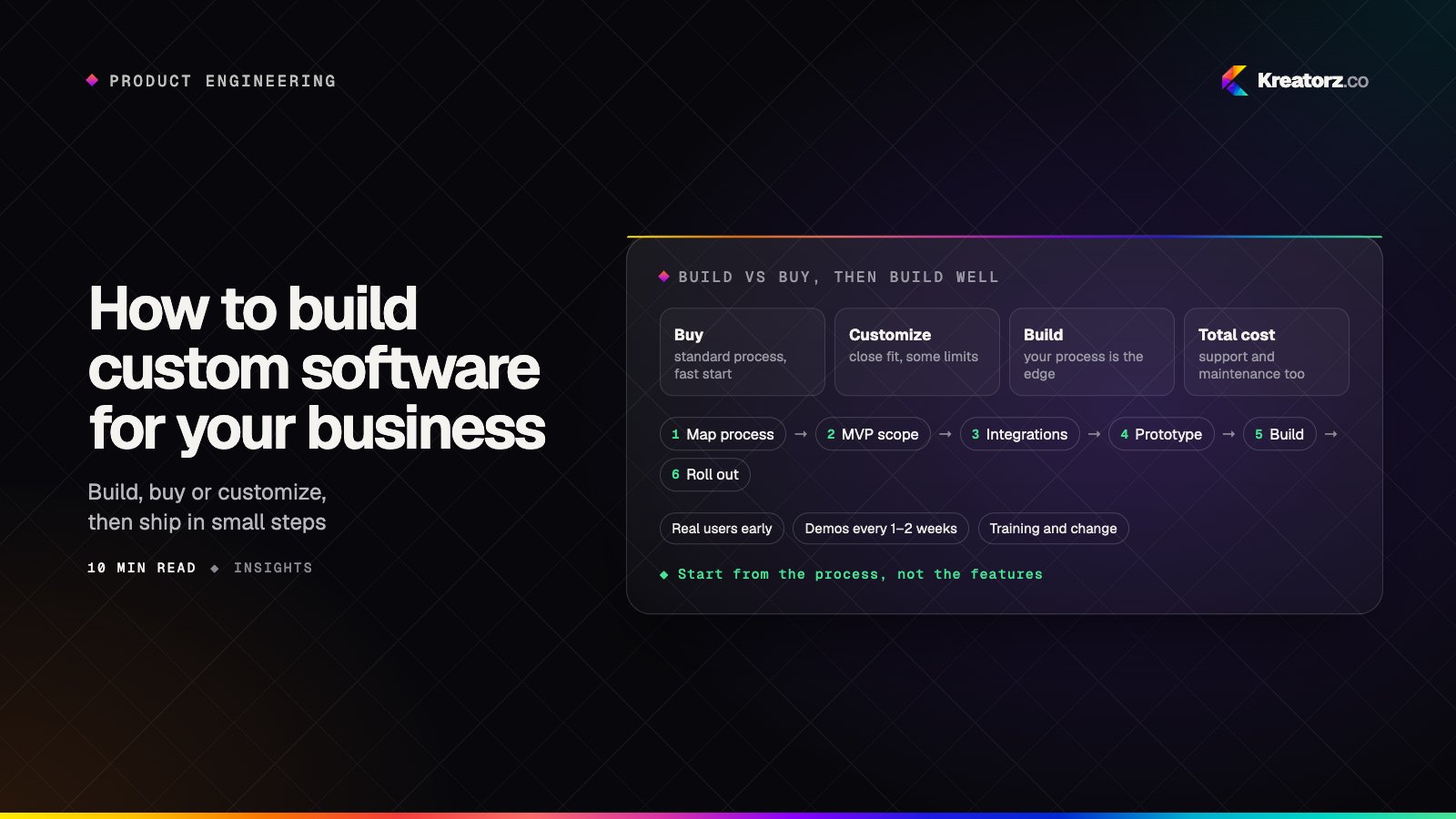
How to build custom software for your business: a step-by-step guide
Custom software can remove the spreadsheets, re-keying and workarounds that slow a business down, but only if it is planned around real processes and real users. Here is a practical, step-by-step way to decide whether to build, scope a first release, choose a partner and keep the system healthy after launch.
18 November 2026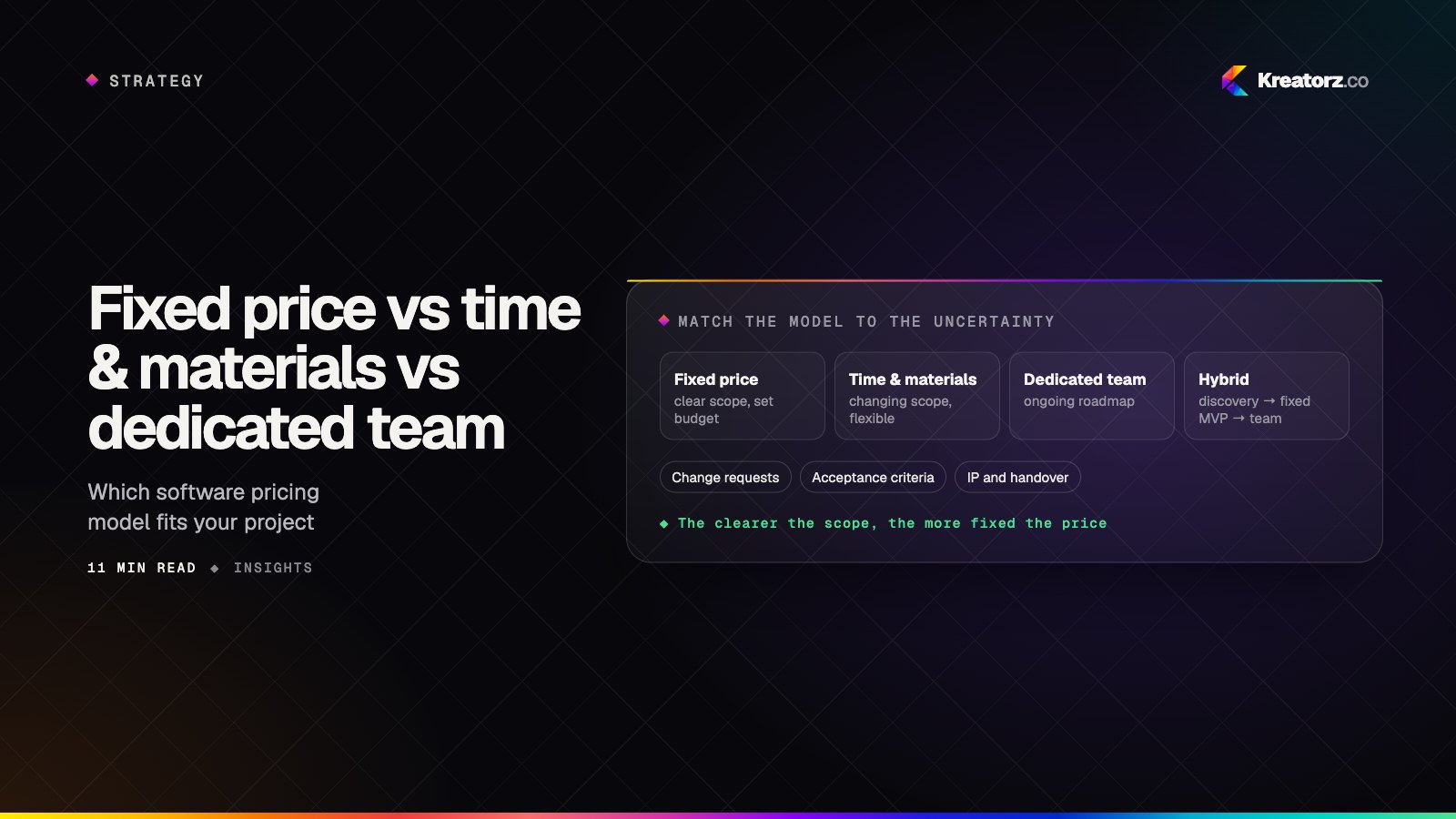
Fixed price vs time and materials vs dedicated team: which software development pricing model should you choose?
The way you pay for software shapes how it gets built. Here is a plain comparison of fixed price, time and materials and dedicated team models, how to choose between them step by step, the hybrids that often work best, and the contract terms and red flags to watch for.
21 November 2026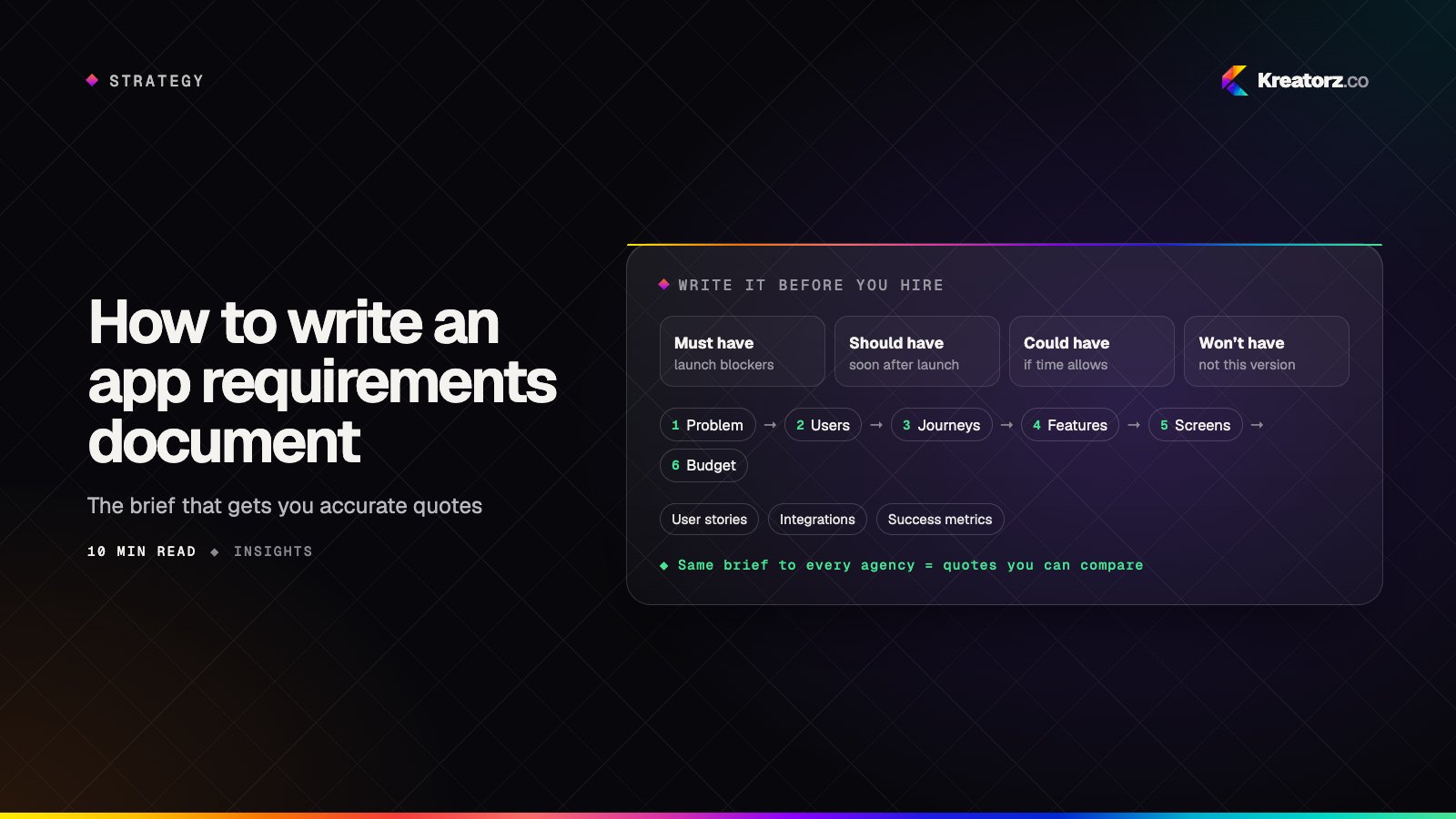
How to write an app requirements document before you hire developers
A clear app requirements document is the fastest way to get accurate, comparable quotes from developers. Here is a step-by-step guide to writing one, from the problem statement and user stories to must-have features, integrations, compliance flags, budget and a fill-in template you can copy.
21 November 2026