Fixed price vs time and materials vs dedicated team: which software development pricing model should you choose?
The way you pay for software shapes how it gets built. Here is a plain comparison of fixed price, time and materials and dedicated team models, how to choose between them step by step, the hybrids that often work best, and the contract terms and red flags to watch for.
Short answer
Choose fixed price when scope is clear and stable, time and materials when requirements will change as you learn, and a dedicated team when you need ongoing product work with your own product owner. Many projects combine them: paid discovery, then a fixed-price MVP, then a dedicated team, with clear change, acceptance and ownership terms.
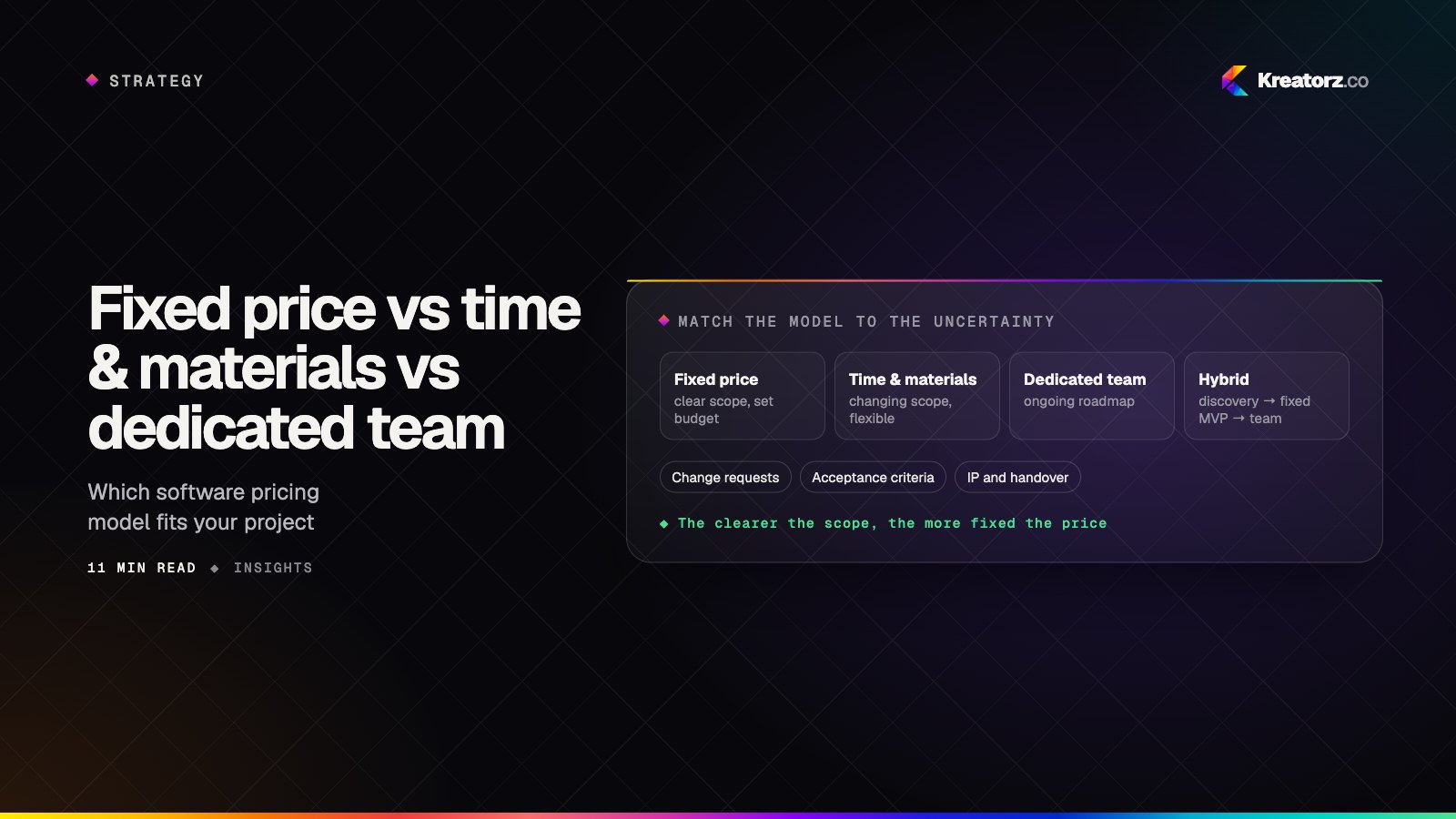
Once you have shortlisted a development partner, the next question is how you will pay them. The pricing model decides who carries the risk when estimates are wrong, how easily you can change your mind, how much of your time the project needs and what both sides are rewarded for.
There are three common software development pricing models: fixed price, time and materials and a dedicated development team. Each has a place. This guide explains what each one is, compares them side by side, walks through how to choose, and covers the hybrid setups, contract terms and red flags that matter more than the label on the proposal.
What each pricing model is
Fixed price
In fixed price software development, you and the vendor agree a defined scope, a delivery schedule and a total price before work starts. The vendor commits to delivering that scope for that price. If the work takes longer than they estimated, that is their problem; if you want something outside the agreed scope, it becomes a change request with its own price and timeline.
Fixed price only works when the scope can be written down precisely: screens, user flows, integrations, platforms and what "done" means for each. A good starting point is a solid app requirements document.
Time and materials
Under a time and materials contract, you pay for the time the team actually spends, at agreed rates, plus any direct costs such as third-party services. Scope is managed as a prioritized backlog rather than a fixed list. You can reorder, add or drop work as you learn, and the budget follows the work.
Time and materials is the most flexible model, but it needs you to stay involved: reviewing progress, setting priorities and deciding when something is good enough.
Dedicated development team
With a dedicated development team, the vendor provides a stable group of people (for example developers, a designer, QA and a delivery lead) who work on your product full time, usually billed on a recurring basis. You direct the priorities, often through your own product owner, while the vendor handles hiring, management, tools and continuity.
It behaves like an extension of your company rather than a project with an end date, which makes it best suited to long-running products.
Fixed price vs time and materials vs dedicated team: comparison table
| Fixed price | Time and materials | Dedicated team | |
|---|---|---|---|
| Best for | Small to medium projects with clear, stable requirements | Evolving products, MVPs where learning drives scope, integrations with unknowns | Long-term products with a continuous roadmap |
| How scope works | Agreed up front; changes go through formal change requests | Prioritized backlog that you can reorder at any time | Rolling roadmap set by your product owner |
| Budget certainty | High for the agreed scope | Lower, unless you add a cap or a budget per phase | Predictable recurring cost, open-ended total |
| Flexibility | Low; every change is renegotiated | High; change priorities sprint by sprint | High; the team works on whatever matters most |
| Your involvement | Heavy at the start, lighter during delivery, heavy at acceptance | Steady throughout: reviews, priorities, decisions | High; you lead the product direction |
| Who carries the risk | Vendor carries estimate risk; you carry the risk of building the wrong thing | You carry cost risk; the vendor carries delivery quality | Mostly you, for direction and cost; the vendor for team quality and continuity |
| Typical contract shape | Statement of work with deliverables, milestones, acceptance criteria and payment per milestone | Master services agreement plus rate card, invoicing by period, optional cap | Master services agreement plus team composition, recurring billing, notice period |
Pros and cons of each model
Fixed price
Pros
- A known total for a known scope, which helps with budgeting and approvals.
- The vendor is motivated to work efficiently, because overruns cost them.
- Less day-to-day management on your side once the scope is signed off.
Cons
- Vendors add a risk buffer to the price, because they carry the estimate risk.
- Change is slow and paid for separately, which discourages learning from users.
- Pressure to hit the price can push quality corners, such as thinner testing, if acceptance criteria are vague.
- Much of the effort goes into specifying everything before anyone has used the product.
Time and materials
Pros
- You can change direction as you learn, without renegotiating a contract.
- You pay for real work rather than a padded estimate.
- Work starts sooner, because you do not need a complete specification first.
- Transparency: you see where the time goes.
Cons
- The total cost is uncertain unless you set limits.
- It needs your regular attention to keep priorities sharp.
- The vendor has less built-in incentive to be efficient, so trust and reporting matter.
Dedicated team
Pros
- Continuity: the same people build deep knowledge of your product and users.
- Capacity you can plan around, without hiring and managing staff yourself.
Cons
- You pay for the team whether or not the backlog is ready, so idle time is your cost.
- Without a strong product owner on your side, the team can drift.
- It is a poor fit for a single, short, well-defined project.
How to choose a pricing model, step by step
Work through these five questions in order. Most projects end up with a clear answer by the third or fourth.
1. How clear is the scope?
If you can describe every screen, rule and integration today, and you are confident users want exactly that, fixed price is realistic. If you have a strong idea but open questions (which features matter most, how an integration behaves, what users will actually do), time and materials fits better. If the work is a product that will keep growing, think dedicated team.
2. How likely are changes?
Be honest. New products almost always change once real users touch them, and so do internal tools once staff start using them. If change is likely, a model that punishes change will cost you either in fees or in a product built to an outdated plan.
3. How much timeline pressure is there?
A hard deadline, such as a launch event or a contract start date, favors fixing the date and flexing the scope. Time and materials with a prioritized backlog does this naturally: the most important work ships first.
4. Do you have internal product ownership?
Time and materials and dedicated teams both need someone on your side who can make product decisions quickly. If nobody can spend that time, fixed price, or a vendor-led phase with clear milestones, will protect you from slow decisions turning into wasted effort.
5. What is your budget style?
Some organizations need one approved number before anything starts; others fund work by quarter or by phase. A single approved number points toward fixed price or capped time and materials. Recurring operating budgets suit a dedicated team. If you are still working out what that number should be, our guide to app development cost explains how to estimate it.
Hybrid approaches that often work best
You do not have to pick one model for the whole life of a product. Some of the most reliable setups combine them.
- Paid discovery, then a fixed-price MVP, then a dedicated team. A short, fixed-scope discovery phase produces user flows, priorities, architecture and an estimate. With that clarity, a fixed price for the first release becomes fair to both sides. After launch, a dedicated team keeps improving the product based on real usage. This is a common path for MVP development.
- Capped time and materials. You keep the flexibility of paying for actual work, with a not-to-exceed amount per phase or per month. When the cap approaches, you review progress and decide together whether to extend, cut scope or stop.
- Milestone-based delivery. The project is split into milestones, each with its own scope, acceptance criteria and payment. Early milestones can be time and materials while the shape is unclear, and later ones fixed price once the design has settled.
- Fixed price per sprint or phase. A fixed fee buys a fixed team for a fixed period, with scope chosen at the start of each sprint. It gives budget predictability without locking the whole roadmap.
Contract terms to insist on
Whatever model you choose, the contract is where its promises become real. These terms matter in every model, with a different emphasis in each.
| Term | Fixed price | Time and materials | Dedicated team |
|---|---|---|---|
| Change requests | A written process for estimating, approving and pricing changes, with a response time | How new work is added to the backlog and approved against the budget | How priorities are set and who can change them |
| Acceptance criteria | Specific, testable criteria for each deliverable, plus a defined acceptance period | Definition of done for backlog items, reviewed at each demo | Quality standards: code review, testing and release practices |
| IP ownership | You own all code, designs and documentation on payment | Same, with ownership transferring as work is paid for | Same, plus all repositories and cloud accounts in your name |
| Exit and handover | What is delivered if the project stops early | Notice period and handover of work in progress | Notice period, knowledge transfer and documentation obligations |
| Reporting | Milestone status and risks | Time spent by person and task, burn against budget | Team velocity, roadmap progress and staffing changes |
Two terms deserve special attention. First, ownership: you should own the code, designs and accounts, and repositories should live in your organization from day one, not be handed over at the end. Second, exit: a clear notice period and handover obligation mean you can move to another partner or bring work in-house without starting over.
Red flags to watch for
- A fixed price quoted after a single call. Without discovery, the number is either padded or wrong.
- Vague acceptance criteria on a fixed-price project. "Working app" is not a criterion, and it will be argued about later.
- Time and materials with no reporting. If you cannot see who worked on what, you cannot manage the budget.
- A "dedicated" team that keeps changing. Frequent rotation defeats the purpose of the model.
- Change requests priced punitively or used as the main way the vendor makes money.
- Code or accounts held by the vendor until a final payment or indefinitely.
- No exit clause, or a notice period so long it locks you in.
For a broader look at evaluating vendors, see our guide to choosing a software development partner.
Which model fits which situation
A startup MVP
A founder has a validated problem, a rough feature list and a launch window. The scope is not yet precise, and it will change once early users arrive. A short paid discovery phase followed by either a fixed-price first release or capped time and materials usually fits. Fixed price works if discovery leaves the scope tight; capped time and materials works if open questions remain.
An enterprise feature
A larger company needs a new module inside an existing system, for example a reporting dashboard or an integration with a partner platform. Requirements are often well understood, budgets are approved annually and procurement prefers a single number. Fixed price, or milestone-based delivery, is often a good fit here, provided the existing system has been assessed first so the unknowns are priced in. This is typical of custom software development work.
An ongoing product
A company runs a subscription product with a continuous roadmap: new features, integrations, performance work and support. There is an internal product owner and a steady flow of priorities. A dedicated development team fits best, because continuity and product knowledge compound over time. This is common for SaaS development.
How Kreatorz approaches pricing
At Kreatorz we use whichever model fits the situation rather than forcing one. For new products we usually start with discovery, then offer a fixed-scope project for the first release; for products that keep growing, we provide dedicated product teams and ongoing support. In every case, clients own their code. We have offices in Sheridan, Wyoming (USA), Brantford, Ontario and Lahore, Pakistan, and you can read more about working with us as an app development company in the USA. If you would like to talk through which model suits your project, book a free consultation.
Frequently asked questions
What is the difference between fixed price and time and materials?
With fixed price, you agree scope, schedule and total cost up front, and the vendor carries the risk of the estimate. With time and materials, you pay for the time actually spent, and you can change priorities as you learn, but the total cost depends on how the work evolves.
Which software development pricing model is best for an MVP?
Usually a combination: a short paid discovery phase, then either a fixed price for a tightly scoped first release or capped time and materials if important questions remain open. Both give you budget control while leaving room to learn from early users.
Is a time and materials contract riskier for the client?
It moves cost risk toward you, but you can manage it with a budget cap per phase, regular demos, transparent time reporting and the right to stop or change direction at any point. In return, you avoid paying for risk buffers and for change requests.
When should I hire a dedicated development team?
When you have a product with a continuous roadmap, someone on your side who can own priorities, and enough work to keep a stable team busy. It suits ongoing products better than one-off projects with a clear end.
How do I protect myself in a fixed price software development contract?
Insist on specific, testable acceptance criteria, a clear change request process, payment tied to accepted milestones, full ownership of code and accounts, and a defined handover if the project ends early. A discovery phase before pricing makes the fixed price far more reliable.
- Custom software developmentWe design and build web platforms, internal tools, customer portals, mobile apps and AI-powered systems that fit your business — instead of bending your business to…Explore
- MVP developmentWe help founders turn an idea into a focused, production-quality minimum viable product — scoped to test what matters, built to scale when the answer is yes.Explore
- SaaS developmentWe design and engineer SaaS platforms — from a focused first release to a multi-tenant product with billing, roles, integrations and the operations to run it.Explore


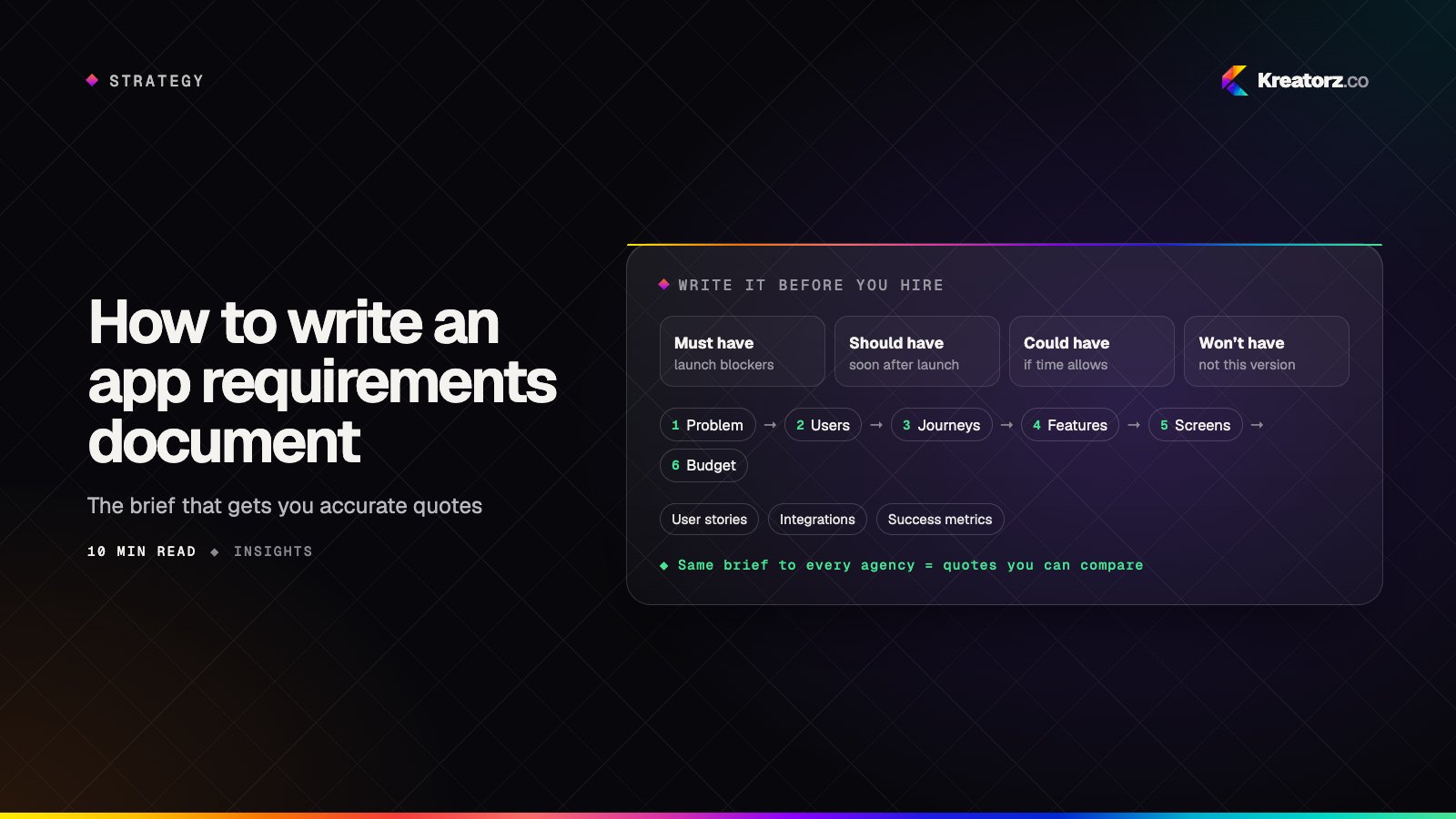
How to write an app requirements document before you hire developers
A clear app requirements document is the fastest way to get accurate, comparable quotes from developers. Here is a step-by-step guide to writing one, from the problem statement and user stories to must-have features, integrations, compliance flags, budget and a fill-in template you can copy.
21 November 2026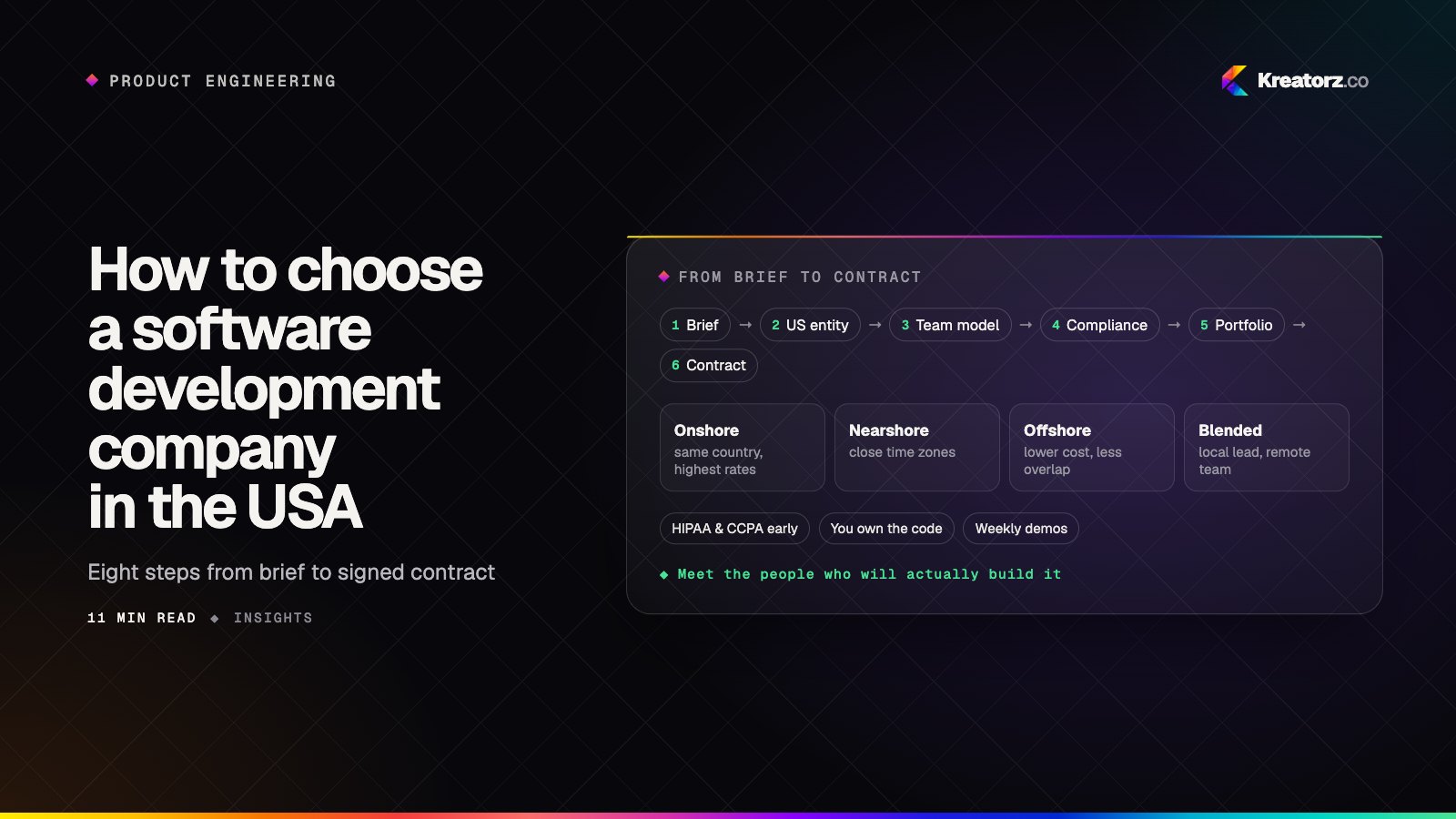
How to choose a software development company in the USA: a step-by-step guide
Hiring a company to build your app, SaaS platform or AI product is a big decision. Here is a practical, step-by-step way for US founders and businesses to compare software development companies, from contracts, time zones and compliance to pricing models, portfolios and red flags.
17 November 2026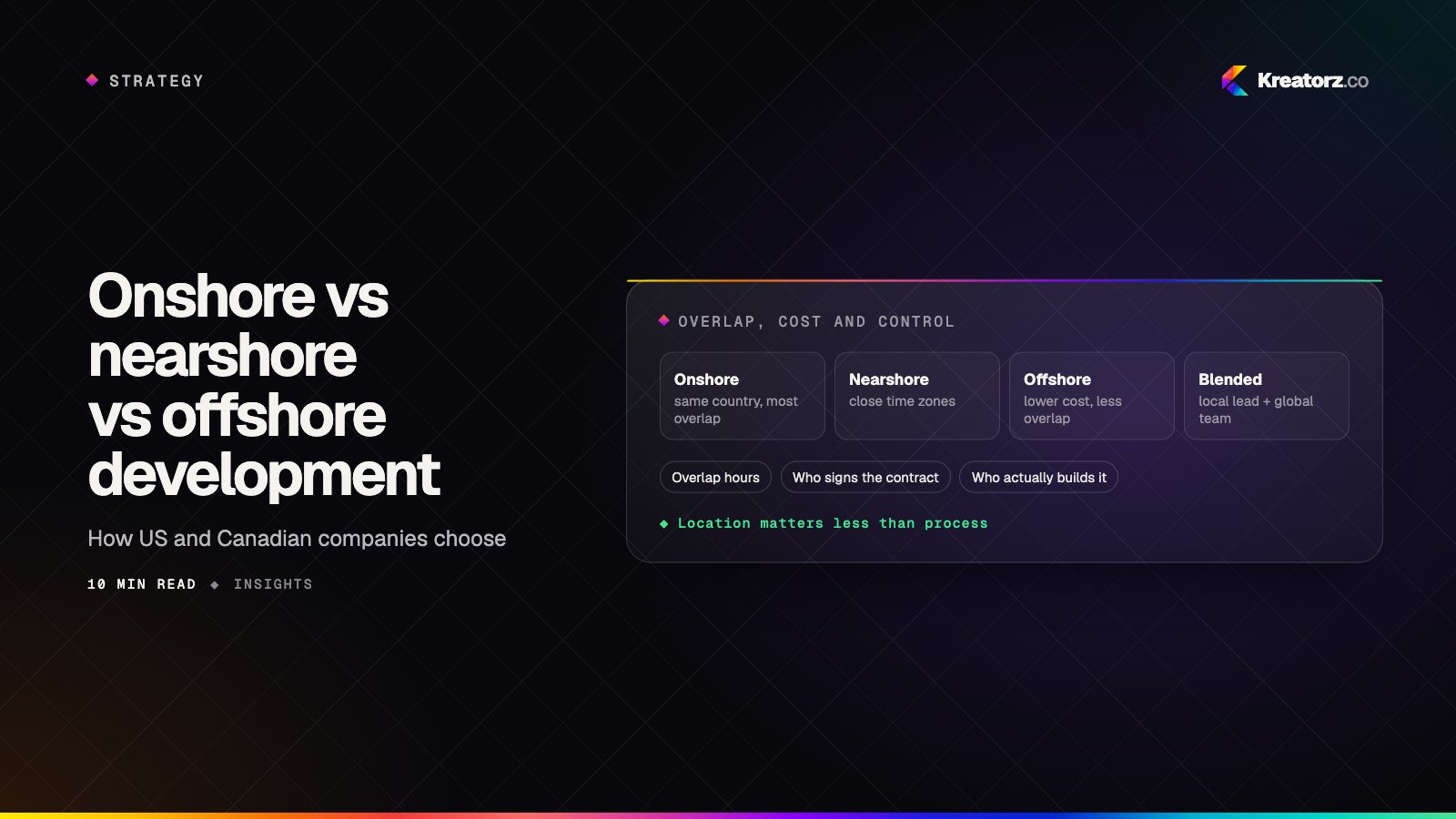
Onshore vs nearshore vs offshore software development: how to choose
Where your development team sits shapes cost, communication, contracts and compliance. Here is a plain comparison of onshore, nearshore and offshore software development for US, Canadian, UK and Middle East companies, plus the blended model, how to run a distributed team well and a step-by-step way to decide.
21 November 2026