Most AI projects fail in the gap between a convincing demo and a dependable product. Kreatorz is an AI app development company that works in that gap, adding the data plumbing, interface design, evaluation, security and cost controls that a demo leaves out.
We build AI into new products and into products you already run — web platforms, internal tools and mobile apps. Sometimes the answer is a large language model. Sometimes it is a classic machine learning model, a rules engine, or no AI at all. We start from the problem, not the technology, and say so plainly when a simpler approach will do the job better.
What our AI application development services cover
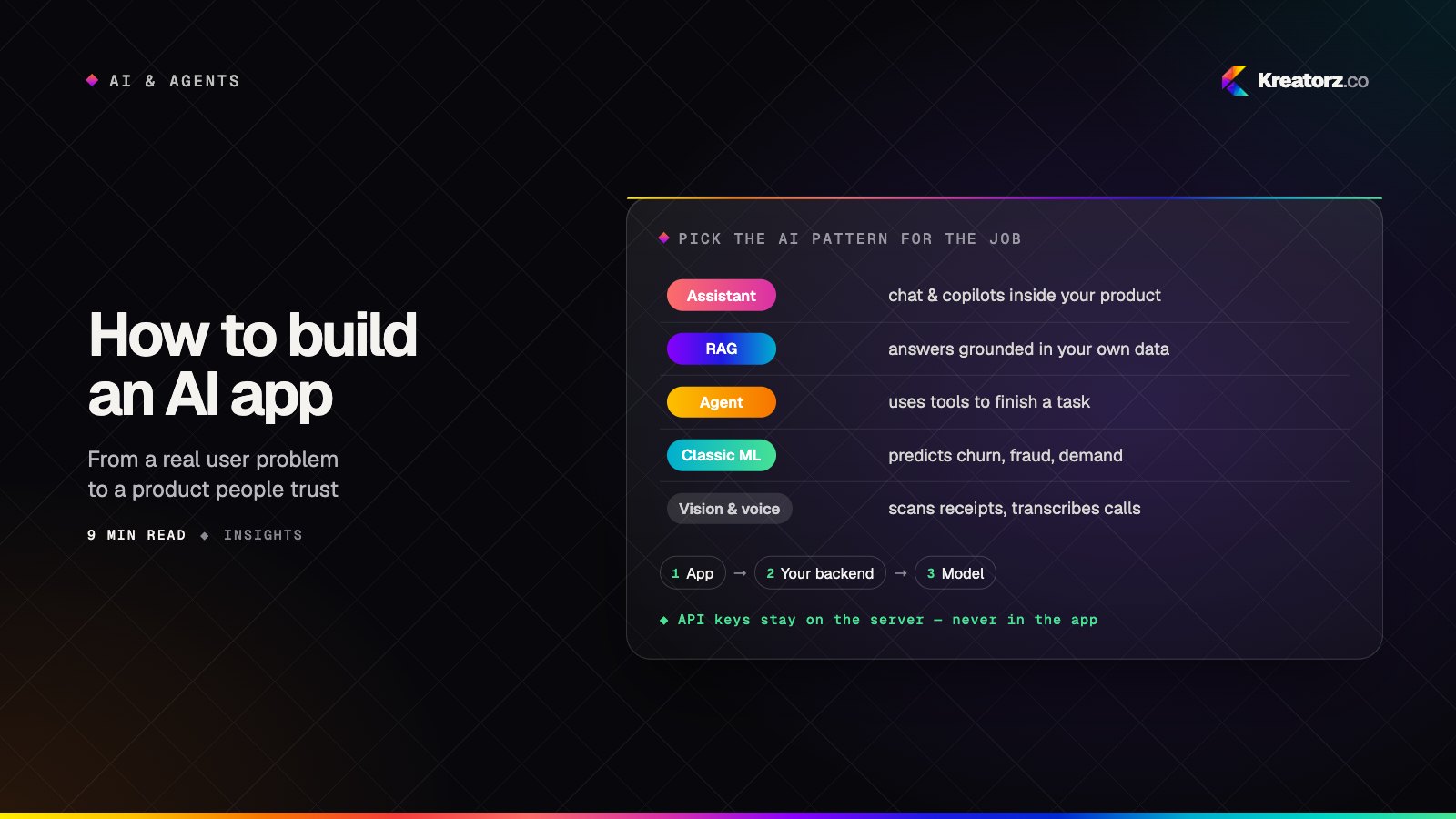
Chat assistants and copilots
Assistants that answer questions, draft content and guide users through tasks inside your product. A good copilot knows the user's context, cites its sources and hands over to a human when it should. Luna gives pet owners 24/7 AI vet chat to help them understand symptoms, with virtual vet consultations when a professional is needed, and Rayna is a private AI relationship coach for women.
RAG knowledge apps
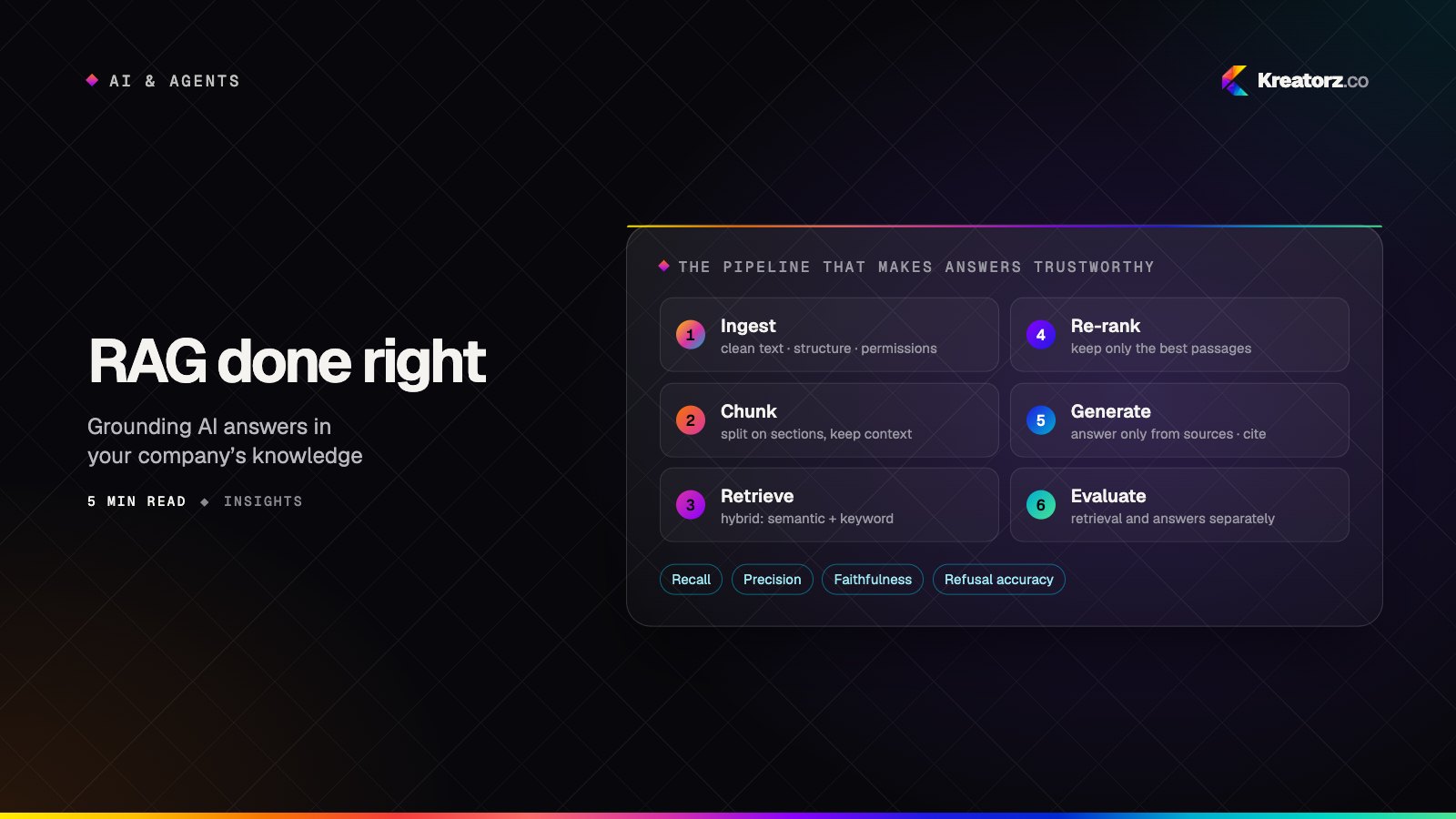
Retrieval-augmented generation lets a model answer from your documents — policies, manuals, contracts, product catalogues, support history — rather than from general training data. We build the ingestion pipeline, chunking, embeddings, search and permission filtering so people only see answers drawn from content they are allowed to access. Our article on RAG done right covers the pitfalls.
AI agents and workflow automation
When a task needs several steps — looking something up, calling an API, updating a record, asking for approval — an agent can carry it through. Relay's AI family assistant, for example, turns emails, messages and reminders into shared, actionable plans. We cover this in depth on our AI agent development page.
Vision and document understanding
Extracting fields from invoices and forms, classifying photos, checking image quality, reading receipts or labels. We combine multimodal models with validation rules so uncertain results go to a person instead of slipping through. Checkpoint AI uses AI purchase scanning and receipt verification to help families manage spending, and Luna analyses symptoms and images to help owners understand their pet's health.
Voice features
Speech-to-text, voice commands, spoken summaries and voice assistants, with attention to latency, accents, background noise and accessibility.
Recommendations and personalisation
Ranking content, products or matches by behaviour and preferences — often a job for a trained model rather than an LLM.
AI in mobile apps
Smart search, assistants, camera features and personalised feeds in iOS, Android and Flutter apps. Model calls run through your own backend so API keys never ship inside the app, and on-device models are an option where privacy or offline use matters. Our AI family app work is one example of putting an assistant inside an everyday consumer product.
Generative AI app development, step by step
- Problem framing — we define the job the AI must do, who it serves, what a good answer looks like and what a bad one costs.
- Data and feasibility check — we look at the content and data you have, its quality and access rules, and run quick experiments against real examples.
- Evaluation set first — before building the product we assemble test cases with expected outcomes, so every later change can be measured rather than eyeballed.
- Model and architecture choice — hosted models such as OpenAI, Anthropic Claude or Google Gemini, open-source models like Llama, or a mix, chosen on quality, latency, cost and data-handling requirements.
- Product build — interface, backend, retrieval, tool integrations and admin controls, delivered in short cycles with weekly demos.
- Hardening — prompt-injection defences, output filtering, rate limits, logging, monitoring and fallbacks for when a provider is slow or down.
- Launch and learn — staged rollout, user feedback capture, quality dashboards and a regular cycle of improving prompts, retrieval and models.
Choosing the right AI approach
| Approach | Good for | Watch out for |
|---|---|---|
| Prompted LLM | Drafting, summarising, flexible conversation | Inconsistent output without strong evaluation |
| RAG (LLM plus your content) | Answers grounded in company knowledge | Retrieval quality and access control |
| AI agent with tools | Multi-step tasks across systems | Needs guardrails and human approval points |
| Trained ML model | Prediction, scoring, ranking at scale | Requires enough good historical data |
| Rules and automation | Predictable, well-defined decisions | Breaks down when inputs vary widely |
Many products combine two or three of these. A support tool might use RAG for answers, a small classifier for routing and plain rules for escalation.
Responsible AI, security and cost control
Designing for trust
People stop using AI features the first time they feel misled. We show sources, signal uncertainty, make it easy to correct or undo AI actions and keep a human in charge of consequential decisions. Our guide to designing AI features people trust sets out the patterns we use.
Security and privacy
AI introduces new attack surfaces: prompt injection through user content or documents, data leaking between tenants, and models being tricked into calling tools they shouldn't. We apply least-privilege access, separate system instructions from user input, filter outputs and log for audit. Sensitive data can be masked before it reaches a model, and we help you pick providers and settings that match your data-handling commitments. More detail in securing AI products.
Cost and latency
Model costs grow with usage, so we design for it from day one: routing simple requests to smaller models, caching repeated answers, trimming context, streaming responses and setting budgets and alerts. The same evaluation set that protects quality lets us test cheaper configurations safely.
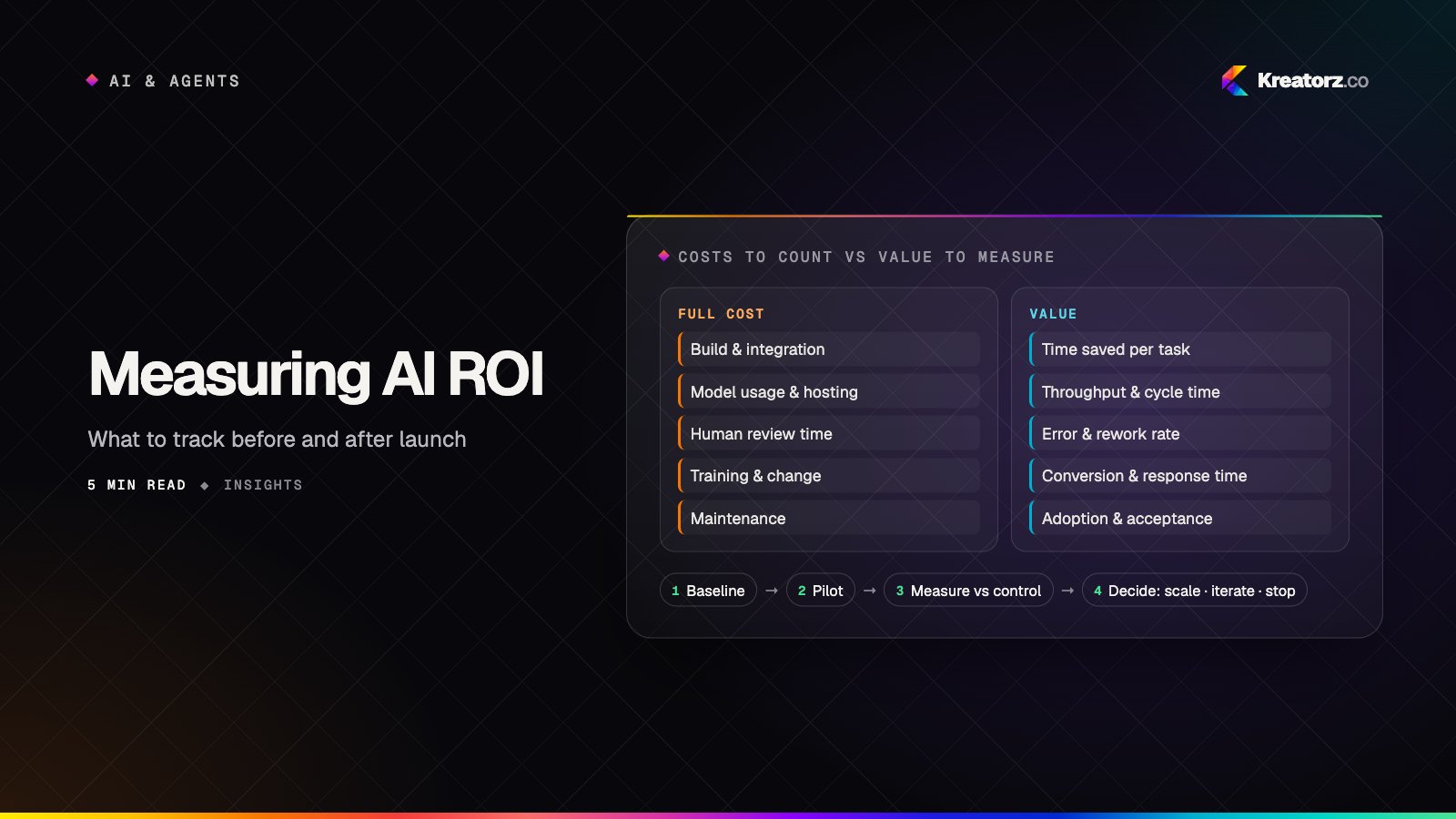
Every AI feature should also tie to an outcome — time saved, tickets resolved, error rates — instrumented from launch. See measuring ROI of AI projects.
Custom AI solutions for existing products
You don't need to rebuild to add AI. We integrate assistants, search and automation into existing SaaS platforms, web apps and internal systems through a separate AI service layer, keeping the core product stable.
Why Kreatorz for AI app development
- AI-native, product-first. We were recognised with the Global AI Impact Award at the Global Image Awards Middle East, Riyadh 2026, and we treat AI as one part of a well-designed product, not a bolt-on.
- Full-stack team. Strategy, UX, mobile, web, Python and Node.js backends, cloud, QA and security together, so the AI feature and the product around it are built as one.
- Model-agnostic. We work with hosted and open-source models and design so you can switch providers without a rewrite.
- Evidence over opinion. Evaluation sets, dashboards and staged rollouts mean decisions are based on measured behaviour.
- Transparent delivery. Weekly demos and a shared backlog keep you close to the work.
- You own it all. Code, prompts, evaluation data, designs and cloud accounts belong to you from day one.
- Worldwide. Offices in the United States, Canada and Pakistan, working with clients across time zones.
Ready to explore an idea? Tell us what you want AI to do and we'll suggest a sensible first step.