A chatbot answers questions. An agent gets things done: it reads a request, works out the steps, uses your tools and systems to carry them out, and reports back. Kreatorz is an AI agent development company that designs and ships these systems for real operations — triaging requests, preparing documents, updating records, reconciling data and coordinating handovers between people and software.
The hard part isn't making an agent act. It's making it act correctly, within limits, and in a way your team can inspect, approve and correct. That is where most of our engineering effort goes.
Where AI agents earn their keep
Agents fit work that is repetitive enough to be worth automating but too varied for fixed rules. Good candidates usually share three traits: the inputs are messy (emails, PDFs, chat messages, forms), the steps involve several systems, and a person currently spends time copying, checking and routing information.
Typical examples:
- Operations intake — reading inbound requests, extracting the details, checking them against existing records and creating the right ticket, booking or order.
- Customer support resolution — looking up account status, applying policy, drafting a reply and taking simple actions, with complex cases passed to staff.
- Sales and account research — gathering information from your CRM and approved sources, then preparing briefings and follow-up drafts.
- Back-office processing — matching invoices to orders, flagging discrepancies and preparing entries for review.
- Product features — agents inside your own software that let users describe what they want and have the product carry it out.
Among the products we have built, Relay is an AI-powered family management platform whose AI family assistant turns emails, messages and reminders into shared, actionable plans, connected to a smart family calendar, task management and a family vault — exactly the kind of messy input agents handle well. Rayna, a private AI relationship coach for women, applies AI to message analysis, hard-conversation prep and daily reflection, with personalised growth tracking over time.
If your task is a single question and answer, you probably need an assistant rather than an agent; see our broader AI app development services.
Our AI agent development services
Single-purpose agents
One agent, one job, a small set of tools. This is where we recommend most organisations start: it delivers value quickly and builds the evaluation and oversight habits needed for anything bigger.
Multi-agent systems
For larger processes we split work between specialised agents — for instance one that classifies, one that researches, one that drafts and one that checks — coordinated by an orchestrator. Splitting responsibilities makes each part easier to test and constrain. We only add agents when the problem genuinely needs them; more agents also mean more cost and more ways to fail.
Tool and system integration
Agents are only as useful as the systems they can reach. We build secure tools over your CRM, ERP, helpdesk, databases, document stores, calendars and internal APIs, typically through a dedicated backend in Node.js or Python. Standards such as the Model Context Protocol help keep these tools reusable across agents and models.
AI workflow automation
Not every step needs a model. We mix deterministic steps — schedules, validations, retries, notifications — with model-driven decisions, so AI handles only what needs judgement.
How agentic AI development works at Kreatorz
- Map the process — we sit with the people doing the work today, document each step, decision and system, and note where errors are costly.
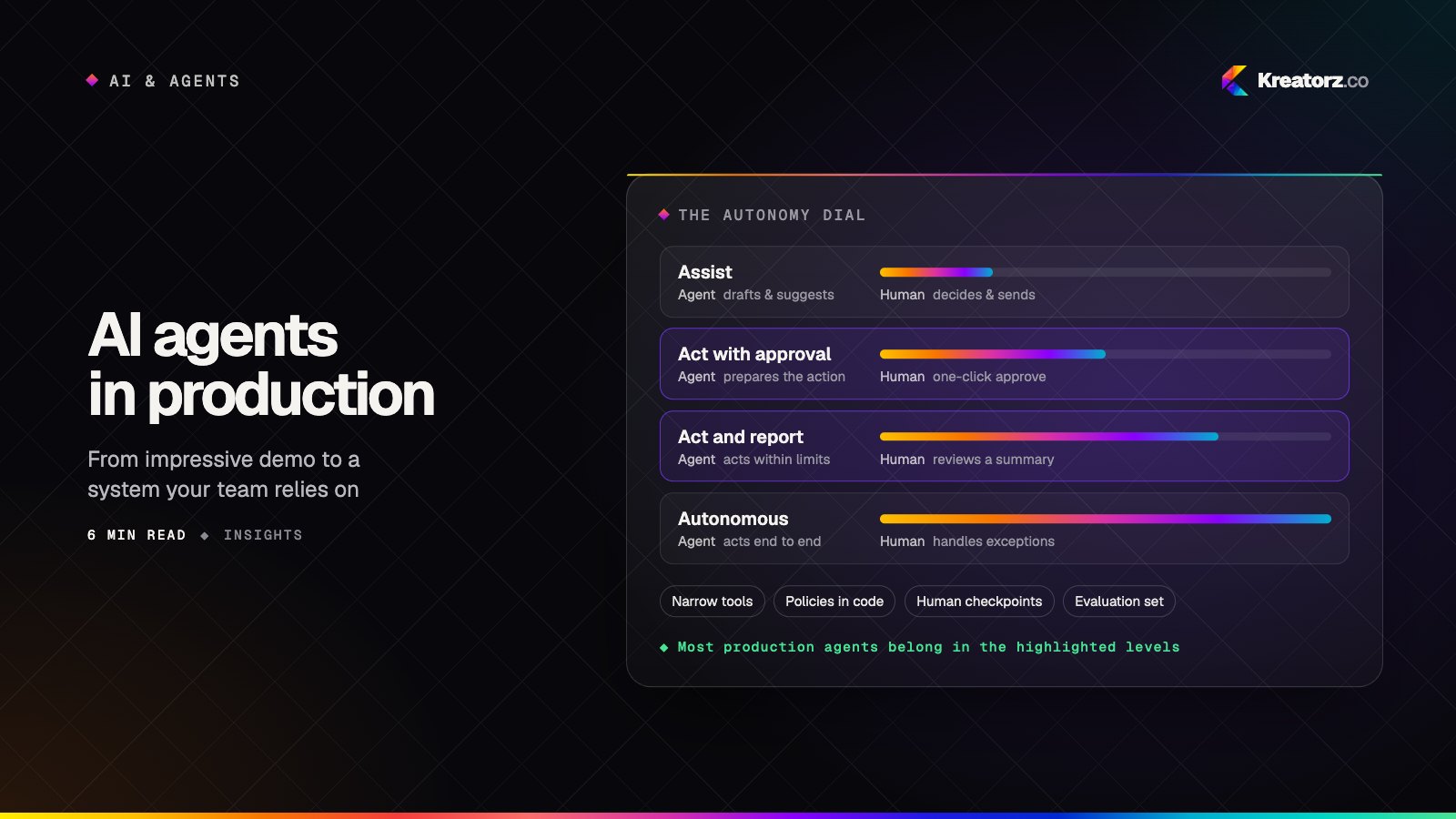
- Define autonomy levels — for every action we agree whether the agent may do it alone, must ask for approval, or must never do it.
- Build the evaluation suite — real historical cases with expected outcomes, plus adversarial ones designed to trip the agent up.
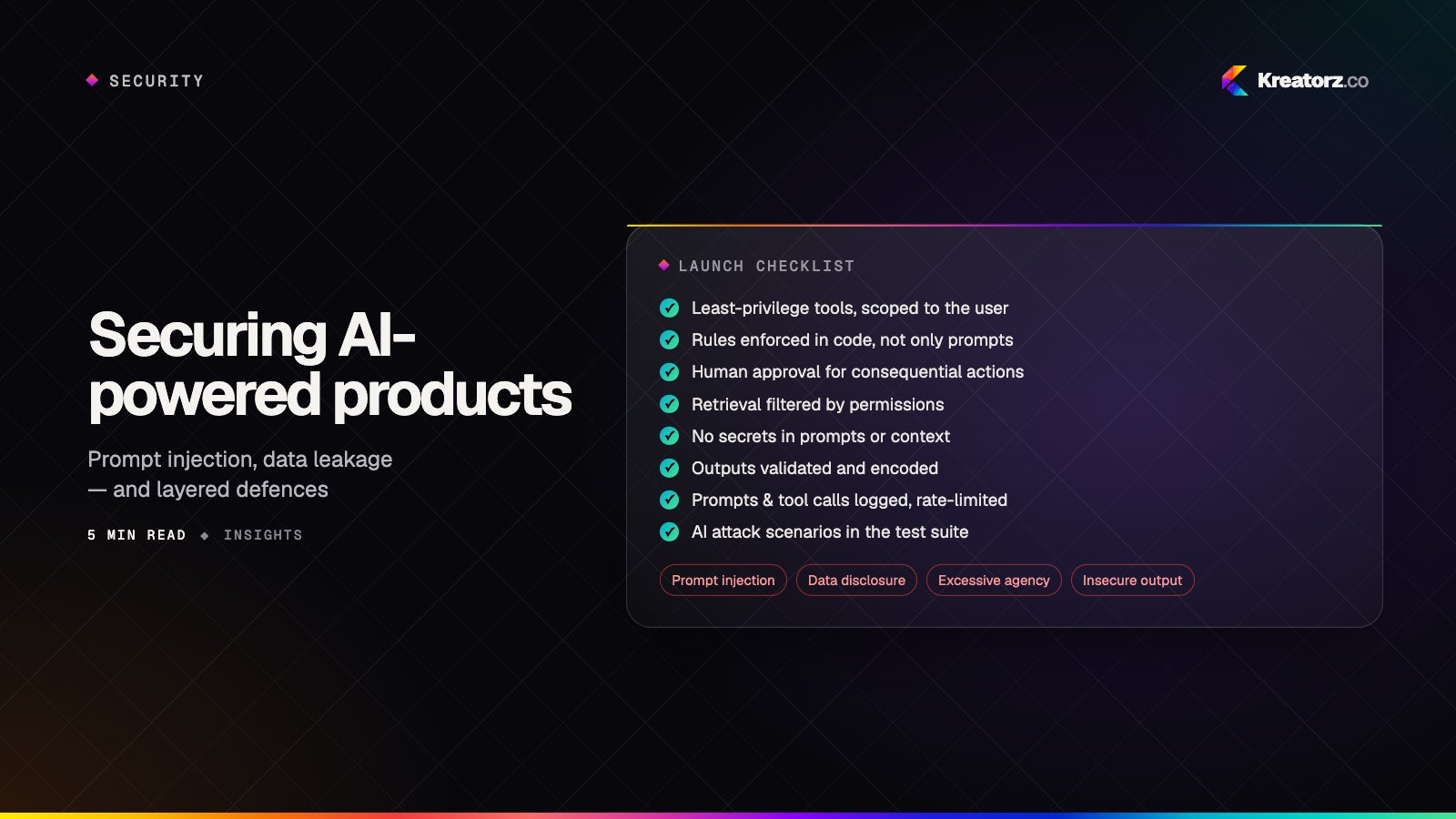
- Design the tools — narrow, well-described functions with strict input validation and least-privilege credentials.
- Build and iterate — prompts, planning logic and tool use refined against the evaluation suite, with weekly demos on real examples.
- Shadow mode — the agent runs alongside your team and proposes actions without taking them, so you can compare its decisions with theirs.
- Gradual autonomy — approved action types move to automatic as accuracy is proven, with monitoring and an easy off switch.
Guardrails and human-in-the-loop design
Permissions and limits
Each agent gets its own credentials with access only to what its job requires. Tools enforce limits in code — maximum amounts, allowed record types, rate limits — rather than relying on the model to behave. Destructive or irreversible actions sit behind approval by default.
Approval interfaces
Approvals happen where your team already works — an admin review queue, team chat or helpdesk — and show what the agent wants to do, why, and the evidence it used.
Defence against manipulation
Agents read untrusted content — customer emails, uploaded files, web pages — which can contain instructions designed to hijack them. We separate trusted instructions from data, validate every tool call against policy and restrict which tools are available in each context. Our article on securing AI products goes deeper.
Observability
Every run is traced: the input, each reasoning step, each tool call and its result, and the final outcome. That record supports debugging, audits and continuous improvement, and lets you answer the question "why did it do that?" with evidence.
Assistant, workflow or agent?
| Chat assistant | Scripted automation | AI agent | |
|---|---|---|---|
| Handles messy input | Yes | Poorly | Yes |
| Takes actions in systems | Rarely | Yes | Yes |
| Adapts steps to the situation | Limited | No | Yes |
| Predictability | Medium | High | Medium, raised by guardrails |
| Best for | Answering and drafting | Fixed, high-volume steps | Varied multi-step tasks |
In practice the strongest solutions combine all three. Our write-up on AI agents in production shares the patterns we rely on.
Measuring whether an agent is working
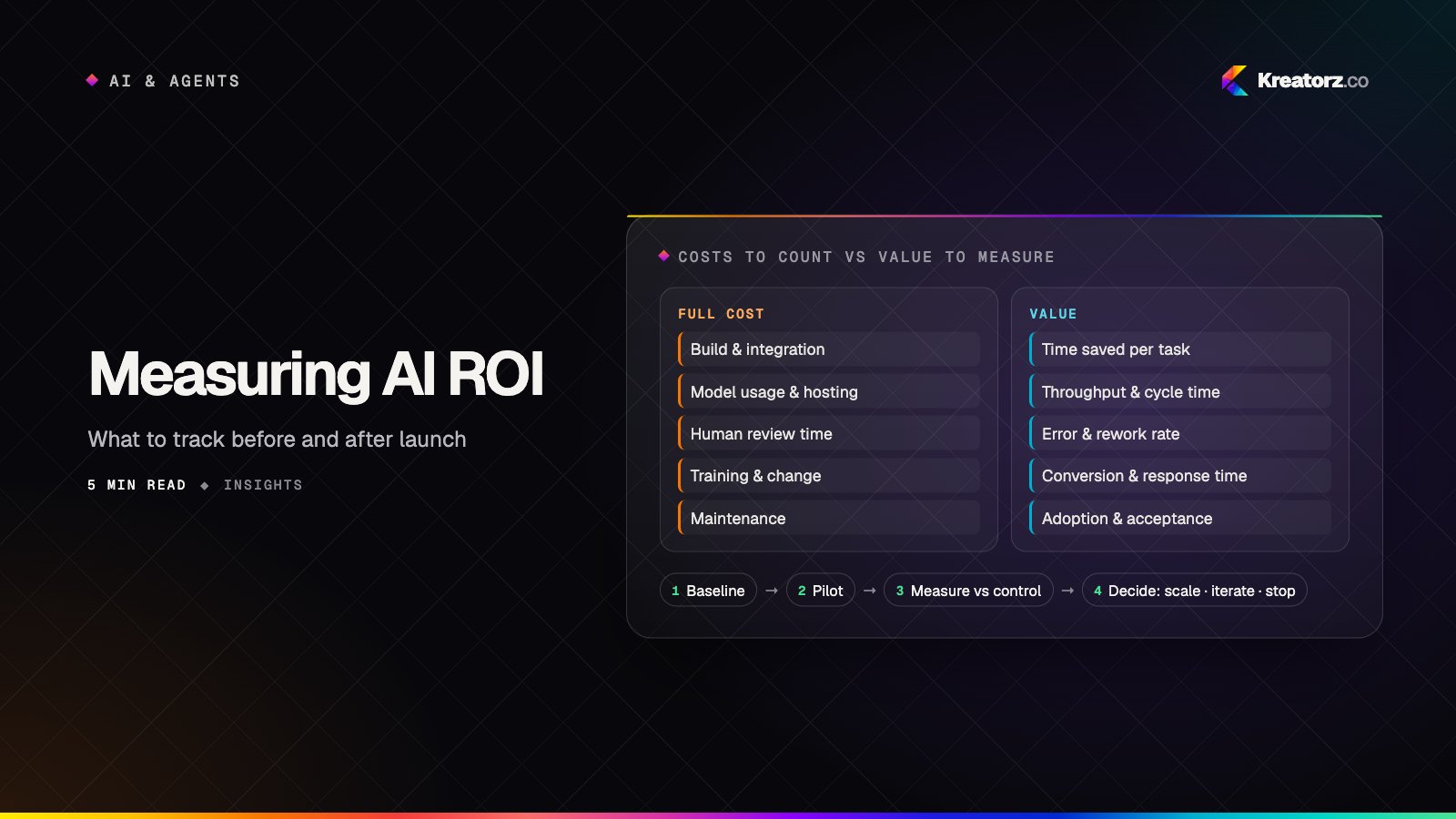
We track completion rate, accuracy against human decisions, override rates, time per task and model cost per completed task. These numbers decide when to widen autonomy and whether the agent pays for itself — see measuring ROI of AI projects.
Why Kreatorz for AI agent development
- Recognised AI work. Kreatorz received the Global AI Impact Award at the Global Image Awards Middle East, Riyadh 2026.
- Engineering, not just prompts. Agents depend on solid integrations, queues, retries, permissions and monitoring; our full-stack team builds all of it.
- Safety by design. Autonomy levels, approval flows and audit trails are part of the plan from the first workshop.
- Model flexibility. We design agents to run on hosted models such as OpenAI, Anthropic Claude or Google Gemini, or open-source models like Llama, and to switch when it makes sense.
- Ownership. Code, prompts, tool definitions, evaluation data and cloud accounts are yours from day one.
- Close collaboration. Weekly demos and a shared backlog, with clients worldwide served from the United States, Canada and Pakistan.
Have a process you'd like an agent to take on? Describe it to us and we'll assess whether an agent is the right fit.