How to choose a software development company in the USA: a step-by-step guide
Hiring a company to build your app, SaaS platform or AI product is a big decision. Here is a practical, step-by-step way for US founders and businesses to compare software development companies, from contracts, time zones and compliance to pricing models, portfolios and red flags.
Short answer
To choose a software development company in the USA, start with a one-page brief and compare companies on the same questions: who signs the contract, where the team works, how many hours you overlap and how they handle compliance such as HIPAA, CCPA and SOC 2. Use live portfolio products, start with paid discovery and confirm you own everything built.
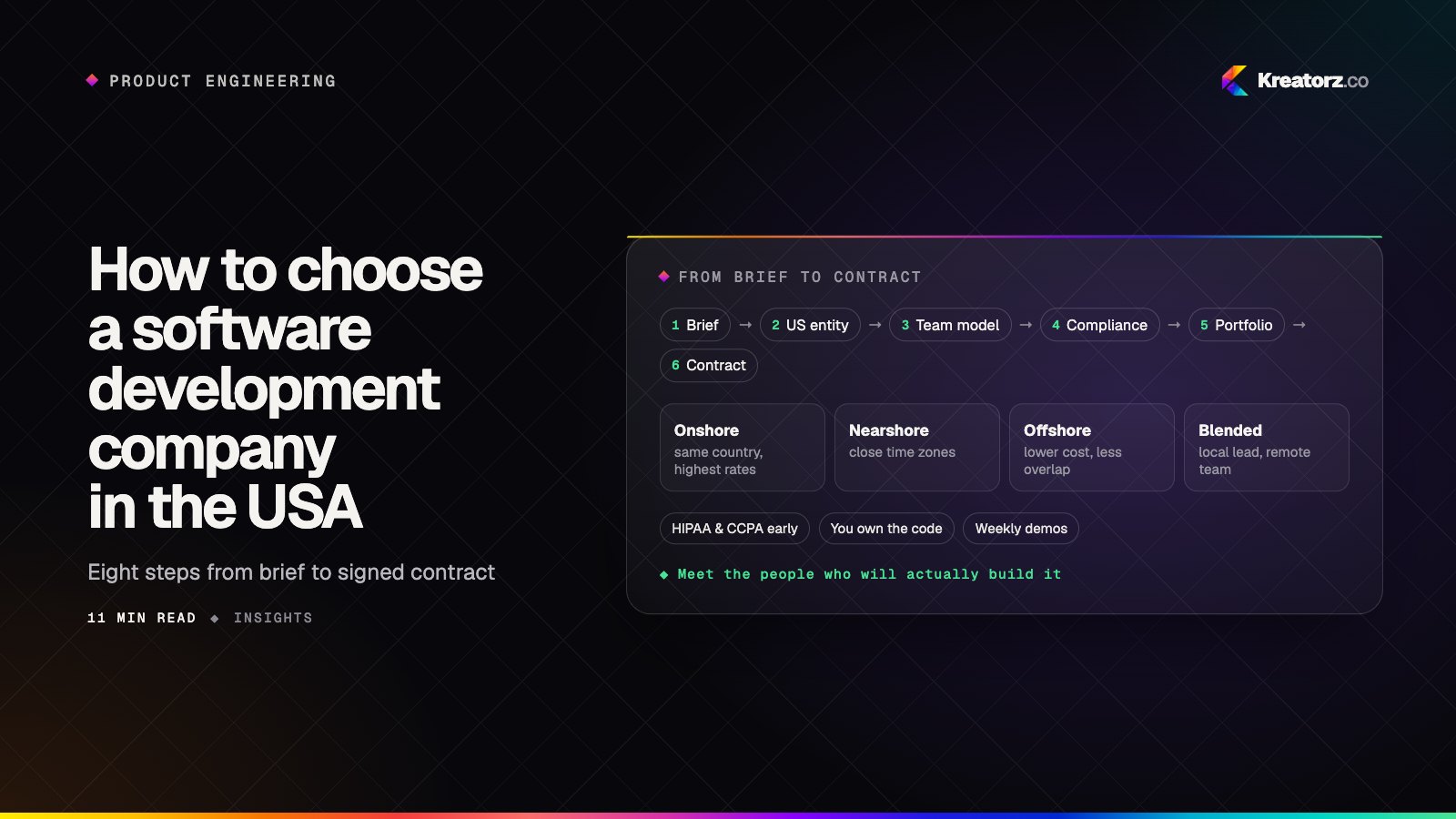
Searching for a "software development company USA" returns thousands of results, and most of them say the same things: senior teams, agile delivery, beautiful apps. The hard part is not finding companies; it is telling them apart before you have spent months and a significant budget.
This guide walks through the process step by step, with a US lens: who you actually sign a contract with, how time zones affect day-to-day work, which compliance questions matter for American products, how onshore, nearshore and offshore teams compare, and how to check a portfolio properly. It applies whether you need an app development company in the USA for a consumer product, a partner for custom software development in the USA, a SaaS development company in the USA for a subscription platform, or an AI development company in the USA for agents and assistants.
Step 1: Write a one-page brief before you talk to anyone
Every comparison you make later depends on giving each company the same starting point. Before your first call, write one page that covers:
- The problem and the users. Who has the problem, what it costs them today, and what "solved" looks like.
- What you are building. A mobile app, a web platform, custom internal software, a SaaS product, an AI agent, or a mix.
- Constraints. A budget range, any hard deadlines (a funding round, a trade show, a contract renewal), and systems the product must integrate with.
- Data and compliance. Whether you will handle health information, payment data, children's data, or personal data from California and other states with privacy laws.
- Who decides. One person on your side who can make product decisions quickly.
A brief like this makes proposals comparable and shows which companies engage with it thoughtfully.
Step 2: Decide what "US-based" needs to mean for you
Who you contract with
Many companies selling to American clients have a US legal entity, even if some of the team works elsewhere. A contract with a US entity generally means the agreement can be governed by the law of a US state, disputes can be handled in US courts or agreed arbitration, and invoicing and payment work the way your finance team expects. Ask directly which entity will sign, where it is registered, and which state's law the contract will use.
Where the people work
The legal entity and the team are not always in the same place. That is fine, but ask where each person on your project is located and what hours they work.
Time zones
The continental US spans four time zones. What matters is how many working hours you share: for most projects, a few hours of daily overlap is enough for a stand-up, quick questions and a weekly demo. Teams with little overlap can still work well, but need disciplined written communication, and decisions take longer.
Step 3: Understand onshore, nearshore and offshore
Most US buyers end up choosing between three broad models, or a blend of them.
| Model | What it means | Typical strengths | What to check |
|---|---|---|---|
| Onshore | Team located in the US | Full time-zone overlap, easy in-person meetings, familiarity with US market norms | Usually the highest rates; confirm seniority matches the price |
| Nearshore | Team in a nearby country, such as Canada or Latin America | Strong time-zone overlap, often lower rates than onshore | Language, legal entity and how the team is managed |
| Offshore | Team in a more distant region, such as South Asia or Eastern Europe | Often the lowest rates, access to a large talent pool | Overlap hours, communication habits, code quality and who owns accountability |
| Blended | A US or nearshore lead with a distributed team | Overlap for decisions and demos, with cost efficiency in delivery | That the senior people you meet stay involved after you sign |
Rates vary widely between regions and between companies within the same region, so treat any single "average hourly rate" you read online with caution. A lower rate is not automatically cheaper: a team that needs fewer weeks and produces less rework often costs less overall. Our guide to how much it costs to build an app explains how to compare budgets on team size, weeks and scope rather than on the hourly figure alone.
Step 4: Bring compliance into the first conversation
US compliance requirements depend on your industry, your users and where they live. A development company is not your legal advisor, but a good one will raise these questions early and design the architecture around the answers. Ask how they have handled requirements like these:
- HIPAA if your product creates, stores or transmits protected health information on behalf of a covered entity such as a healthcare provider or health plan. Expect questions about business associate agreements, hosting, access controls and audit logging.
- CCPA and other state privacy laws if you collect personal data from California residents or residents of other states with comprehensive privacy laws. These affect consent, data access and deletion requests, and what you share with third parties.
- SOC 2 if you are building SaaS for business customers. Many enterprise buyers ask vendors for a SOC 2 report. The report covers your company's controls, not just your code, but the way the product is built, deployed and monitored makes it much easier or much harder to achieve.
- COPPA if your product is directed at children under 13 or knowingly collects their data.
- Payment card rules (PCI DSS) if you handle card data. Most products reduce their scope by using a payment provider so card numbers never touch their own servers.
The answer you want is not "we are fully compliant" but a specific account of what they did on a past project and how the requirement changes the plan and estimate.
Step 5: Vet portfolios properly
A portfolio shows what a company wants you to see. To learn more from it:
- Look for products like yours in shape, not only in industry. A multi-sided marketplace, a real-time app, or an AI agent working on private documents each has its own hard problems. Experience with the same kind of complexity matters more than experience in the same sector.
- Use the live product. Download the app or try the SaaS product, and check speed, polish and how it handles errors.
- Ask what they actually built. The whole product, or one feature? Who made the product decisions?
- Ask for a walk-through. Have them explain one project: the original problem, the key decisions, what went wrong and what they would do differently.
- Speak to references. Ask a past client how the team handled a missed estimate, a change of direction or a production incident, not just whether they were happy overall.
For AI work in particular, ask to see something in production rather than a demo. Any AI agent development company in the USA should be able to talk about evaluation, guardrails, monitoring and usage costs, because those are what separate a prototype from a product.
Step 6: Probe how they build and how they communicate
You do not need to be technical to ask good questions here.
- Team. Who exactly will work on your project? Are product, design, mobile, web, backend, QA and DevOps all covered, and are they in-house? Can you meet the people who will build it?
- Cadence. How often will you see working software? A weekly demo and a new build every week or two is a healthy rhythm for most projects.
- Quality. Does every change get code review? What is covered by automated tests? How are releases deployed and rolled back?
- Visibility. Will you see the backlog and repository, or only status reports?
- Change. What happens when scope changes? How are the effects on time and cost shown to you before you approve them?
Mobile app developers in the USA and elsewhere should also explain how they handle App Store and Google Play submission, device testing and OS updates.
Step 7: Choose a pricing model that fits your uncertainty
The pricing model affects behavior as much as budget.
| Model | Works well when | Watch out for |
|---|---|---|
| Fixed price | Scope is small, clear and unlikely to change | Padding, disputes over change requests, quality cuts under pressure |
| Time and materials | Scope will evolve as you learn | Needs active oversight and an agreed budget cap |
| Dedicated team | A long-term product with a steady roadmap | Make sure you can scale the team up or down |
| Phased (discovery, then build) | New products with real unknowns | Agree in writing what discovery must deliver |
For most new products, a phased approach works best: a short, fixed-scope discovery phase that produces a validated plan, followed by iterative build with a budget cap and regular reviews. Be wary of anyone who gives you a precise fixed price for a complex product after one call. They are either padding the number heavily or planning to argue about scope later.
Compare proposals on the same things: the team, the number of weeks, scope and assumptions. Timelines deserve the same scrutiny as budgets; our guide to how long it takes to build an app shows what a realistic schedule looks like phase by phase.
Step 8: Read the contract for ownership and exit
Before you sign, confirm the agreement covers:
- Intellectual property. You own the code, designs and content created for you, with ownership clearly transferred.
- Accounts. Your code repository, cloud hosting, app store accounts, domains and third-party services are registered to your company from day one, with the developer given access.
- Confidentiality and data protection. Especially if they will handle customer or patient data, including any business associate agreement you need.
- Handover and exit. What you receive if you part ways, how much notice is required, and how knowledge is transferred.
- Warranty and support. How bugs found after launch are handled and what ongoing maintenance costs.
- Governing law. Which state's law applies and how disputes are resolved.
Red flags worth walking away from
- A detailed fixed quote with no discovery and few questions about your users.
- Vague answers about which legal entity signs the contract or where the team works.
- Reluctance to let you meet the engineers who will build your product.
- The developer, not you, owning the repository, cloud or app store accounts.
- No code review, automated testing or regular demos, or no clear answer about them.
- "Fully compliant" claims about HIPAA or SOC 2 with nothing specific behind them.
- A price far below every other proposal, or pressure to sign quickly.
Questions to ask on your first calls
- Which entity will we contract with, and which state's law will govern the agreement?
- Where is each person on the team located, and how many hours will we overlap each day?
- What would you need to know before you could estimate this properly?
- What do you see as the riskiest part of this project?
- How have you handled HIPAA, CCPA or SOC 2 requirements on a past project?
- How often will we see working software, and how do you handle changes in scope?
- What will we own at the end, and what exactly will you hand over?
For a broader, non-US-specific checklist on discovery, team quality and communication, see our guide to choosing a software development partner.
The bottom line
The right software development company for a US business is one you can hold accountable, that overlaps with your working day, understands your compliance rules and shows you working software early and often. Write a clear brief, ask precise questions, use the portfolio products, start with paid discovery, and make sure you own everything that is built.
If you would like to include us in your comparison, Kreatorz has a US office in Sheridan, Wyoming, an office in Brantford, Ontario that works on Eastern Time, and a team in Lahore, Pakistan. One senior, cross-functional team covers product, design, mobile, web, backend, AI, QA and DevOps; you see weekly demos and new builds every one to two weeks; and you own your code. You can read more about how we work as an app development company in the USA, or tell us about your project.
Frequently asked questions
How do I choose a software development company in the USA?
Start with a one-page brief, then compare companies on the same questions: who signs the contract, where the team works and how many hours overlap, how they handle compliance, what they actually built, how they communicate and what you will own. A short paid discovery phase tests the relationship before a full build.
Is it better to hire an onshore, nearshore or offshore development team?
It depends on budget and how much real-time collaboration you need. Onshore teams give full overlap at higher rates, nearshore teams usually offer strong overlap at lower rates, and offshore teams can be cost-effective but need disciplined communication. Many US companies use a blend.
What should a contract with a software development company include?
Clear intellectual property ownership, your company owning all accounts from day one, confidentiality and data protection terms, handover and exit provisions, warranty and support terms, and the governing law and dispute process. Have your own lawyer review it.
How much does it cost to hire a software development company in the USA?
Costs depend on scope, platforms, integrations, AI features, compliance and team location. Compare proposals on team size, weeks and scope rather than hourly rate alone. Our guide to app development cost explains how to estimate a budget.
What should I look for in an AI development company in the USA?
Look for AI products running in production, not only demos, and ask how they evaluate output quality, add guardrails, protect your data and monitor usage costs. A good one will also tell you when a simpler, non-AI solution would serve users better.
Does a development company need to sign a HIPAA business associate agreement?
If the company will handle protected health information on behalf of a covered entity or another business associate, a business associate agreement is generally required. Confirm the specifics for your situation with your legal or compliance advisor.
- App development company in the USAWe design, build and scale mobile apps, web platforms, SaaS products and AI features for startups and growing businesses across the United States.Explore
- Custom software developmentWe design and build web platforms, internal tools, customer portals, mobile apps and AI-powered systems that fit your business — instead of bending your business to…Explore
- SaaS developmentWe design and engineer SaaS platforms — from a focused first release to a multi-tenant product with billing, roles, integrations and the operations to run it.Explore


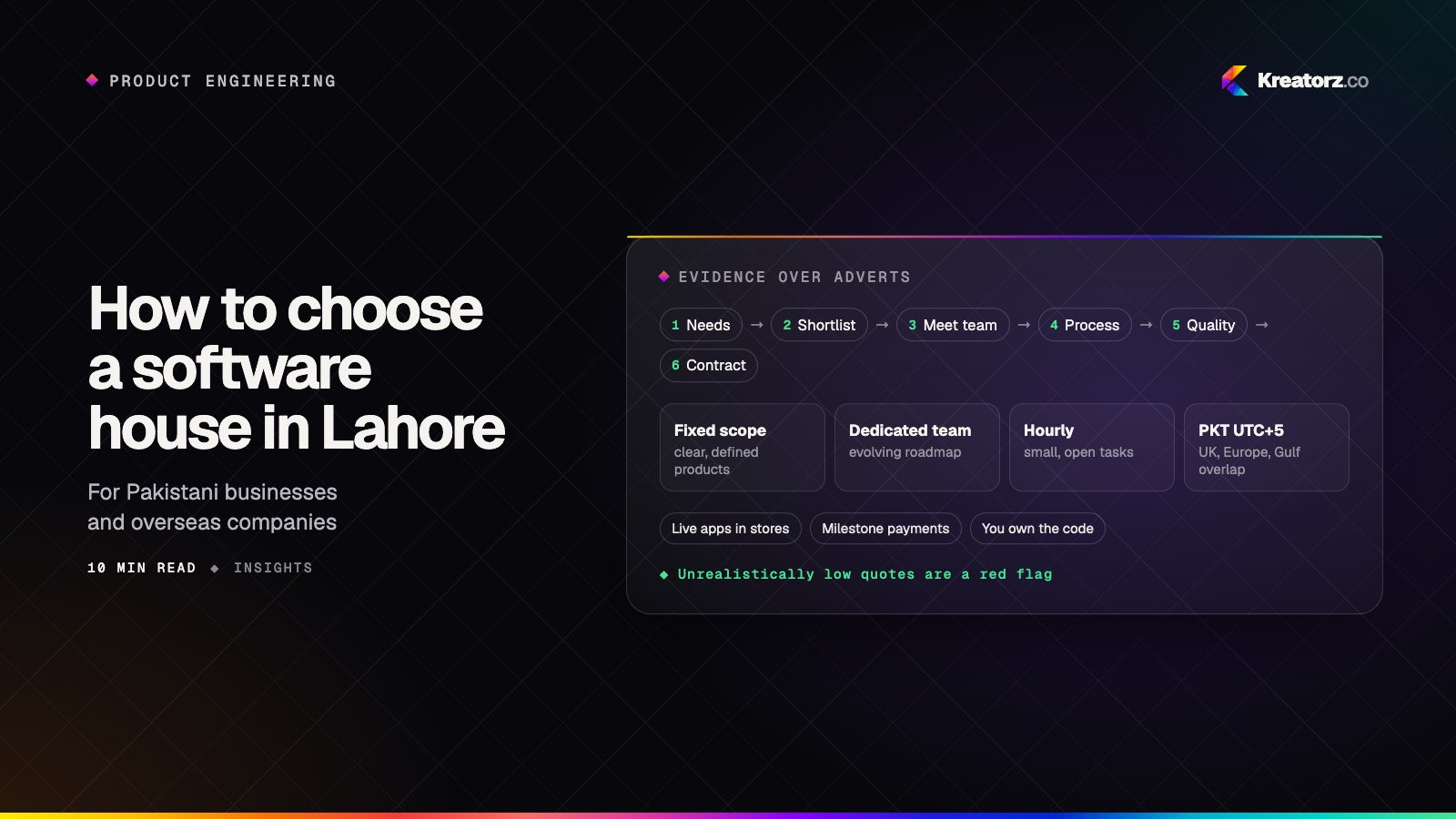
How to choose a software house in Lahore: a step-by-step guide
Whether you are a Pakistani business or an overseas company hiring a team in Pakistan, here is a practical, step-by-step way to choose a software house in Lahore for your app, custom software, SaaS or AI product, plus the red flags and questions that separate strong teams from risky ones.
17 November 2026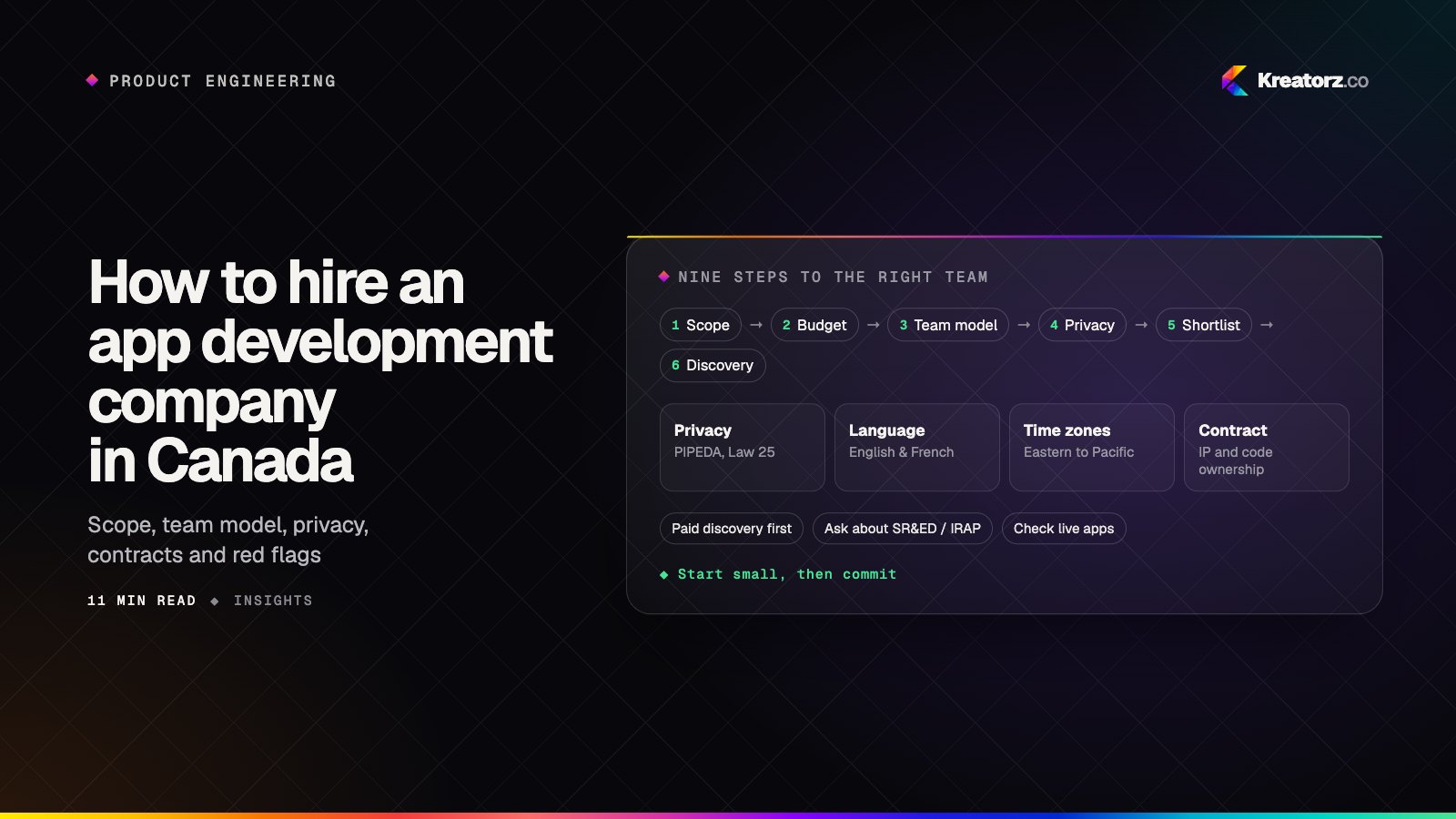
How to hire an app development company in Canada: a step-by-step guide
Hiring a team to build your mobile app, SaaS platform or AI product is a big decision. Here is a practical, step-by-step process for Canadian founders and businesses, from scoping and team models to privacy, contracts, IP and the red flags worth walking away from.
17 November 2026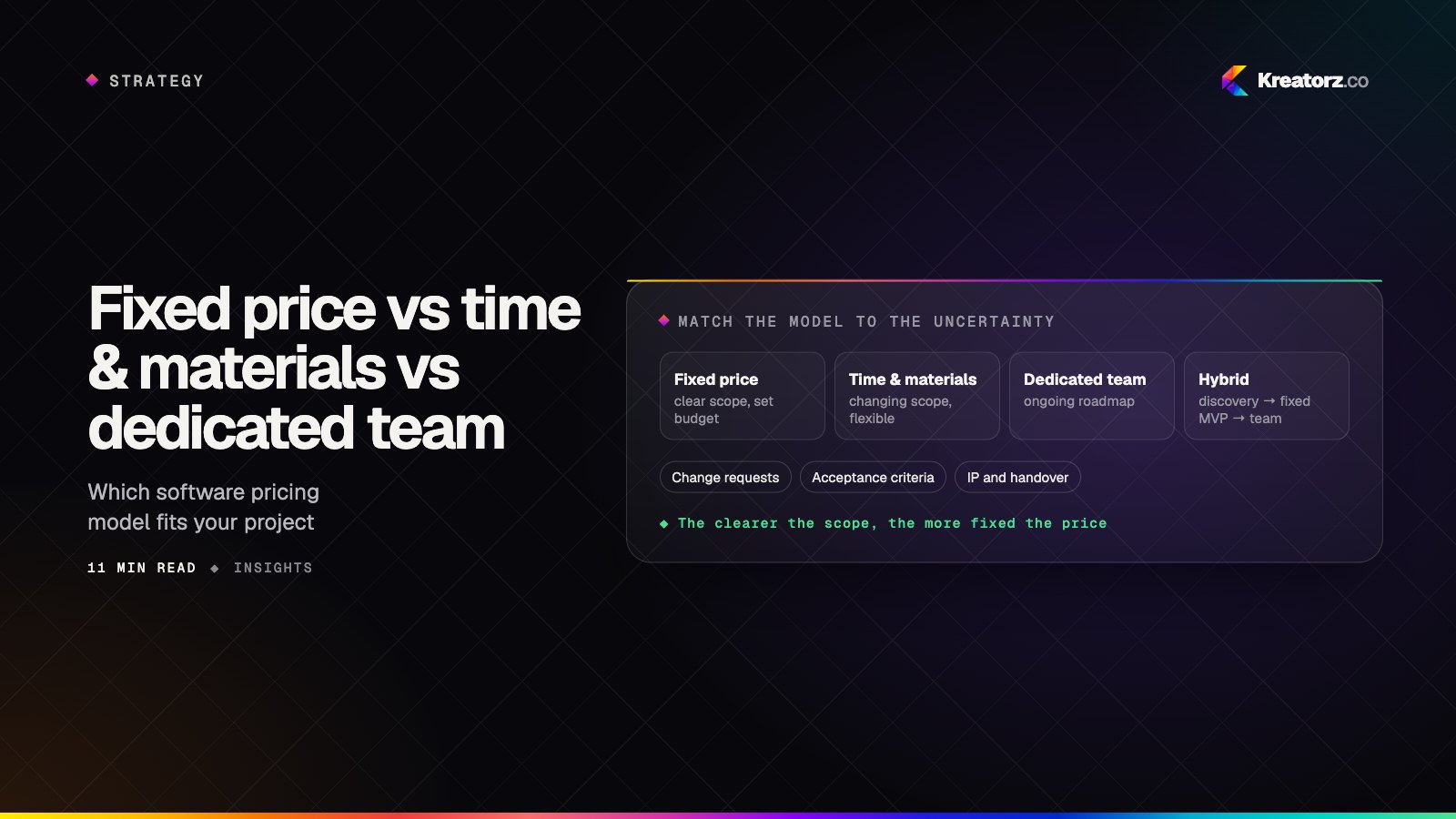
Fixed price vs time and materials vs dedicated team: which software development pricing model should you choose?
The way you pay for software shapes how it gets built. Here is a plain comparison of fixed price, time and materials and dedicated team models, how to choose between them step by step, the hybrids that often work best, and the contract terms and red flags to watch for.
21 November 2026