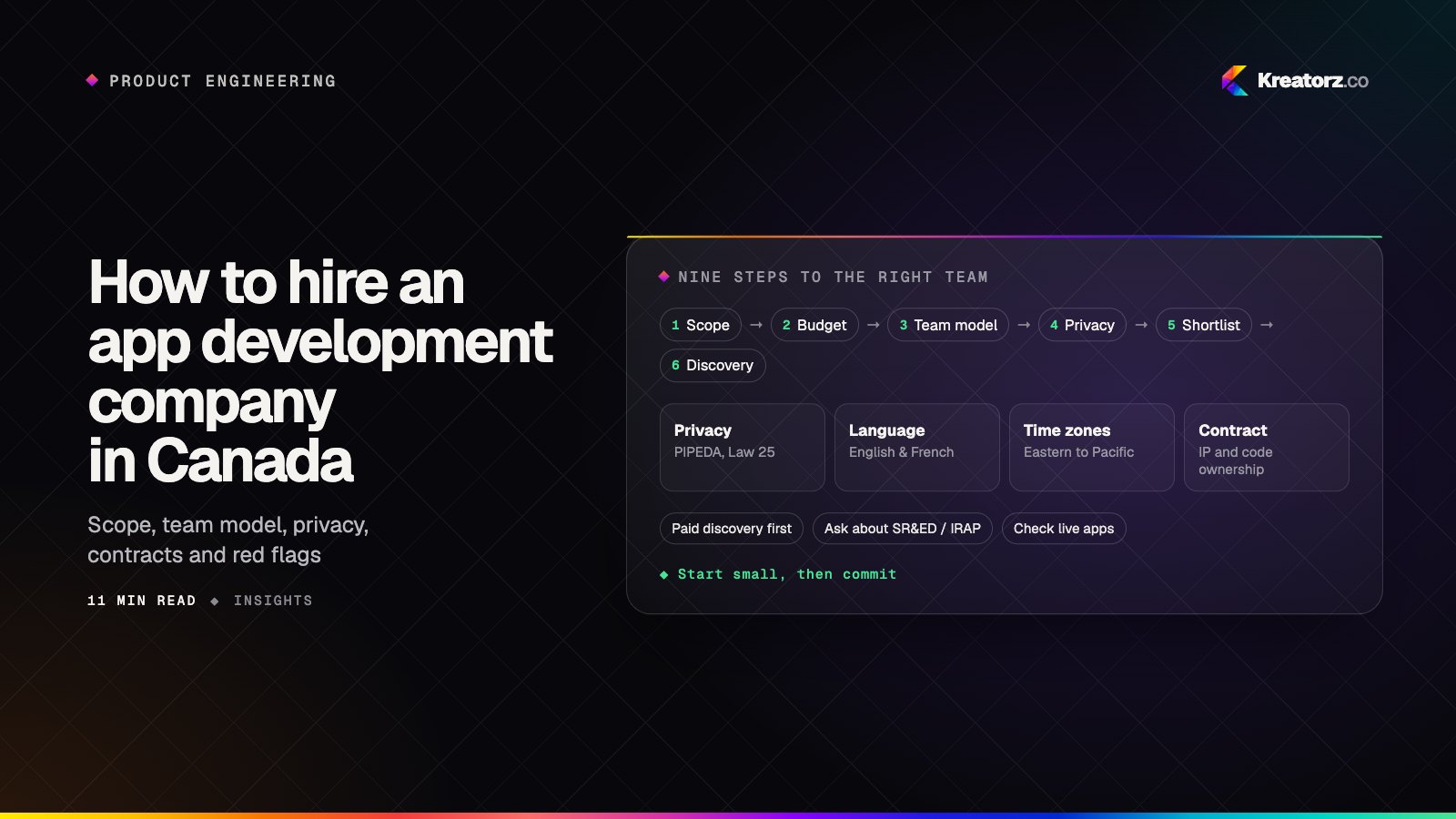
How to hire an app development company in Canada: a step-by-step guide
Hiring a team to build your mobile app, SaaS platform or AI product is a big decision. Here is a practical, step-by-step process for Canadian founders and businesses, from scoping and team models to privacy, contracts, IP and the red flags worth walking away from.
Short answer
To hire an app development company in Canada, write a one-page brief with a budget range, choose a local, nearshore, offshore or blended team with real time-zone overlap, and shortlist three to five companies with live, relevant products. Start with paid discovery, plan for privacy laws such as PIPEDA and Quebec’s Law 25, and secure IP and account ownership.
If you are a Canadian founder or business owner, there is no shortage of agencies, studios and freelancers offering mobile app development in Canada. The hard part is telling them apart, because the differences that decide whether your project succeeds only show up when you look closely at how a team works.
This guide walks through how to hire an app development company in Canada, one step at a time. It applies whether you need a mobile app, a web platform, a SaaS product, an AI feature or custom internal software. It focuses on the decisions that are specific to hiring from Canada: team location and time zones, privacy expectations, language, funding questions and contracts. For a broader look at evaluating any vendor, our guide to choosing a software development partner is good further reading.
Step 1: Define what you are actually hiring for
Before you contact a single company, get clear on what you want built and why. You do not need a full specification. You need a short brief that any serious software development company in Canada can respond to on the same footing.
Write down:
- The problem. Who has it, what it costs them today, and how you will know it is solved.
- The product type. A mobile app for iOS and Android, a SaaS platform, custom software for your operations, an AI product, or a mix.
- The first release. The smallest version that would be genuinely useful. Separate the must-haves from the "later" list.
- Constraints. Deadlines and what drives them, existing systems to integrate with, the type of data you will handle, and any industry rules that apply.
- Who decides. The one person who can make product calls quickly. Slow decisions delay more projects than slow developers.
Step 2: Set a realistic budget range and timeline
You will get more useful proposals if you share a budget range up front. Without one, companies either guess or design a proposal around the most expensive version of your idea.
App budgets come down to people × time: how many people you need, and for how long. Scope, platforms, design depth, integrations, AI features and compliance all change that equation. Our guide to how much it costs to build an app explains the drivers and gives a simple formula for a first estimate, and our guide to how long it takes to build an app breaks the timeline down by phase.
As a rough, indicative guide only:
| Complexity | Typical examples | Typical timeline |
|---|---|---|
| Simple | Sign-in, a few core screens, basic data, notifications | Often around 2–3 months |
| Medium | Payments or subscriptions, roles, messaging, integrations, a fuller admin panel | Often around 3–6 months |
| Complex | Marketplaces, real-time features, AI capabilities, compliance-heavy workflows | Often 6 months or more, in phases |
Budget for what happens after launch as well: hosting, app store fees, maintenance, operating system updates and new features.
Ask about funding programs early
Some Canadian businesses may be eligible for government support for research and development or innovation work. Ask your accountant or financial advisor whether programs such as SR&ED or IRAP could apply to your project. Eligibility rules are specific, and they can affect how work needs to be documented, so raise the question before the project starts rather than after.
Step 3: Choose a team model: local, nearshore or offshore
One of the first decisions for Canadian buyers is where the team should be. There is no single right answer, but each model has clear trade-offs.
| Model | What it looks like | Strengths | Watch out for |
|---|---|---|---|
| Local (Canada) | A team in your city or province | Easy in-person meetings, shared business context, same time zone | Usually higher rates; limited team size in some regions |
| Nearshore | A team in a nearby time zone, often elsewhere in North America | Real-time collaboration, similar working culture | Check who actually does the work and where |
| Offshore | A team many time zones away | Lower rates and access to a large talent pool | Overnight waits, handoff delays, more effort to stay aligned |
| Blended | A local lead with a wider distributed team | Local accountability with room to scale | Make sure the whole team works as one, not as separate vendors |
Time zones matter more than people expect
Canada spans several time zones, and most businesses work on Eastern or Pacific Time. If your team is many hours away, every question can become a 24-hour round trip. Over a project of several months, that adds up.
Ask any company you speak to:
- What hours will the team overlap with ours?
- Who will be available for a same-day call if something urgent comes up?
- When will demos and planning meetings happen in our local time?
A blended team can work well when a lead in your time zone owns communication and the rest of the team has meaningful overlap. What does not work well is a team you can only reach through overnight email.
Step 4: Plan for privacy, language and accessibility
Canadian apps often carry expectations that a team used to building only for other markets may not think about by default. Raise these early so they are part of the plan rather than late additions.
Privacy
If your app collects personal information, Canadian privacy laws are likely to be relevant. That may include the federal Personal Information Protection and Electronic Documents Act (PIPEDA) and provincial laws, such as Quebec's Law 25, which introduced its own requirements for businesses handling personal information of people in Quebec. Health, financial and children's data can bring additional rules.
We are not lawyers, and this is not legal advice. Talk to a qualified privacy or legal advisor about what applies to your product. What you can do when hiring is check that the development company:
- understands privacy principles such as consent, limited collection, safeguards and individual access;
- asks where data will be stored and processed, and who can access it;
- can build consent flows, data export and deletion, access controls and audit logs where needed;
- is willing to work alongside your privacy advisor rather than treating privacy as your problem alone.
English and French
If you serve customers in Quebec or across Canada, you may need your app in both English and French. Bilingual support is easier and cheaper to plan from the start than to retrofit. Ask whether the team has built multilingual apps and how content will be managed in both languages after launch. While you are at it, ask how they approach accessibility in design and testing.
Step 5: Build a shortlist and vet portfolios properly
Aim for a shortlist of three to five companies. Match the specialism to the product: a SaaS development company in Canada with subscription and multi-tenant experience for a platform, an AI development company in Canada with shipped, evaluated AI features for an AI product, or a team strong in custom software development in Canada for internal tools and integrations. Look for teams that have built something with similar complexity, not necessarily the same idea. A team that has handled real-time features, payments, AI or complex integrations in another industry may be a better fit than one that has built many simple apps in yours.
When you review a portfolio:
- Look for live products. Download the apps, use the websites and see how they actually feel.
- Ask what the company did. Did they design and build the whole thing, or one part of it?
- Ask for a walkthrough. A good team can explain the problem, the decisions they made, what went wrong and what they would do differently.
- Speak to references. Ask how the team handled a problem or a change in scope, not just whether the client was happy.
Step 6: Ask the right questions in your first meetings
The first conversations tell you more than any proposal. Notice whether a company asks about your users and business before talking about technology, and whether it is willing to challenge your scope.
Useful questions to ask:
- What would you need to know to estimate this properly?
- What do you see as the riskiest part of this project?
- Who exactly will work on it, and can we meet them?
- Which roles are included: design, mobile, web, backend, QA, DevOps, AI?
- How will we see progress, and how often will we get a working build?
- How do you handle changes in scope, and how will we see the impact on time and cost?
- How do you handle code review, automated testing and security?
- What will we own at the end, and what will you hand over if we move in-house?
Vague answers are information too.
Step 7: Start with a paid discovery phase
For anything beyond a very small project, the most reliable way to start is a short, paid discovery phase before committing to the full build. In discovery, the team works with you to:
- clarify users, goals and core user journeys;
- prioritize features for the first release;
- identify integrations, data, privacy and AI requirements;
- recommend platforms and architecture, for example native or cross-platform for mobile app development;
- produce a phased plan with a team shape, timeline and the assumptions behind the estimate.
Discovery also tests the working relationship on a small piece of work. If communication is poor now, it will not improve during the build.
Step 8: Get the contract and IP right
Contracts are where many Canadian buyers get caught out, usually because the important details were never written down. Have a lawyer review the agreement, and make sure it covers:
- Intellectual property. You should own the code, designs and content created for you, with ownership clearly transferred.
- Accounts. Your code repository, cloud hosting, domains and app store accounts should be in your name from day one, with the company given access.
- Data protection and confidentiality. Especially if the team will handle customer data or work across borders.
- Payment and changes. Milestone or periodic billing, a budget cap for time-and-materials work, and how scope changes are approved.
- Exit and handover. What you receive if you part ways, including documentation, and the notice period.
- Warranty and support. How defects after launch are handled and what ongoing support costs.
Step 9: Agree how you will work together
Before the build starts, agree on the rhythm of the project: weekly demos of working software, a shared backlog you can see at any time, installable builds every one to two weeks, written updates on risks and decisions, and one named lead accountable for delivery. This rhythm keeps a project honest, because problems surface early, when they are cheap to fix.
Red flags worth walking away from
- A detailed fixed quote with no discovery and few questions.
- Reluctance to let you meet the people who will build your product.
- Vague answers about testing, code review or how often you will see working software.
- The company, not you, owning your repository, cloud or app store accounts.
- Dismissive answers about privacy, data storage or French-language support when you have raised them.
- Pressure to sign quickly, or a price far below every other proposal.
- No live products in the portfolio, or references who cannot describe how problems were handled.
How Kreatorz works with Canadian businesses
Kreatorz is an app development company with an office in Canada, in Brantford, Ontario, about an hour from Toronto, working on Eastern Time. We also have a US office in Sheridan, Wyoming and a team in Lahore, Pakistan. One senior cross-functional team covers product, design, mobile, web, backend, AI and cloud. Clients own their code, and we work in the open with weekly demos and working builds every one to two weeks.
If you are building a mobile app, SaaS platform, AI product or custom software and want a team to compare against this checklist, tell us about your project. We are happy to answer every question on it.
Frequently asked questions
How do I choose an app development company in Canada?
Start with a one-page brief and a budget range, then shortlist three to five companies with relevant experience. Compare them on how they approach discovery, who will be on the team, engineering habits, communication rhythm and contract terms, not just price. A short paid discovery phase is the best way to test a team before committing to a full build.
How much does it cost to hire an app development company in Canada?
It depends on scope, platforms, integrations, AI features, compliance needs and the team model you choose. Local, nearshore and offshore teams charge very different rates, but speed and rework matter as much as the hourly figure. Our guide to app development costs explains how to build a first estimate.
Is it better to hire a local, nearshore or offshore development team?
Each has trade-offs: local teams make in-person meetings easy, nearshore teams offer real-time collaboration, and offshore teams offer lower rates with more overnight delays. A blended model, with a lead in your time zone and a wider team behind it, is a common middle ground.
What privacy laws apply to apps built for Canadian users?
Depending on your business and users, federal law such as PIPEDA and provincial laws such as Quebec's Law 25 may apply, along with sector-specific rules for health or financial data. Ask a qualified privacy or legal advisor what applies to you, and choose a development company that can build privacy controls into the product and work alongside your advisors.
Who owns the code when I hire an app development company?
That depends on your contract, which is why it matters. Make sure the agreement transfers ownership of the code, designs and content to you, and that your repository, cloud and app store accounts are in your name from the start.
Can government programs help fund app development in Canada?
Some businesses may be eligible for programs that support research, development or innovation. Ask your accountant whether programs such as SR&ED or IRAP apply to your project, ideally before work begins, since eligibility can depend on how the work is planned and documented.
- App development company in CanadaWe design, build and scale mobile apps, web platforms, SaaS and AI products for Canadian businesses — and act as a nearshore development team for US companies.Explore
- Mobile app developmentWe plan, design, build and grow mobile apps for iPhone and Android — choosing the right technology for your product, not the one we happen to prefer.Explore
- Custom software developmentWe design and build web platforms, internal tools, customer portals, mobile apps and AI-powered systems that fit your business — instead of bending your business to…Explore


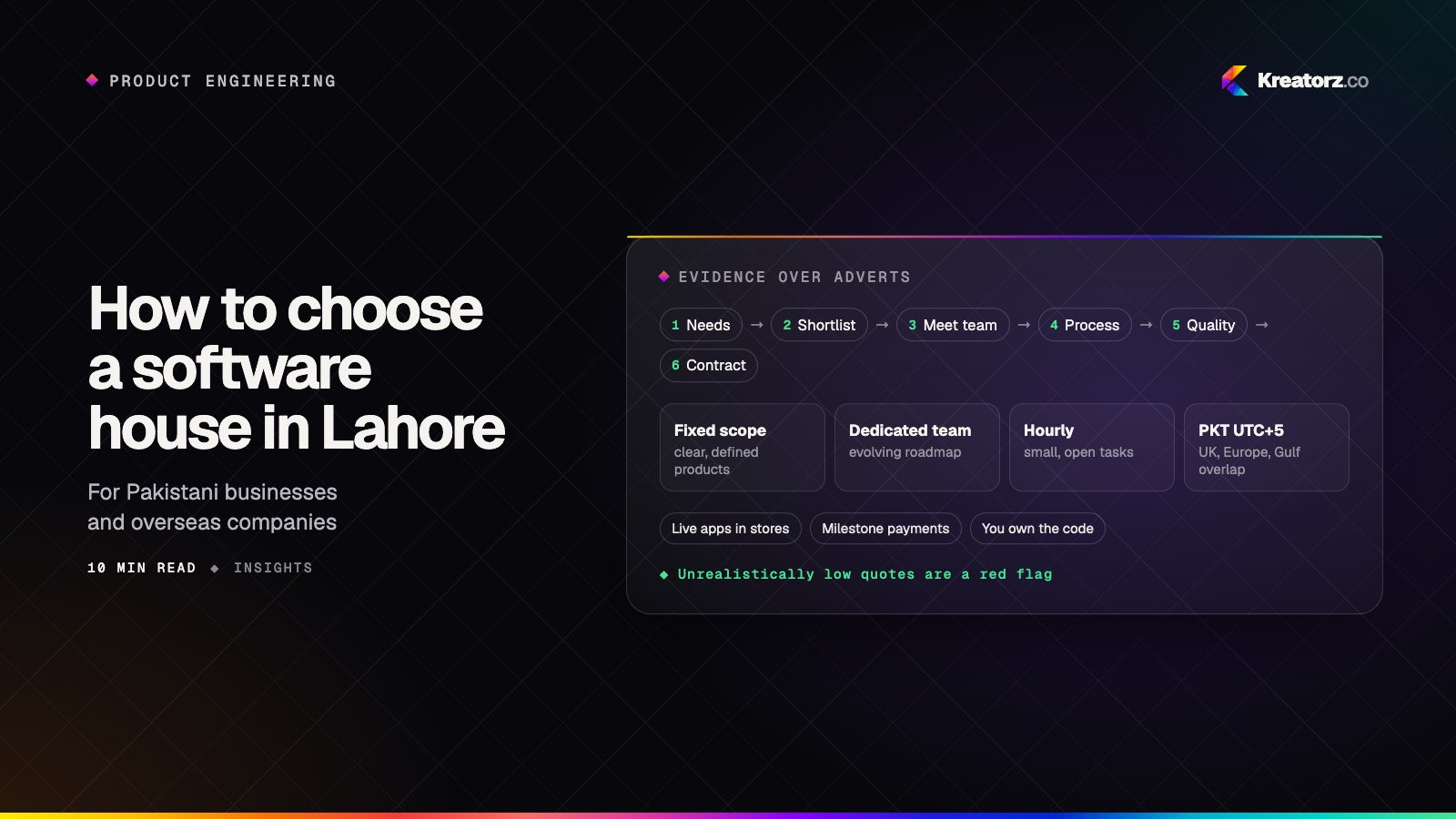
How to choose a software house in Lahore: a step-by-step guide
Whether you are a Pakistani business or an overseas company hiring a team in Pakistan, here is a practical, step-by-step way to choose a software house in Lahore for your app, custom software, SaaS or AI product, plus the red flags and questions that separate strong teams from risky ones.
17 November 2026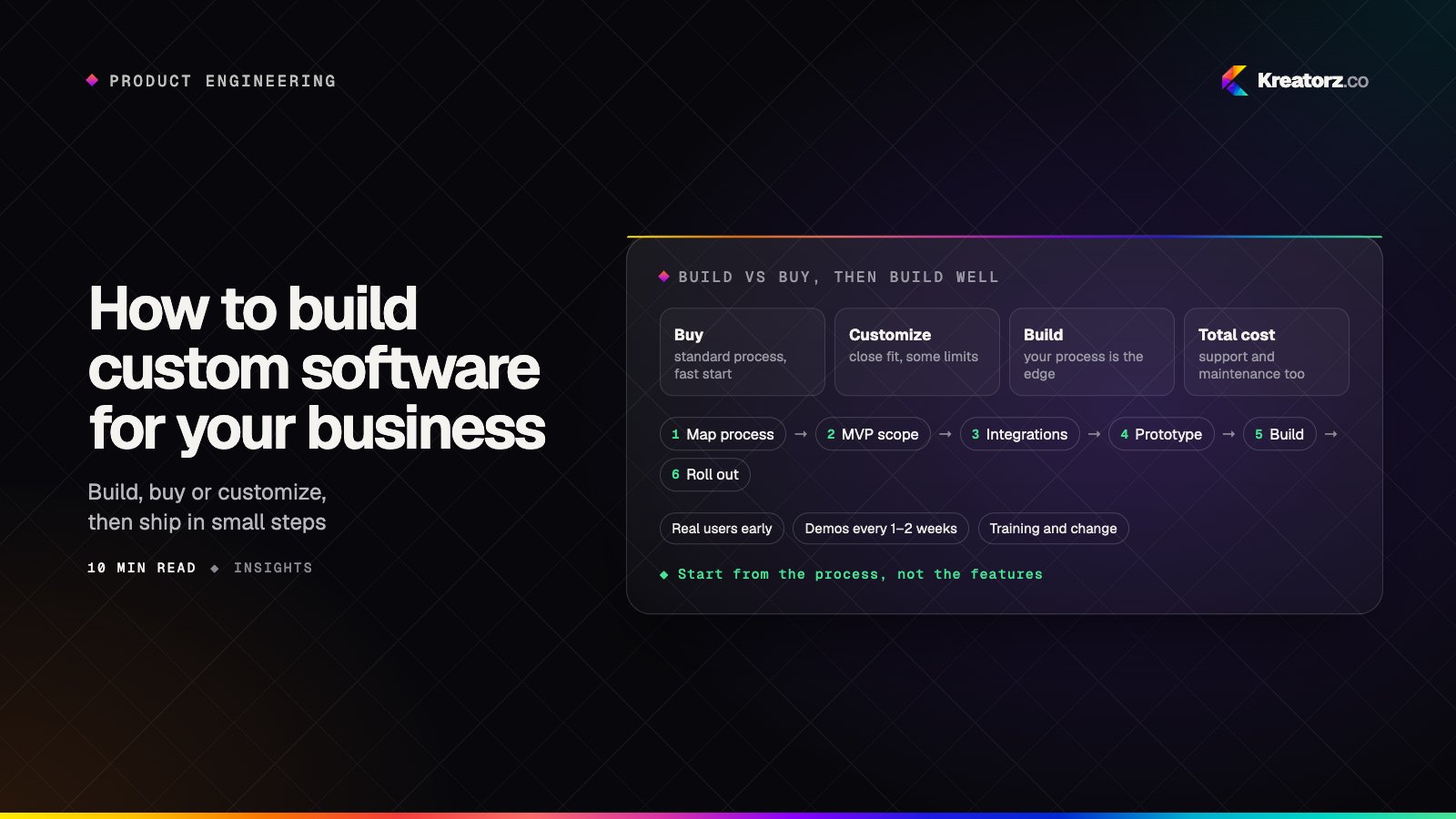
How to build custom software for your business: a step-by-step guide
Custom software can remove the spreadsheets, re-keying and workarounds that slow a business down, but only if it is planned around real processes and real users. Here is a practical, step-by-step way to decide whether to build, scope a first release, choose a partner and keep the system healthy after launch.
18 November 2026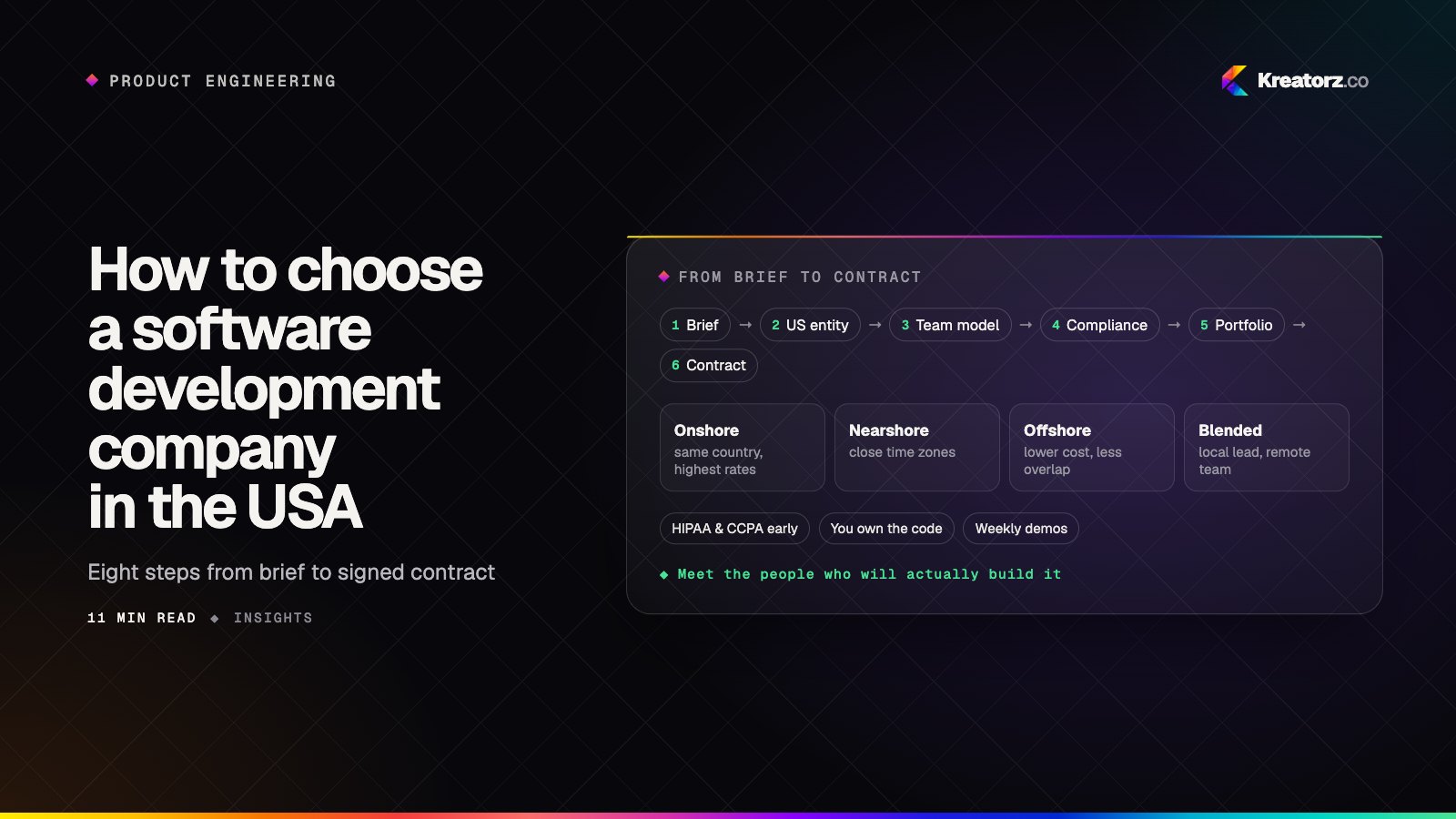
How to choose a software development company in the USA: a step-by-step guide
Hiring a company to build your app, SaaS platform or AI product is a big decision. Here is a practical, step-by-step way for US founders and businesses to compare software development companies, from contracts, time zones and compliance to pricing models, portfolios and red flags.
17 November 2026