A large language model knows a lot about the world and nothing about your business. Ask it about your refund policy, your product catalog or last quarter's contracts and it will either refuse or guess. Retrieval-augmented generation (RAG) fixes that: before the model answers, the system finds the most relevant passages in your own content and gives them to the model as evidence, so the answer is grounded in your data and can point to where it came from.
Kreatorz builds RAG systems end to end — ingestion, search, prompts, interface, evaluation and the security around them. One senior team covers AI engineering, backend, product design and cloud, so the system you get is a product people use every day, not a notebook demo.
RAG systems we build
- Internal knowledge assistants — one place for staff to ask questions across policies, handbooks, wikis, tickets and shared drives, with answers that link to the source.
- RAG chatbots for customers — support and pre-sales assistants that answer from your help center, product data and documentation, and hand over to a person when they should. See AI chatbot development.
- Document Q&A — ask questions of contracts, reports, manuals, research and regulatory documents, including long PDFs, tables and scanned files.
- Enterprise AI search — semantic and hybrid search across many systems, with filters, permissions and summaries on top.
- RAG inside your product — "ask your data" features for SaaS products, so your customers get answers from their own records. See SaaS development.
- RAG for AI agents — retrieval as a tool that AI agents use to look things up before they act.
What makes a RAG system accurate
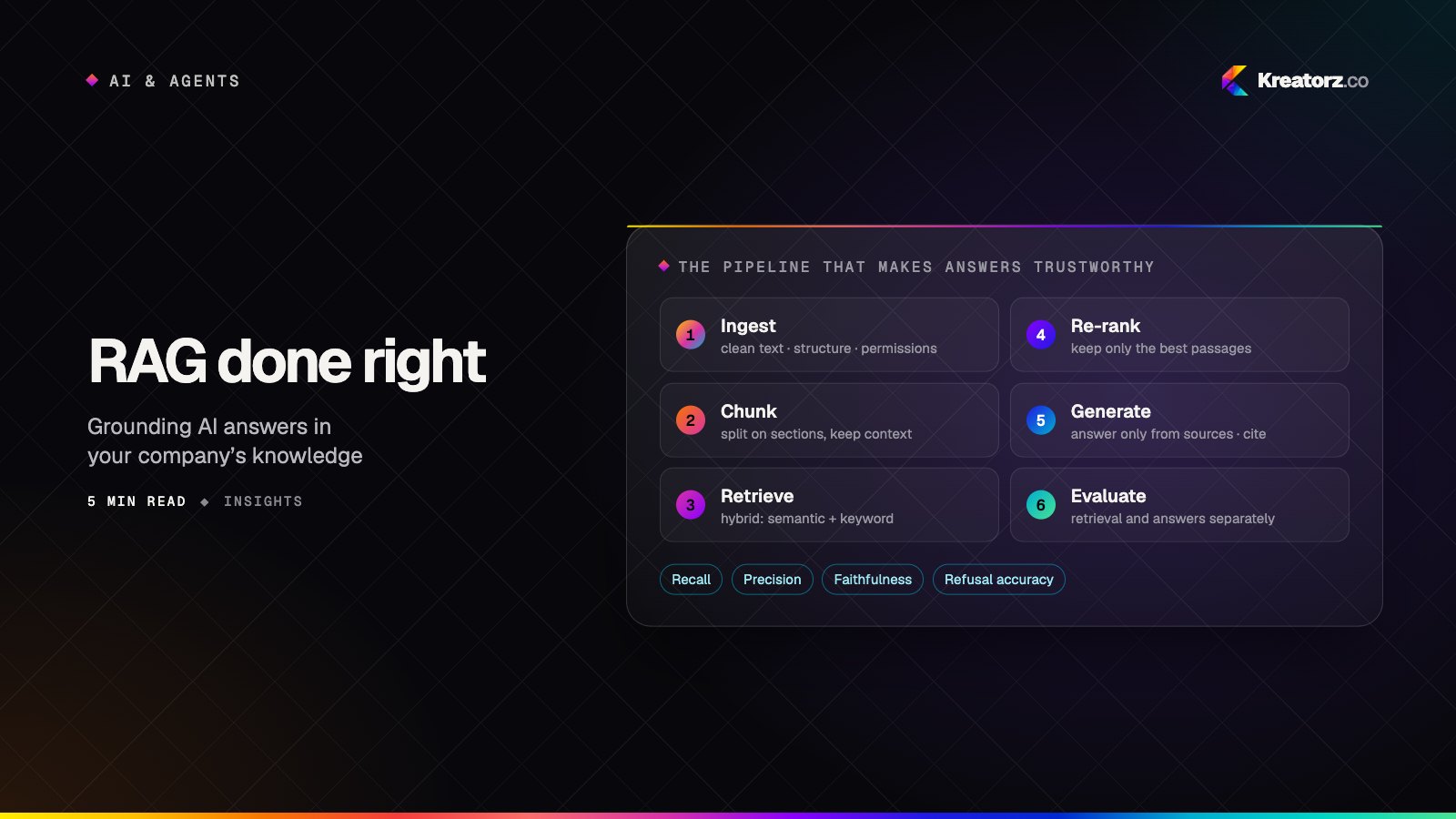
Most RAG failures have nothing to do with the model. They come from the pipeline around it. We engineer each stage deliberately:
| Stage | What we do |
|---|---|
| Ingestion | Connectors for your sources, clean text extraction from PDFs, slides, tables and scans, and scheduled re-syncing so answers stay current |
| Chunking | Splitting content along its real structure — sections, clauses, rows — with titles and metadata kept attached |
| Retrieval | Hybrid search (keywords plus embeddings), metadata filters and re-ranking, so the right passage reaches the model |
| Permissions | Access filters applied at retrieval time, so people only see answers drawn from content they are allowed to open |
| Generation | Prompts that require sources, quote exact figures and say "I don't know" when the evidence is missing |
| Evaluation | A test set of real questions with expected answers, run on every change to measure accuracy and catch regressions |
| Monitoring | Logs of questions, sources and feedback, cost tracking and dashboards that show where answers fall short |
Our article on RAG done right goes deeper on each stage.
RAG, fine-tuning or both?
RAG is the right default when answers depend on facts that change — documents, prices, policies, records — and when you need citations and access control. Fine-tuning changes how a model behaves, such as its tone, format or a narrow skill, but it is a poor way to teach it facts. Many production systems use RAG for knowledge and a small amount of fine-tuning or careful prompting for style. We help you choose during discovery. See LLM development for model selection and fine-tuning.
Security and data privacy
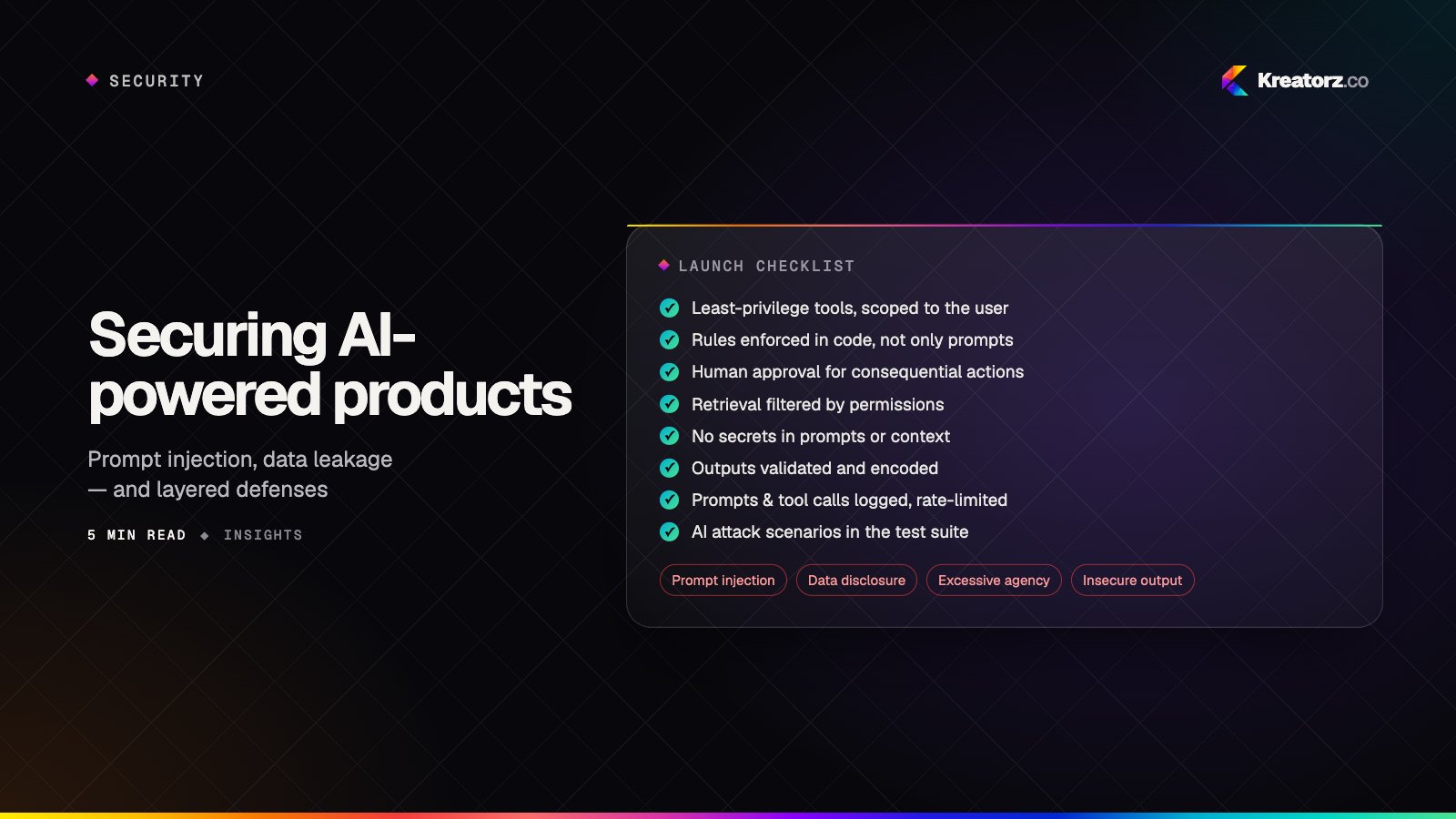
Your content stays under your control. We can run on your cloud account, use model providers that do not train on your data, keep sensitive data out of prompts, and add audit logs of who asked what and which sources were used. For regulated data — health, financial or personal information — we design for the rules that apply and work with your compliance advisors. Our guide to securing AI products covers prompt injection and data leakage.
How a RAG project runs
- Discovery — the questions people need answered, the sources that hold the answers, and who can see what. We build a first evaluation set from real questions.
- Proof of value — a working prototype on a slice of your content, measured against the evaluation set, in a few weeks.
- Production build — connectors, permissions, interface, admin tools and monitoring.
- Launch and improve — a staged rollout, feedback capture and a regular cycle of improving retrieval, prompts and content.
Start your RAG project
Tell us what people need to find and where that knowledge lives today. We will come back with sharp questions and a clear next step. Get a free consultation.