How to build a marketplace app: features, payments, trust and the cold start
A marketplace succeeds or fails on liquidity — buyers finding what they want and sellers getting enough demand to stay. Here is how to choose your model, scope the MVP, handle payments and trust, pick a tech stack and solve the chicken-and-egg problem.
Short answer
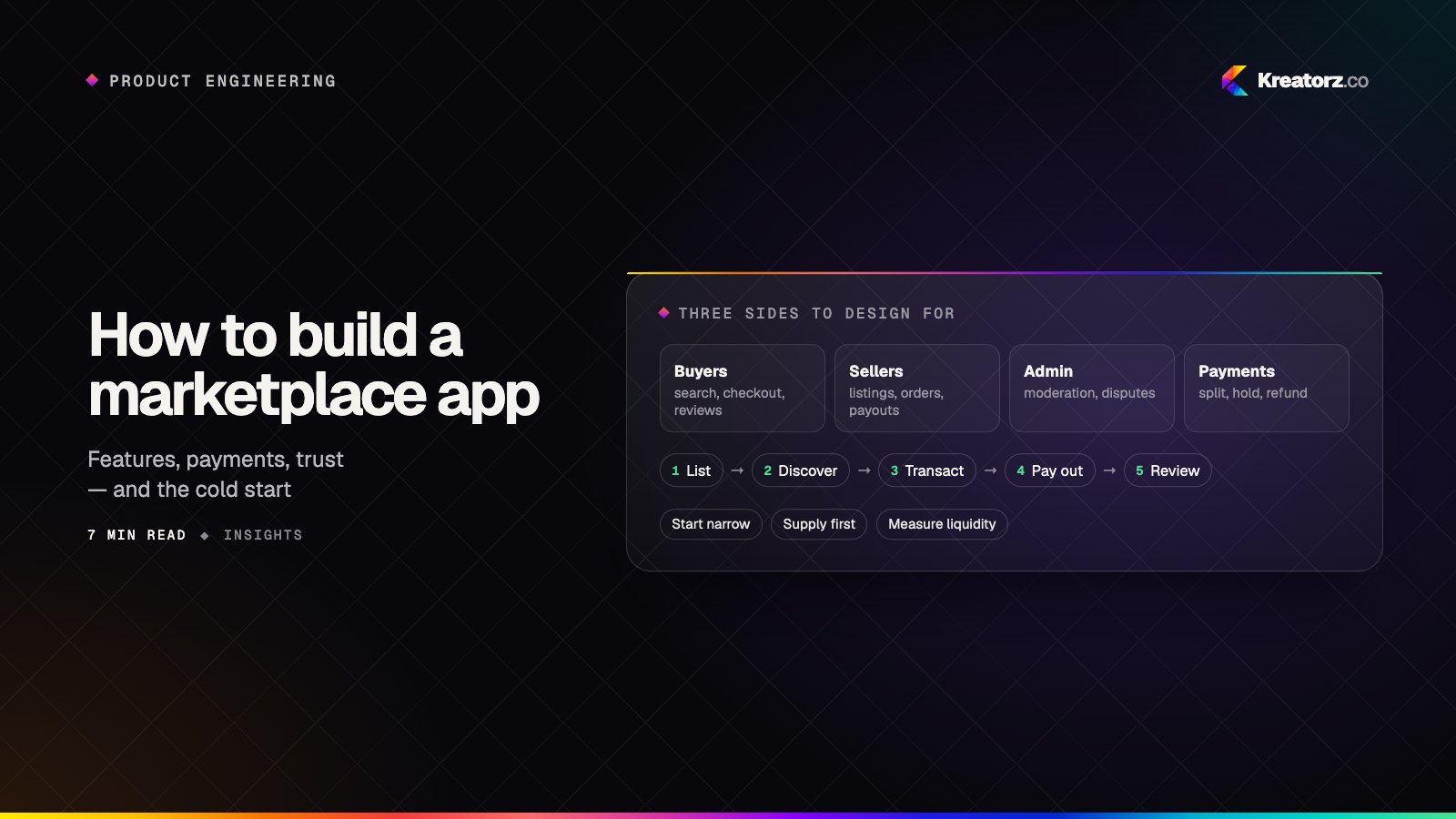
To build a marketplace app, choose your model and revenue approach first, then scope an MVP around the core loop for buyers, sellers and your admin team: listing, discovery, transaction, payment, payout and review. Use a marketplace payment platform such as Stripe Connect, build verification and moderation for trust, and beat cold start by launching narrow and recruiting supply first.
Marketplace apps — platforms that connect buyers with sellers, clients with service providers, or renters with owners — are some of the most valuable products in software. They are also some of the hardest to get right, because you are not building one product for one customer. You are building at least two experiences, plus the payments, trust and operations that hold them together.
This guide explains how to build a marketplace app step by step: choosing a model, scoping a focused MVP, handling payments and trust, choosing a tech stack, and solving the cold-start problem every marketplace faces on day one.
Start with the marketplace model
Before features, decide what kind of marketplace you are building. The model determines your user journeys, payment flows and how you make money.
| Model | What changes hands | Examples of the pattern |
|---|---|---|
| Products | Physical or digital goods | Handmade goods, secondhand items, B2B supplies |
| Services | Time and expertise | Home services, freelancers, tutors, healthcare providers |
| Rentals and bookings | Temporary access to something | Equipment, spaces, vehicles, accommodation |
| B2B | Larger, repeat orders between businesses | Wholesale, procurement, logistics capacity |
Then decide how the platform earns revenue. Common options include a commission on each transaction, a subscription or listing fee for sellers, a fee charged to buyers, and paid promotion for listings. Many marketplaces combine two of these. Your choice affects the payments architecture, so make it early.
Core features of a marketplace MVP
Every marketplace has three sides to design for: the buyer, the seller and your own operations team. A good MVP covers the essential journey for each one and nothing more.
For buyers
- Search, browse and filters that help people find the right listing quickly.
- Listing pages with clear photos, descriptions, pricing, availability and reviews.
- A smooth checkout or booking flow with secure payment.
- Messaging with the seller, order or booking status, and notifications.
- Reviews and ratings after the transaction.
For sellers
- Onboarding and identity or business verification.
- Tools to create and manage listings, prices and availability.
- An orders or bookings dashboard.
- Payouts and a clear view of earnings and fees.
For your team (the admin panel)
- User, listing and order management.
- Moderation tools for listings, reviews and reports.
- Dispute handling and refunds.
- Fee settings, payouts oversight and reporting.
The admin panel is often underestimated. In the early months, much of a marketplace's quality comes from people on your team quietly approving sellers, fixing listings and resolving problems. Give them good tools.
Payments: the hardest part to get right
Marketplace payments are more complex than a normal online store, because money flows from a buyer, through the platform, to a seller — minus your fee. That raises questions about holding funds, splitting payments, refunds, chargebacks, seller payouts and tax reporting.
Most marketplaces should not build this from scratch. Payment platforms designed for marketplaces, such as Stripe Connect, handle seller onboarding and identity checks, split payments, payouts to sellers' bank accounts and much of the regulatory complexity. Your team still needs to design:
- When money moves — charged at booking, held until the service is delivered, or released after a review window.
- How fees are calculated — percentages, fixed fees, or different rates by category or seller tier.
- Refunds and disputes — who pays when an order goes wrong, and how your team resolves it.
- Reporting — what sellers see, what your finance team needs and what tax forms the payment provider handles for you.
Get these rules agreed in discovery. Changing the flow of money after launch is far harder than changing a screen.
Trust and safety
People are transacting with strangers on your platform. Trust is the product as much as the listings are.
- Verification for sellers, and for buyers where the stakes are high.
- Reviews and ratings that only verified transactions can leave.
- Secure in-app messaging and payment, so users are not pushed to take conversations or money off the platform where you cannot protect them.
- Clear policies on prohibited items, cancellations and refunds.
- Moderation that combines automated detection with human review. AI can help flag suspicious listings, fake reviews or scam messages, while your team makes the final call.
Choosing a tech stack for a marketplace app
There is no single right stack, but a proven, well-supported one helps a small team move quickly and hire easily. A typical modern setup includes:
- Mobile apps built with a cross-platform framework, so buyers and sellers get iOS and Android from one codebase. See our comparison of Flutter, React Native and native.
- A web app for buyers and a dashboard for sellers, often in React or Next.js.
- A backend and API in a mainstream language such as Node.js or Python, built around a relational database for orders, payments and inventory.
- Search that supports filters, ranking and, where it matters, location.
- Cloud infrastructure on AWS or a similar provider, with background jobs for notifications, payouts and emails.
Our full-stack development and Node.js development teams often use this shape, because it scales well from a first release to a much larger platform.
Solving the chicken-and-egg problem
A marketplace with no sellers has nothing for buyers, and a marketplace with no buyers gives sellers no reason to join. This cold-start problem is the defining challenge of the category, and it is solved by strategy as much as software.
- Start narrow. Launch in one city, one category or one niche where you can build real density, then expand. A busy small marketplace beats an empty large one.
- Bring supply first. In most marketplaces, sellers or providers are recruited first — often by hand — so buyers find something worth staying for.
- Give sellers value on their own. Tools that help sellers manage bookings, inventory or invoicing can attract them before demand arrives.
- Do things that do not scale. Manually match early orders, onboard sellers personally and fix problems yourself. You will learn what to automate.
- Measure liquidity. Track how often searches lead to a transaction and how quickly listings sell or get booked. That tells you whether the marketplace is working.
Building your MVP: a practical sequence
- Discovery — choose the model, the first niche and the revenue model, and map the buyer, seller and admin journeys.
- Design — prototype the core buyer and seller flows and test them with real users from both sides.
- Build the core loop — listing, discovery, transaction, payment, payout and review, plus the admin tools to support it.
- Pilot — launch to a small group of recruited sellers and buyers, and support them closely.
- Learn and expand — use the data to improve conversion and liquidity, then add categories, locations and features.
An MVP development approach keeps the first release focused on that core loop. Features like advanced recommendations, loyalty programs and complex seller analytics can come later. Our guide to how long it takes to build an app shows how a phased plan like this fits together.
Metrics that matter for marketplaces
- Gross merchandise value (GMV) — the total value of transactions on the platform.
- Take rate — the share of GMV the platform keeps as revenue.
- Liquidity — the share of listings that sell or get booked, and the share of searches that end in a transaction.
- Repeat rate — how often buyers and sellers come back.
- Time to first transaction for new sellers and new buyers.
Ready to build your marketplace?
A marketplace app is a demanding product, but a clear model, a focused MVP and a disciplined launch in one niche give it the best chance of success. If you are planning one, our marketplace app development team can help you scope the buyer, seller and admin experiences and the payment flows behind them. Get in touch to talk it through.
Frequently asked questions
How much does it cost to build a marketplace app?
It depends on the number of user types, platforms, payment complexity, integrations and admin tools. Marketplaces usually fall into the medium-to-complex range because they include at least two user experiences plus payments and moderation. Our guide to app development costs explains how to estimate it.
How long does it take to build a marketplace MVP?
A focused marketplace MVP — one niche, the core buyer and seller journeys, payments and essential admin tools — often takes around three to six months. Launching in phases gets you to real users sooner.
What features does a marketplace app need?
At minimum: search and listings for buyers, checkout or booking with secure payment, seller onboarding and listing management, payouts, messaging, reviews and an admin panel for moderation, disputes and refunds.
How do marketplace apps handle payments?
Most use a payment platform designed for marketplaces, such as Stripe Connect, to onboard sellers, split each payment between the seller and the platform, pay sellers out and handle much of the compliance. The platform defines when funds move, how fees work and how refunds are handled.
How do I get the first users for a marketplace?
Start in a narrow niche or location, recruit the supply side first, often personally, and give early users a great experience by hand. Expand once that first market has enough activity for buyers and sellers to find each other reliably.
Should a marketplace start as a web app or a mobile app?
It depends on how your users behave. Many marketplaces start with a responsive web app for discovery and a mobile app for the side that needs it most, such as service providers on the move. A cross-platform framework makes adding mobile apps faster when the time comes.
- Marketplace app developmentWe design and build two-sided marketplaces, on-demand delivery and booking platforms, with buyer and seller apps, split payments, trust and safety, and the admin…Explore
- Mobile app developmentWe plan, design, build and grow mobile apps for iPhone and Android — choosing the right technology for your product, not the one we happen to prefer.Explore
- MVP developmentWe help founders turn an idea into a focused, production-quality minimum viable product — scoped to test what matters, built to scale when the answer is yes.Explore


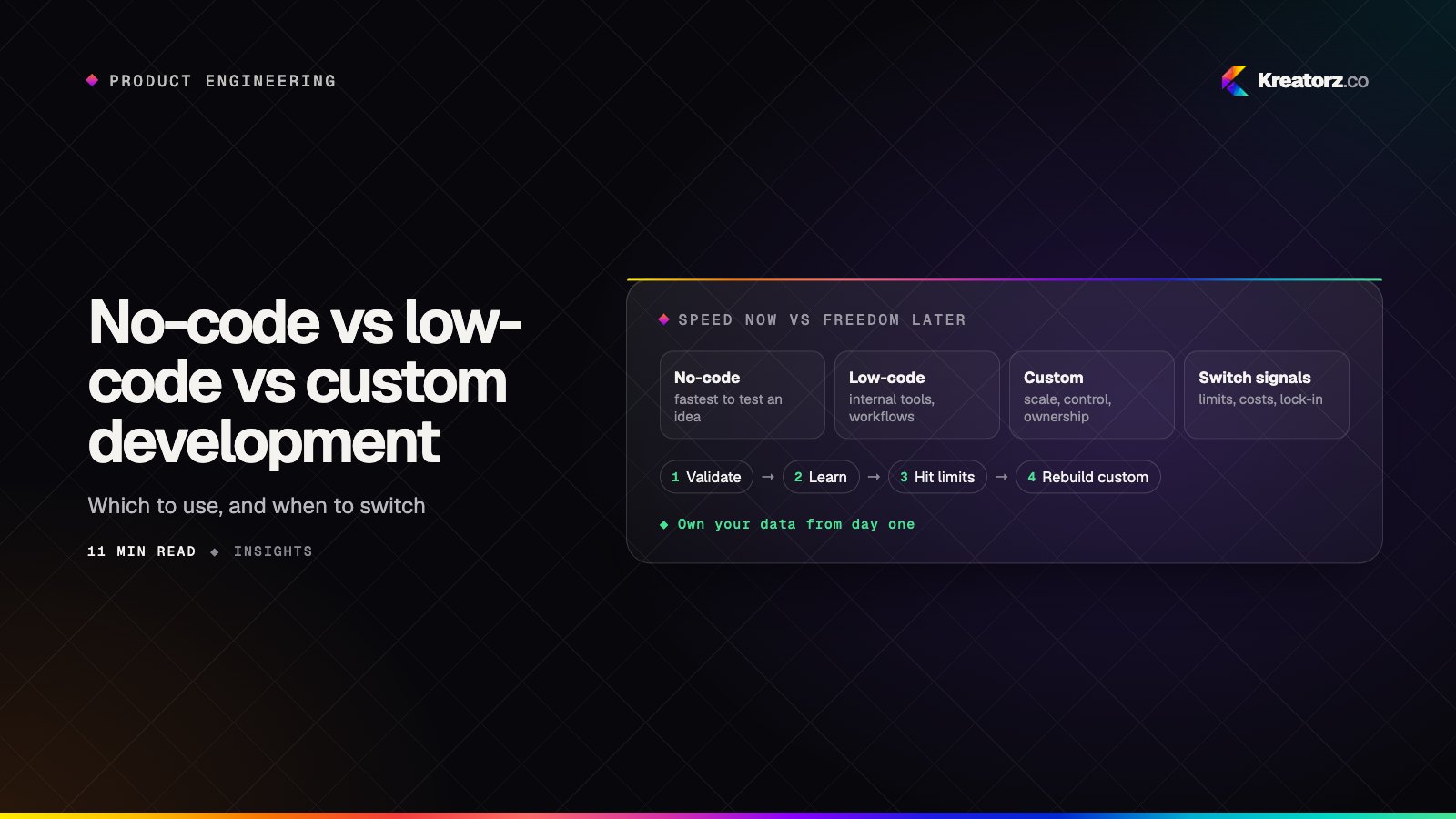
No-code vs low-code vs custom development: which should you use to build your app?
No-code builders, low-code platforms and custom code can all produce a working app, but they trade speed for control in very different ways. Here is how the three compare on cost, flexibility, scale, integrations, security and ownership, where each one genuinely wins, the hidden limits to watch for, and when to move from no-code to custom.
21 November 2026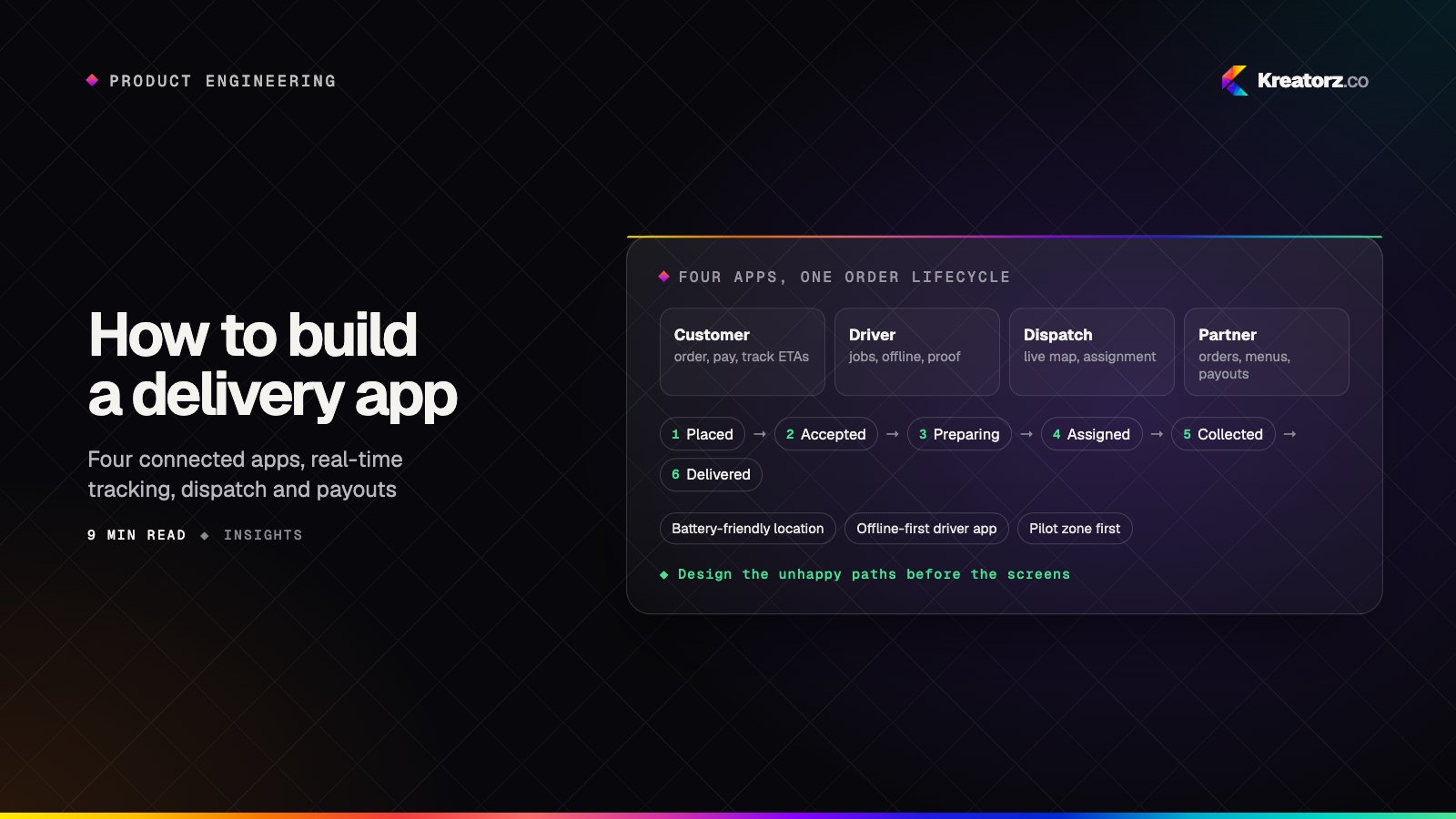
How to build a delivery app: the four connected apps, real-time tracking, dispatch and payouts
A delivery app is never one app. It is a customer app, a driver app, a dispatch dashboard and a partner portal, held together by real-time tracking, assignment rules and the money flowing between them. Here is how to plan, build and launch one.
17 November 2026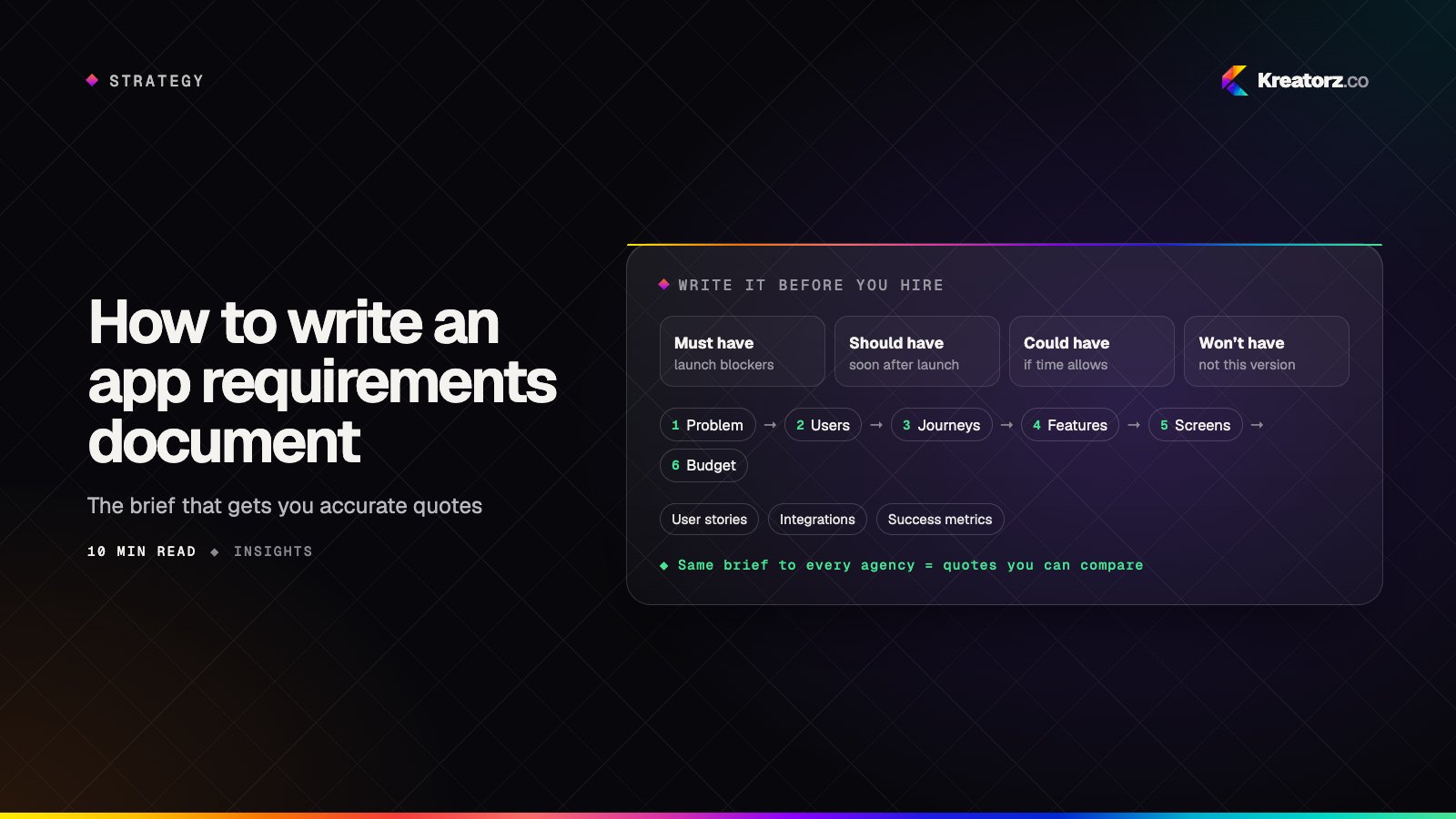
How to write an app requirements document before you hire developers
A clear app requirements document is the fastest way to get accurate, comparable quotes from developers. Here is a step-by-step guide to writing one, from the problem statement and user stories to must-have features, integrations, compliance flags, budget and a fill-in template you can copy.
21 November 2026