Flutter, React Native or native? Choosing a mobile stack in 2026
The cross-platform versus native debate has matured. The right answer now depends less on raw performance and more on your team, your product's demands and your plans for the next three years.
Few technical decisions shape a mobile product as much as the stack you build it on. It affects how fast you ship, who you can hire, how the app feels in users' hands and what it costs to maintain for years. And yet the choice is often made on habit or hearsay.
The good news: all three mainstream options — Flutter, React Native and fully native (Swift for iOS, Kotlin for Android) — are mature, well supported and used in serious production apps. There is no universally wrong answer. There is, however, usually a better answer for your situation.
The short version
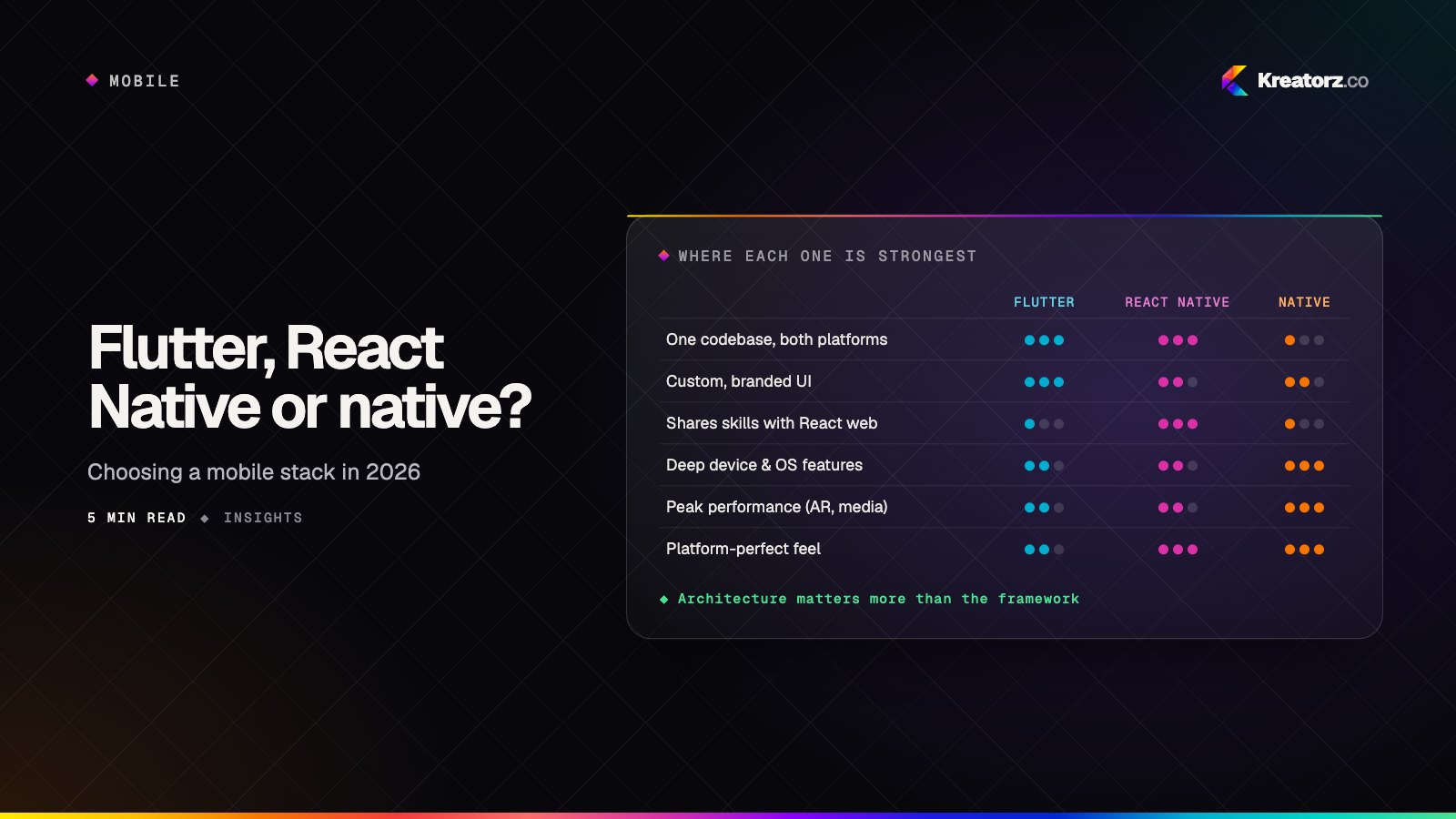
| If your priority is… | Lean towards |
|---|---|
| One team, one codebase, a highly custom branded UI | Flutter |
| Sharing skills and logic with an existing React web team | React Native |
| Deep platform features, maximum performance, platform-perfect feel | Native |
| Fastest path to a validated MVP on both platforms | Flutter or React Native |
| An app that is mostly a wrapper for web content | Reconsider — a great web app may be enough |
The rest of this guide explains the trade-offs behind that table.
Flutter
Flutter uses the Dart language and draws its own interface rather than using the platform's native components. That one design decision explains most of its strengths and trade-offs.
Where it shines
- Pixel-perfect consistency. Your design looks the same on every device, which suits strongly branded products.
- Productivity. A single codebase, fast hot reload and a rich widget library make small teams very effective.
- Reach. The same codebase can target iOS, Android, web and desktop, which is useful for internal tools and companion apps.
What to weigh
- Because it draws its own UI, matching every platform convention takes deliberate effort when you want a truly "native" feel.
- Dart is less common than JavaScript or TypeScript, so the hiring pool is smaller — though it is easy for experienced developers to learn.
- New platform features sometimes arrive in Flutter after a delay, or require writing a small native module.
React Native
React Native lets you write your app in JavaScript or TypeScript using React, and renders real native components. Its modern architecture has closed much of the historical performance gap.
Where it shines
- Shared skills with the web. If your team already builds in React, much of the knowledge — and some of the code, such as business logic and validation — carries over.
- A huge ecosystem. Libraries exist for almost everything, and frameworks such as Expo smooth over much of the tooling and release complexity.
- Native look and feel by default, since it uses the platform's own components.
What to weigh
- Third-party library quality varies; choosing well-maintained dependencies matters.
- Complex animations and heavy computation need care to keep the interface smooth.
- Upgrades across major versions can take planning in larger apps.
Fully native: Swift and Kotlin
Native development means building separate apps with each platform's own language and tools: Swift for iOS and Kotlin for Android.
Where it shines
- Full, immediate access to every platform capability — new OS features on day one, deep integrations with hardware, widgets, wearables, background processing.
- The best possible performance for demanding workloads: real-time media, AR, complex graphics, on-device machine learning.
- A platform-perfect experience that follows each OS's conventions exactly.
What to weigh
- Two codebases usually mean two specialised teams (or more time), and features must be built twice.
- Keeping both apps in sync — features, fixes, releases — needs disciplined process.
The questions that actually decide it
Rather than starting from the technology, we find it more useful to answer these questions honestly.
1. What does the app really need from the device?
List the platform features your product depends on: camera processing, Bluetooth, background location, health data, payments, widgets, wearables, AR. If several are central to the experience, native — or a cross-platform app with well-planned native modules — deserves serious consideration.
2. How custom is the interface?
A highly branded, animated interface that should look identical everywhere suits Flutter. An app that should feel like a natural part of each operating system suits React Native or native.
3. Who will build and maintain it?
The best stack is often the one your team — or your partner's team — knows deeply. An excellent React team will usually ship a better React Native app than a better-on-paper Flutter app built while learning. Think about hiring over the next few years, not just the next sprint.
4. How fast do you need to learn?
For a new product still validating its market, a single cross-platform codebase usually wins: you ship to both stores at once and change direction cheaply. (See our guide on getting from idea to MVP in weeks.)
5. What does year three look like?
Consider the roadmap beyond launch: more platforms, a web version, deeper integrations, larger teams. Some products start cross-platform and add native modules where they need them — a perfectly healthy path when the architecture is clean.
Architecture matters more than the framework
Whichever stack you choose, a few practices determine whether the app stays fast to change:
- Separate the layers — interface, business logic and data access — so one can change without rewriting the others.
- Design your API for mobile: efficient payloads, pagination, and graceful handling of poor connections.
- Plan for offline and failure — mobile networks are unreliable; users notice when apps aren't.
- Automate builds, tests and releases so shipping an update is routine, not an event.
- Monitor crashes and performance from the first release.
Our default recommendations
Without knowing your specifics, these are reasonable starting points:
- New product, both platforms, small team: Flutter or React Native, chosen by team skills and design ambitions.
- Existing React web product adding mobile: React Native, sharing logic and conventions.
- Hardware-heavy, media-heavy or platform-showcase apps: native, or cross-platform with native modules for the demanding parts.
- Internal business tools: Flutter, for one codebase across mobile, tablet, web and desktop.
The bottom line
In 2026 the question is not which framework is "best" — it is which one gives your team the fastest path to a great product that you can keep improving for years. Be honest about your device requirements, your design ambitions and your people, and the choice usually becomes clear.
Planning a mobile app and want a second opinion on the stack? Talk to our team — we build in Flutter, React Native, Swift and Kotlin, so our recommendation follows your product, not our habits.
Related services
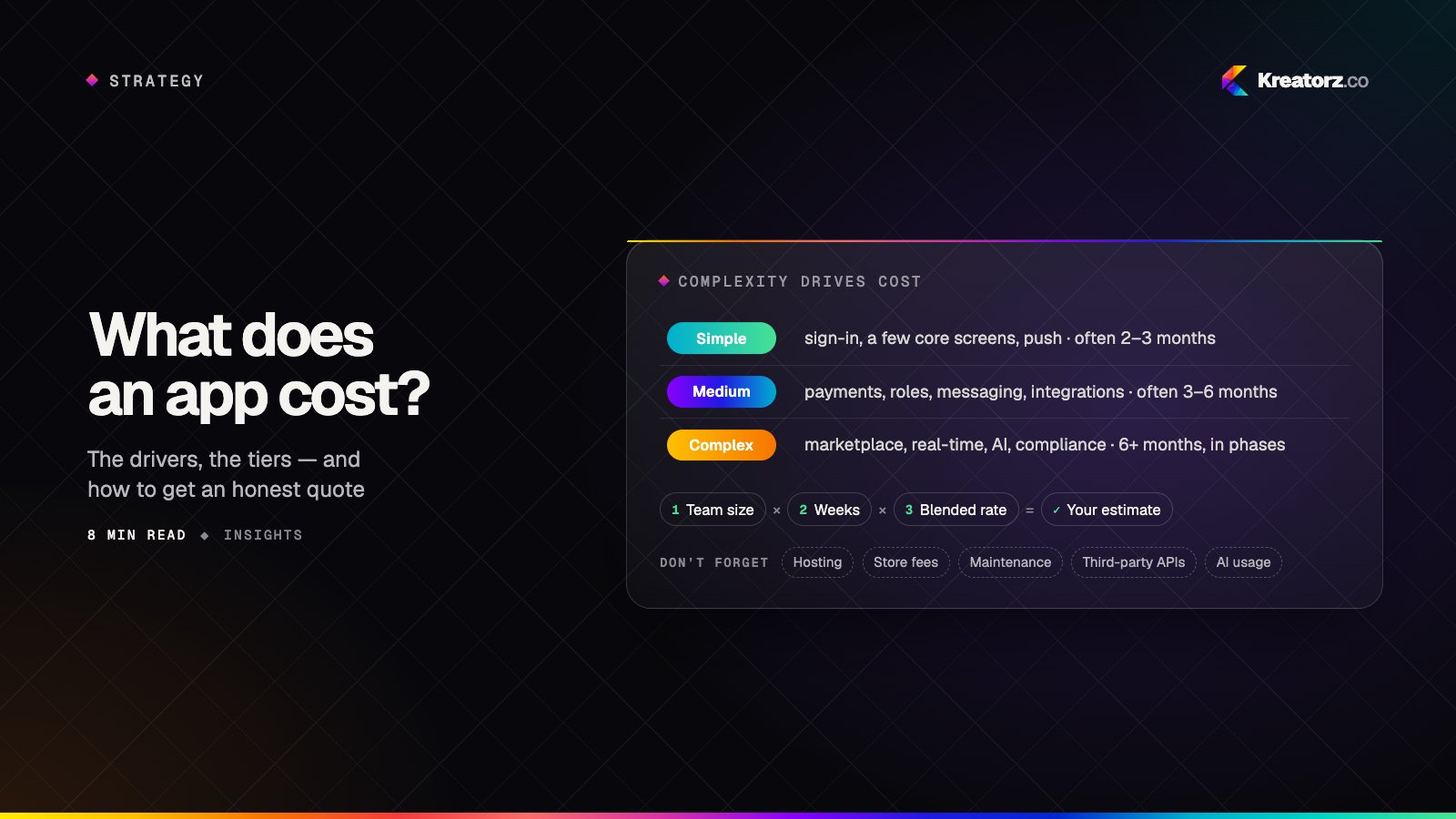
How much does it cost to build an app? A practical guide for 2026
There is no single price for an app, but there is a reliable way to reason about it. Here is what actually drives app development cost, how complexity tiers compare, how to estimate a budget yourself and how to reduce cost without cutting quality.
15 November 2026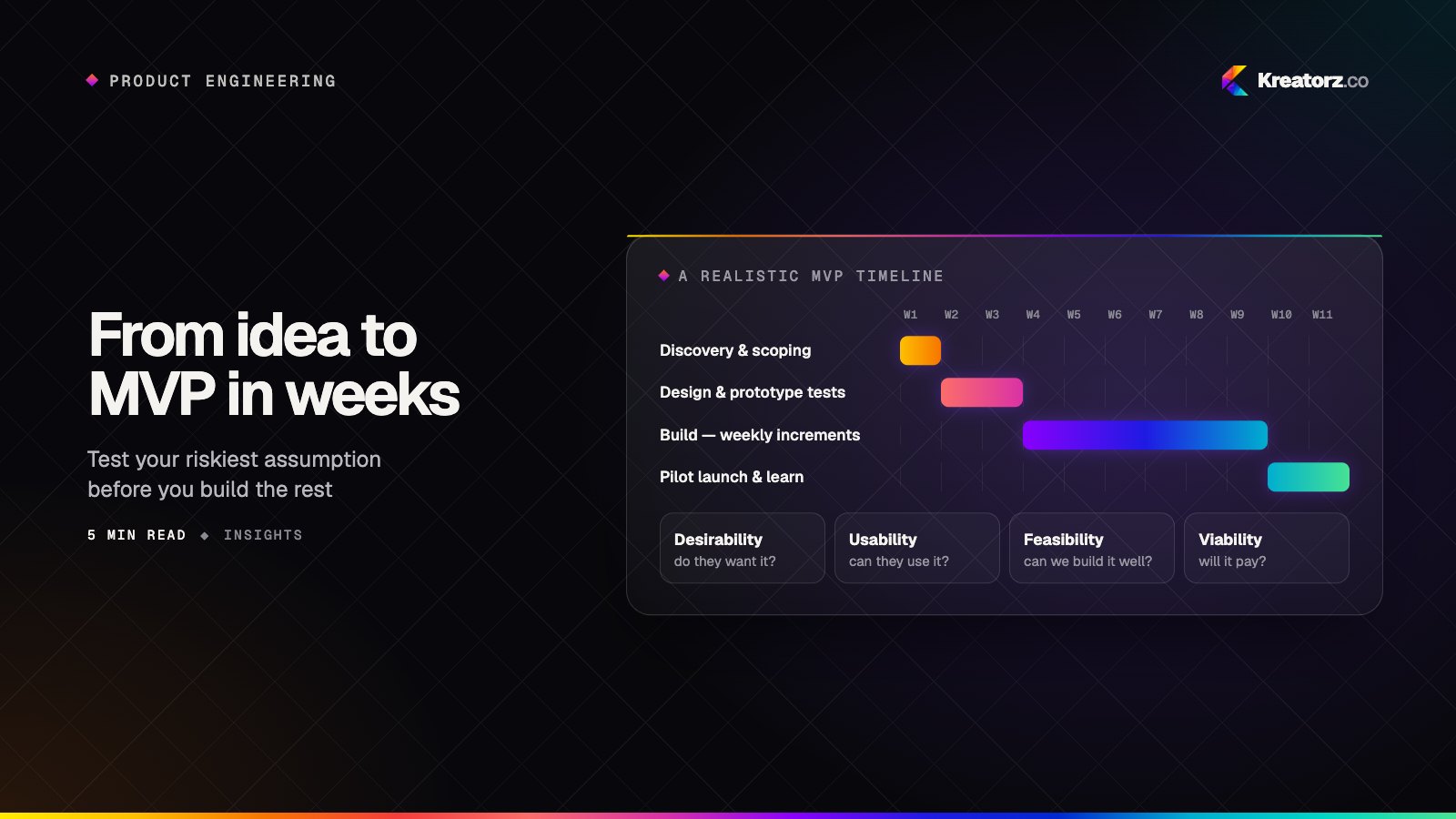
From idea to MVP in weeks: how to de-risk a new product
A minimum viable product is not a smaller version of the final product — it is the fastest honest test of your riskiest assumption. Here is the process we use to launch quickly without building the wrong thing.
14 October 2026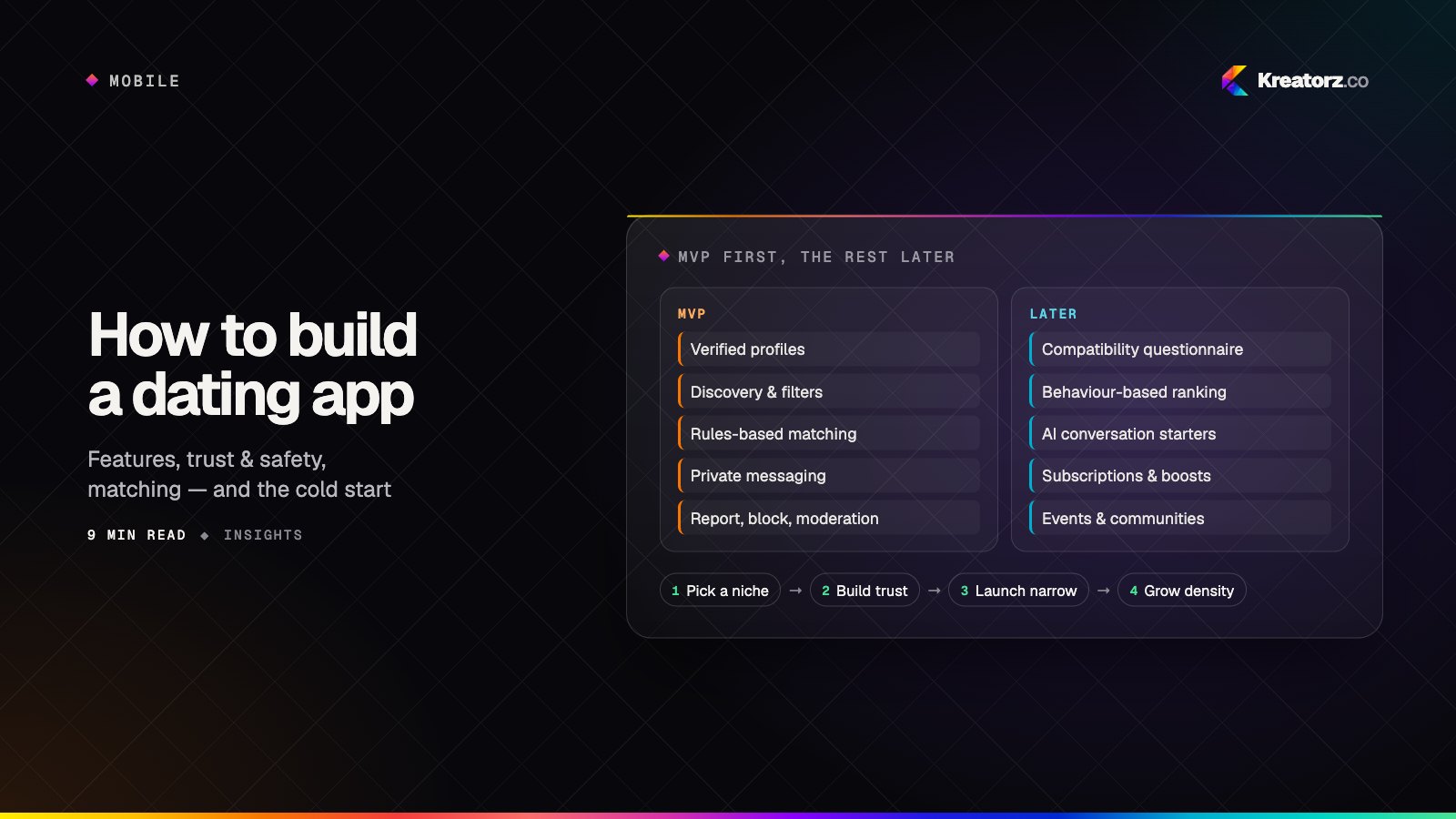
How to build a dating app: features, safety, matching and MVP scope
Building a dating app is less about copying swipe mechanics and more about trust, density and a clear audience. Here is a practical guide to features, matching, safety, privacy, monetisation and what to ship first.
15 November 2026