
How to build a fintech app: partners, ledgers, compliance and trust
A fintech app is a consumer product sitting on top of regulated infrastructure. Here is how to choose licensed partners, design money flows and a ledger that always balances, reduce your compliance and security burden, build trust into the UX and scope an MVP that can actually launch.
Short answer
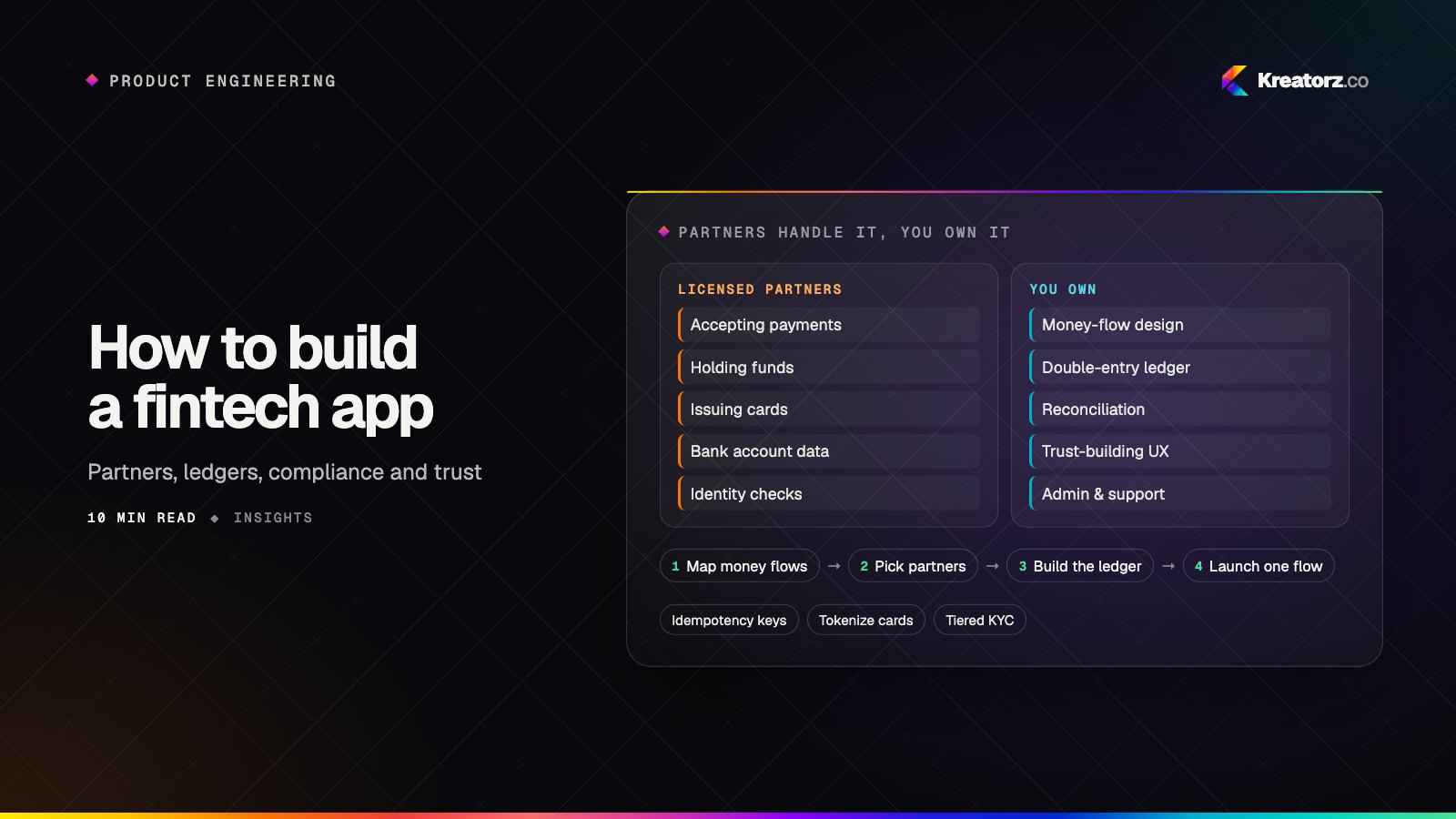
To build a fintech app, map every money flow first, then partner with licensed providers, such as payment processors, banking-as-a-service platforms and identity verification services, for the regulated parts. Keep your own double-entry ledger with idempotent operations and automated reconciliation, reduce PCI scope through tokenization, design KYC into onboarding, and launch with one core money flow done well.
Building a fintech app is different from building most other apps. A slow feed in a social app is an annoyance. A balance that looks wrong, a payment that goes through twice or a transfer stuck in "pending" with no explanation is a reason to delete the app and warn friends.
The good news is that you rarely need to build a bank to launch a financial product. Most fintech apps today are a well-designed product layer on top of licensed infrastructure partners. The hard engineering work is choosing those partners, modeling how money moves, keeping your own records accurate, and making all of it feel calm and trustworthy to the person holding the phone.
This guide walks through those decisions in order: money flows, partners, ledger design, security and compliance, trust-building UX, MVP scope and AI.
Start with how money moves
Before screens or a tech stack, write down every way money enters, moves through and leaves your product.
For each flow, answer:
- Who pays, and who receives? A user paying a merchant, a user sending money to a friend, a business paying out to contractors, a parent funding a child's card.
- Where are funds held in between? With a payment processor, in an account at a partner bank, in a stored-value wallet, or nowhere at all.
- When does money actually settle? Card payments, bank transfers and instant payment rails all settle on different timelines, and "authorized" is not the same as "settled."
- What can go wrong? Declines, reversals, chargebacks, refunds, partial captures, failed payouts and disputes.
- Who is responsible for each step? You, your partner, or the user.
The answers decide which partners you need, which regulations may apply and what your ledger must record. Accepting payments and running a peer-to-peer wallet look similar on a whiteboard but are very different products.
Choose licensed infrastructure partners
Holding customer funds, issuing cards, moving money between bank accounts and verifying identities are regulated activities. In most cases, the right move for a new product is to partner with providers that are licensed to do them and focus your own team on the product experience.
| Partner type | What it handles | Typical use in your app | What you still own |
|---|---|---|---|
| Payment processor | Accepting cards and wallets, payouts, refunds, disputes | Checkout, subscriptions, marketplace payouts | Pricing logic, order state, refund rules, support |
| Banking-as-a-service | Accounts held at a partner bank, transfers, sometimes cards | Wallets, business accounts, money held on behalf of users | Product design, onboarding UX, your ledger, customer support |
| Card issuing platform | Issuing virtual and physical cards, authorization controls | Spending cards, expense cards, controlled cards for families | Spending rules, card UX, real-time authorization decisions |
| Account data aggregation | Connecting users' existing bank accounts and reading balances and transactions | Budgeting, insights, account verification | Categorization, insights, how data is stored and shown |
| Identity verification | Document checks, selfie and liveness, sanctions screening | Onboarding, KYC for accounts and cards | When to ask, how to explain it, how to handle failures |
Well-known examples include payment processors such as Stripe and account-data platforms such as Plaid, alongside a range of card-issuing and banking-as-a-service providers. When comparing partners, look at:
- Coverage. The countries, currencies and payment methods your users actually need.
- Licensing model. Whether the provider holds the relevant licenses itself or relies on partner banks, and what that means for your obligations.
- Compliance support. Which KYC, monitoring and reporting duties they take on, and which stay with you.
- API quality. Clear webhooks, test environments, idempotency support and good documentation save weeks of engineering.
- Program requirements. Some partners review your product and policies before launch. Plan time for that.
Whether your product needs its own license depends on what you do, where you operate and how your partners are structured. Confirm this early with a qualified legal or compliance advisor. It is one of the few decisions that can change your entire roadmap.
Design a ledger that always balances
Your partners keep their own records, but you still need your own source of truth for what each user owns, owes and has in flight. That is your ledger, and it is the part of a fintech app that most rewards getting right early.
Use double-entry records
In a double-entry ledger, every movement of money is recorded as at least two entries that sum to zero: a debit from one account and a credit to another. A top-up debits "funds in transit from the processor" and credits the user's wallet. A transfer debits one user and credits another. A fee debits the user and credits your revenue account.
This makes errors visible: if a transaction's entries don't balance, you see it immediately instead of at month end. A few rules help:
- Never edit or delete entries. Correct mistakes with new, reversing entries so the history stays intact.
- Derive balances from entries, or keep cached balances that you can always rebuild from them.
- Store amounts as integers in the smallest currency unit, with an explicit currency, never as floating-point numbers.
- Model pending and settled states separately, so users see an accurate available balance while money is still in flight.
Make every money operation idempotent
Networks fail, users double-tap buttons and webhooks arrive twice. Every request that moves money should carry an idempotency key, a unique identifier that lets your system and your partner recognize a retry and return the original result instead of charging again. Apply the same discipline to webhook handlers: record each event ID you have processed and ignore duplicates.
Reconcile automatically
Reconciliation is the regular comparison of your ledger against your partners' records and bank statements. Automate it from the start: match every transaction, flag anything missing or mismatched, and route exceptions into a review queue for your operations team. Discrepancies caught daily are easy to fix; found months later, they are painful.
Security and compliance basics
Security and compliance in fintech are broad topics, and the specific requirements depend on your product, markets and partners. The basics below apply to almost every financial app. Treat them as a starting point to review with your legal and compliance advisors, not as legal advice.
KYC and AML
Know-your-customer (KYC) rules require verifying who your users are before they can use certain financial features. Anti-money-laundering (AML) rules require monitoring for suspicious activity and screening against sanctions lists. Identity verification providers and banking partners often handle much of the checking, but you design when and how it happens in the product, and you usually need processes for reviewing flagged users and activity.
A practical pattern is tiered onboarding: let users explore with light verification, and ask for more only when they unlock features that require it, such as higher limits or card issuance.
Reduce PCI scope with tokenization
If your servers receive, store or transmit raw card numbers, you take on a heavy PCI DSS compliance burden. The simplest way to reduce it is to never touch card data at all. Use your payment provider's hosted fields, mobile SDKs or checkout pages so card details go straight to the provider, and store only the token it returns. Your app can charge that token later without ever seeing the card number.
Security fundamentals
- Strong authentication with multi-factor options, biometrics and device binding for sensitive actions.
- Encryption in transit and at rest, with secrets kept in a managed secrets store.
- Least-privilege access for staff and services, and detailed audit logs of money movements and admin actions.
- Limits, velocity checks and anomaly alerts to catch fraud early.
- Regular security testing, including admin tools.
Our guide to securing AI products covers additional risks if your app includes AI features.
Build trust into the user experience
People decide whether to trust a financial app within the first few screens. Trust comes less from badges and more from clarity:
- Show exactly what will happen before it happens. Amount, fees, recipient, timing and whether the action can be undone.
- Make balances unambiguous. Distinguish available, pending and total, and explain the difference in plain language.
- Confirm every money movement. Clear success screens, receipts and notifications, with a reference number support can look up.
- Design errors carefully. "Your payment did not go through and you have not been charged" is far better than a generic error code.
- Explain verification. Tell users why you need a document or a selfie, and what happens next.
- Make support easy to reach from any transaction.
Trust also depends on your mobile app feeling fast and stable. For AI features, see designing AI features people trust.
Scope an MVP that can actually launch
Fintech MVPs fail when they try to launch every money flow at once. Each new flow adds partner work, edge cases, testing and sometimes compliance review. A focused first release usually includes:
- One core money flow done extremely well, such as accepting payments, funding a wallet or controlling card spending.
- Onboarding with the level of verification that flow requires.
- An accurate ledger, idempotent operations and automated reconciliation from day one.
- Receipts, transaction history and notifications.
- An admin panel for support, refunds, user review and reconciliation exceptions.
Leave multi-currency, additional payment rails, lending, investing and advanced analytics for later phases. Our guide to going from idea to MVP in weeks covers how to keep scope tight, and our breakdown of app development costs explains why fintech projects usually take more effort than typical apps.
Payment features in products we have built show how focused a first release can be. Easy Tipping lets customers tip service professionals by QR code while businesses track tips and manage how they are shared across the team. YaFi, an on-demand delivery app, includes the YaFi Pay wallet to make checkout fast. If your product adds payments to a two-sided platform, our guide to building a marketplace app covers split payments and payouts.
Where AI fits in fintech
AI works well in fintech when it helps users understand and control their money, and when its decisions stay explainable. Useful applications include:
- Categorization and insights that turn raw transactions into clear spending summaries.
- Document and receipt reading to capture data without manual entry.
- Support assistants that answer questions about transactions and account status, with a clear path to a human.
- Anomaly detection that flags unusual activity for review.
Checkpoint AI is an example of AI working at the moment of purchase: users scan an item with AI before buying, the app checks it against their own spending rules, a card stays locked until the purchase is approved, and receipt verification closes the loop.
Keep AI away from final decisions that move money or affect access to financial services unless a human reviews them and the logic can be explained. See our AI app development service and our guide to how to build an AI app.
The bottom line
A successful fintech app is a clear product built on solid foundations: licensed partners for the regulated parts, a double-entry ledger with idempotent operations and automated reconciliation, a security and compliance posture designed in from the start, and a user experience that always tells people exactly where their money is. Start with one money flow, get it right, and expand from there.
If you are planning a payment, wallet, budgeting or spending-control product, see our fintech app development service or book a free consultation to talk through your money flows.
Frequently asked questions
Do I need a banking license to build a fintech app?
Often not. Many fintech apps partner with licensed payment processors, banking-as-a-service platforms and card issuers that handle regulated activities. Whether you need your own license depends on your product, markets and partners, so confirm with a legal or compliance advisor early.
What is a ledger in a fintech app?
A ledger is your own record of every money movement in the product. A double-entry ledger records each movement as balanced debits and credits, which makes errors visible and lets you rebuild any balance from its history.
How do fintech apps avoid charging users twice?
They make every money operation idempotent. Each request carries a unique idempotency key, so a retry after a network failure or a double tap returns the original result instead of creating a second charge. Webhook events are deduplicated the same way.
How can a fintech app reduce PCI compliance scope?
Keep card data off your servers entirely. Use your payment provider's hosted fields, SDKs or checkout pages so card details go directly to the provider, and store only the token it returns.
What should a fintech MVP include?
One core money flow, onboarding with the verification it requires, an accurate ledger with reconciliation, receipts and transaction history, and an admin panel for support and review. Add further money flows in later phases.
Can AI be used in a fintech app?
Yes, for categorization, insights, receipt and document reading, support assistants and anomaly detection. Keep decisions that move money or affect access to services explainable and reviewed by people.
- Fintech app developmentWe design and build payment, wallet, budgeting, tipping and financial-wellness apps — with secure architecture, payment integrations and AI features — for fintech…Explore
- Mobile app developmentWe plan, design, build and grow mobile apps for iPhone and Android — choosing the right technology for your product, not the one we happen to prefer.Explore
- AI app developmentWe design, build and run AI-powered apps — assistants, copilots, knowledge tools, vision and voice features — that solve a measurable problem and hold up in production.Explore


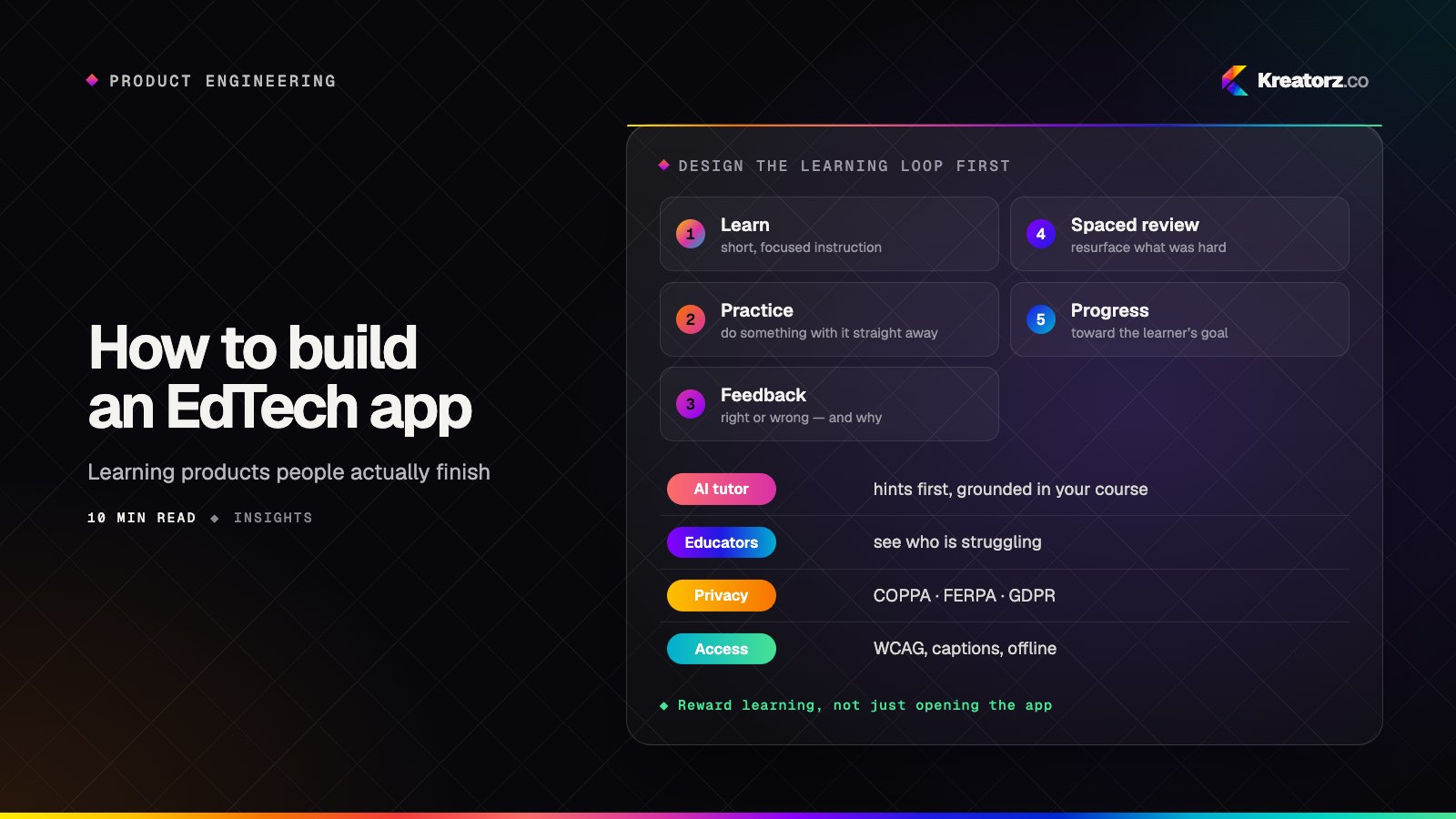
How to build an EdTech app: learning loops, AI tutors and the features that keep learners going
Putting lessons online is easy. Building a learning product people actually finish takes a tight learning loop, retention mechanics that serve learning, AI tutors that guide rather than hand over answers, tools for educators, and privacy and accessibility built in. Here is how we approach it.
17 November 2026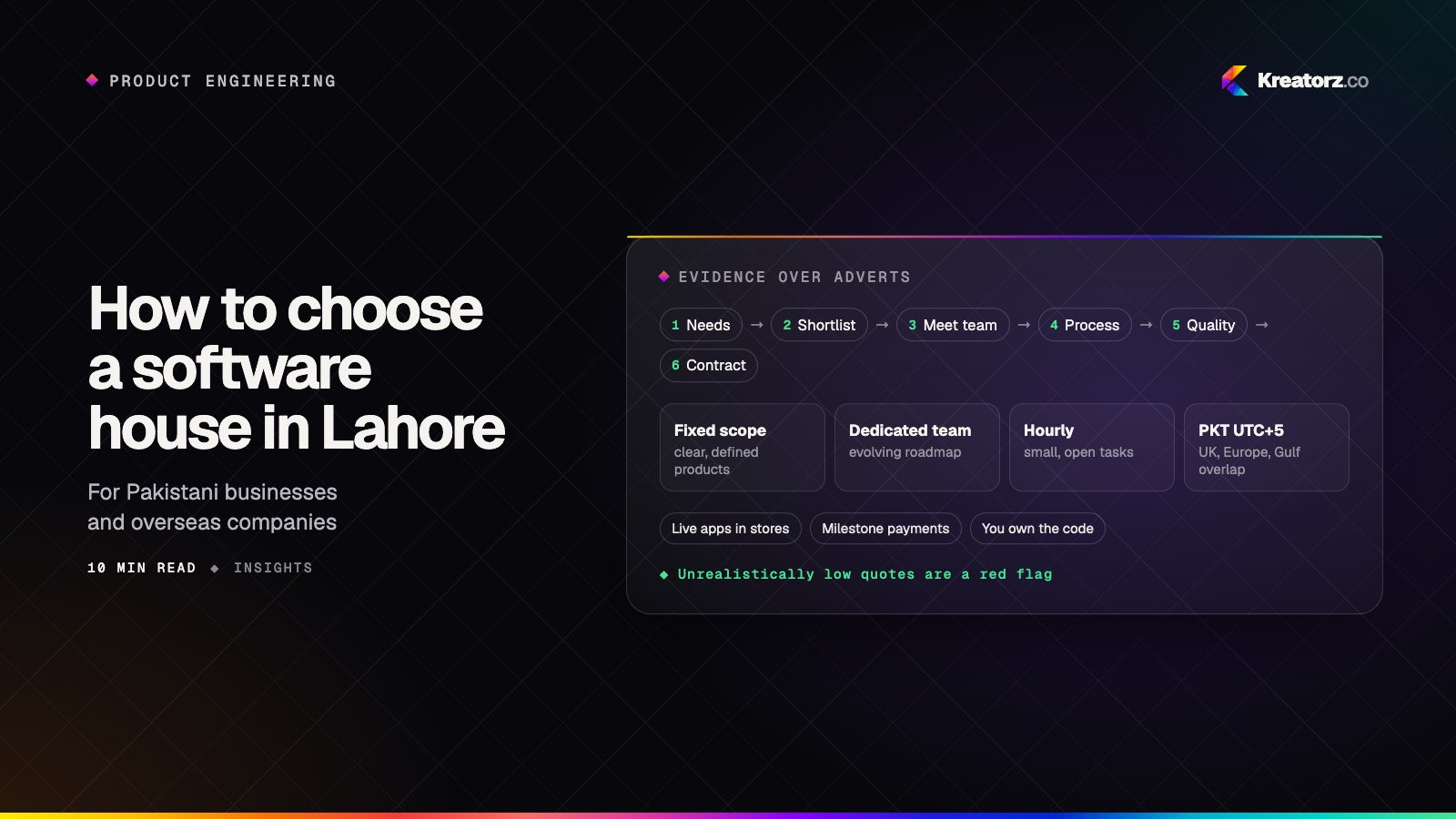
How to choose a software house in Lahore: a step-by-step guide
Whether you are a Pakistani business or an overseas company hiring a team in Pakistan, here is a practical, step-by-step way to choose a software house in Lahore for your app, custom software, SaaS or AI product, plus the red flags and questions that separate strong teams from risky ones.
17 November 2026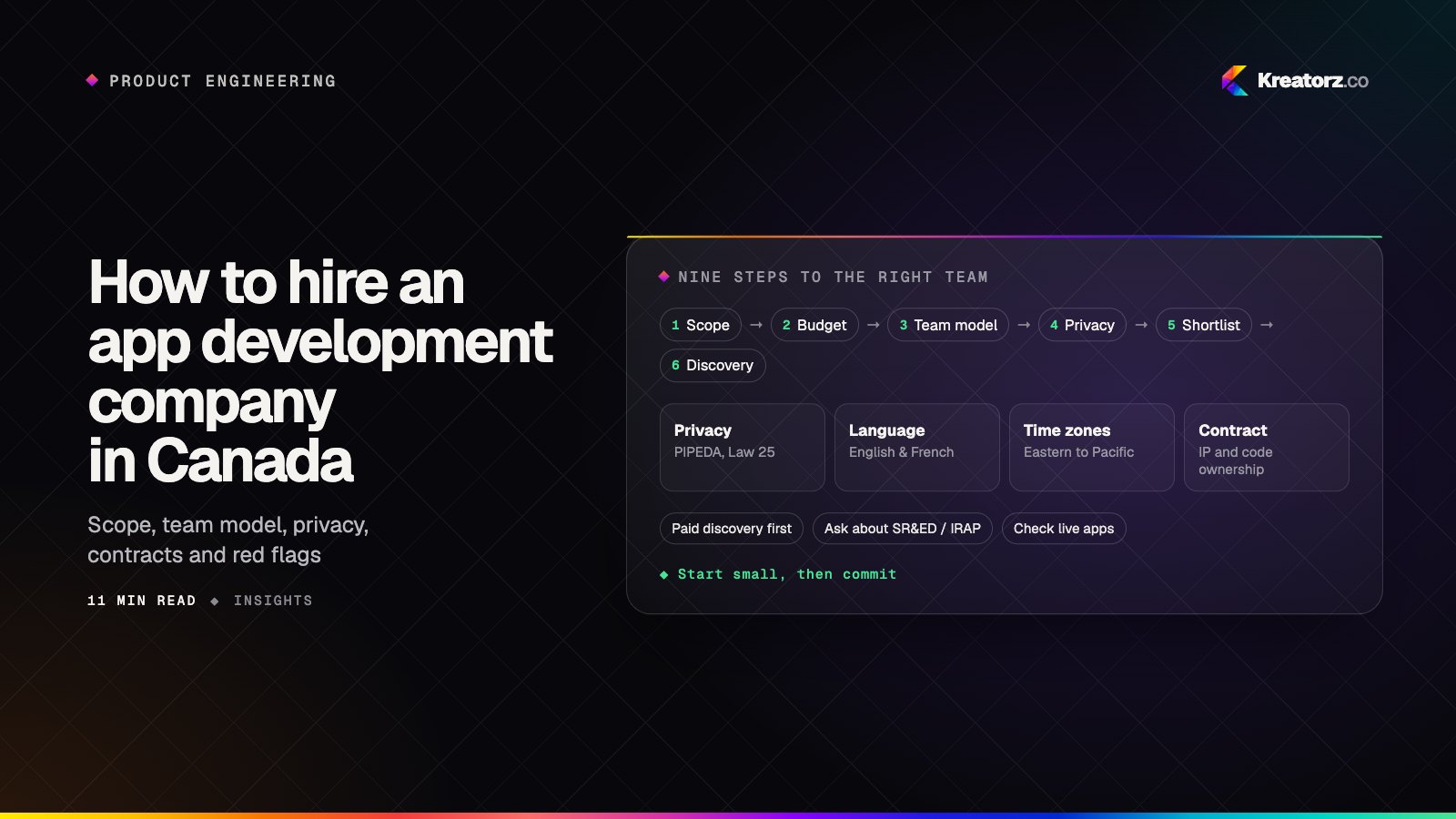
How to hire an app development company in Canada: a step-by-step guide
Hiring a team to build your mobile app, SaaS platform or AI product is a big decision. Here is a practical, step-by-step process for Canadian founders and businesses, from scoping and team models to privacy, contracts, IP and the red flags worth walking away from.
17 November 2026