AI app builders vs hiring a development team: which should you use?
AI app builders such as Lovable, Bolt, Base44 and Replit can turn a prompt into a working app in an afternoon. That is a real change for founders and teams. But a generated prototype and a product people trust with their data are not the same thing. Here is what these tools do well, where they fall short and how to combine them with a development team.
Short answer
Use an AI app builder to validate an idea, build a clickable prototype or create a simple internal tool quickly. Hire a development team when the product needs a complex backend, real security, sensitive data, integrations, scale or long-term maintenance. Many teams do both: prototype with a builder, then rebuild and harden the parts that matter with engineers.
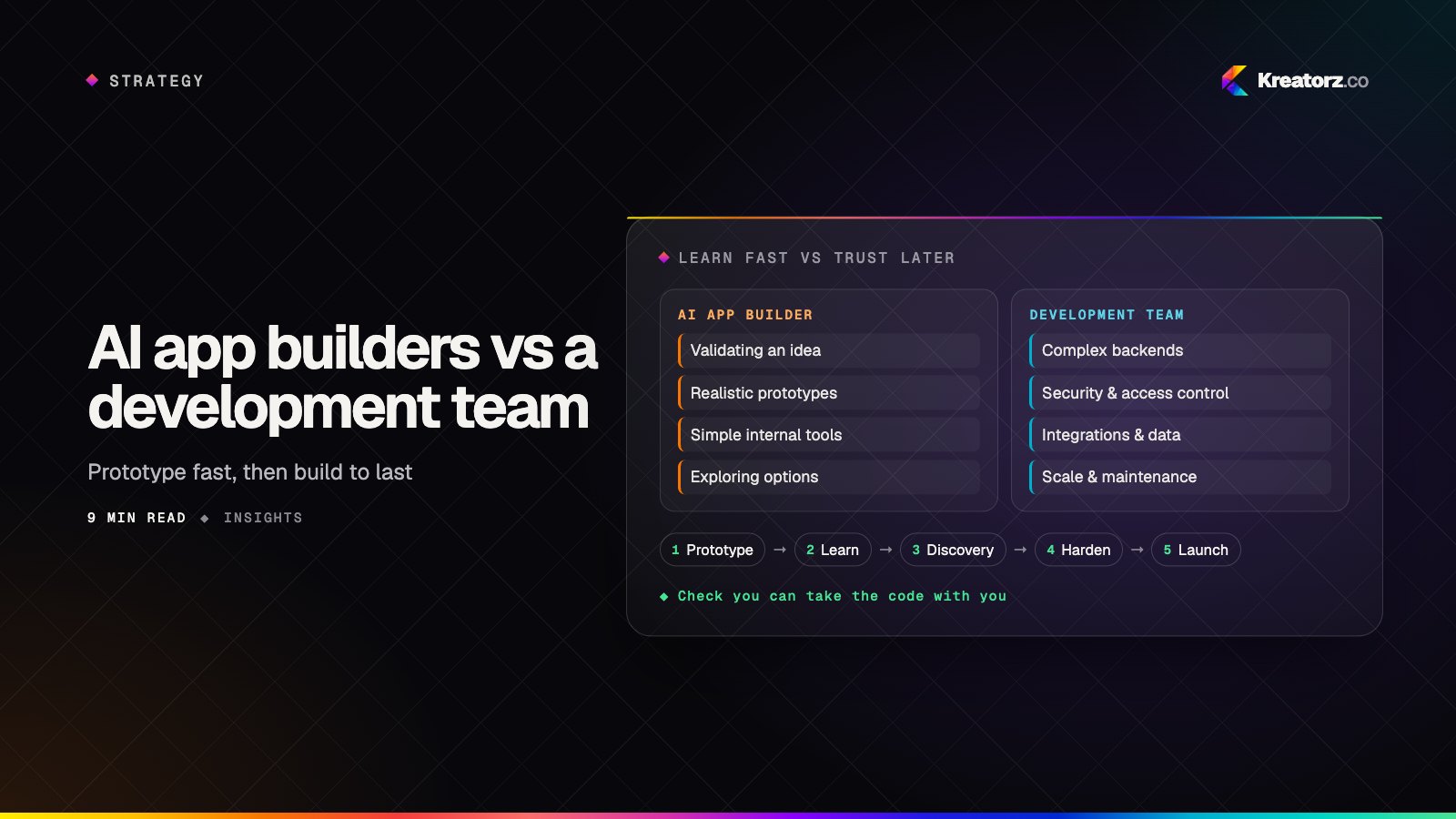
A new generation of AI app builders lets you describe an app in plain English and watch it appear. Tools such as Lovable, Bolt, Base44 and Replit generate screens, data models and working code from a prompt, then let you refine the result by chatting. For a founder with an idea and no engineers, that can feel like the end of the old question of whether to hire a team.
It isn't quite. These tools are genuinely useful, and we recommend them for the right jobs. But the distance between "it works on my screen" and "customers rely on it every day" is where most of the effort in software lives. This guide explains what AI app builders do well, where they fall short and how to decide between a builder, a development team or a mix of both.
What AI app builders are
AI app builders are platforms that combine a large language model with a hosted development environment. You describe what you want, the tool writes the code, runs it in a preview and deploys it with a click. Most of them:
- Generate a web app front end from a prompt, often with a modern component library
- Create a database and basic sign-in, frequently by connecting to a hosted backend service
- Let you iterate by chatting ("add a settings page", "make the table sortable")
- Host the app for you, or let you export or sync the code to a repository
- Charge a subscription, usually with usage limits or credits tied to how much you generate
They differ in how much code they show you, how easily you can export it and which backend services they connect to, and they change quickly. Check the current features and terms of any tool before you commit to it.
What AI app builders do well
Used for the right job, these tools save real time and money.
- Validating an idea. You can put a working version in front of potential customers in days instead of weeks and learn whether the problem is worth solving.
- Clickable, realistic prototypes. A prototype that runs on real data is far more convincing to investors, stakeholders and test users than a slide deck or static mockups.
- Simple internal tools. A dashboard over a spreadsheet, an intake form, a tracker for a small team: low-risk tools with a handful of users are a natural fit.
- Exploring options. Trying three layouts or flows before choosing one is cheap when generation takes minutes.
- Clarifying requirements. A working prototype is often a better brief for a development team than a long document, because everyone can see and click the same thing.
If your goal is to learn, an AI builder is often the fastest and least expensive way to get there. Our guide to going from idea to MVP covers how to choose the riskiest assumption to test first.
Where AI app builders fall short
The limits show up when an app has to be reliable, secure and maintained by someone who understands it.
Complex backends and business logic
Builders are strongest at screens and simple create, read, update and delete operations. Real products have rules: pricing that depends on several factors, approval workflows, scheduled jobs, background processing, multi-step transactions that must either fully succeed or fully roll back. Generated code can attempt these, but each new prompt can quietly change behavior somewhere else, and there is often no test suite to catch it.
Security and access control
The most common problems we see in generated apps are about who can see what. Access rules may be enforced only in the browser, database permissions may be too open, secrets may end up in front-end code, and input validation may be missing. This is not a hypothetical risk. In 2025 a flaw in how Lovable-generated apps set up database row-level security was published as CVE-2025-48757: on affected sites, unauthenticated visitors could read or write database tables. None of this is visible in a demo, and all of it matters the moment real users and real data arrive. If you handle personal, financial or health information, a professional security review is not optional.
Data and integrations
Connecting to payment providers, CRMs, ERPs, calendars, maps or legacy systems means handling authentication, retries, webhooks, rate limits and failures. Builders can wire up a happy path, but production integrations live or die on the unhappy paths: the payment that fails halfway, the webhook that arrives twice, the API that times out.
Scale and performance
An app that is quick with ten users can slow down badly with ten thousand if queries, indexes and caching were never designed. Generated code rarely considers data volume, concurrency or cost per user.
Ownership and lock-in
Some platforms let you export clean code; others keep you tied to their hosting, their backend service or their way of structuring a project. Before you build anything you plan to keep, check whether you can take the code, the data and the infrastructure with you, and what it would take to run it elsewhere. Ownership of the tools themselves also changes: Base44, for example, was acquired by Wix in June 2025. A platform's pricing, terms and roadmap can shift after a deal like that.
Maintenance
Software needs ongoing care: dependency updates, security patches, browser and platform changes, bug fixes and new features. Maintaining a large codebase that nobody designed, and that the original author cannot explain, gets harder with every change.
AI app builder vs development team at a glance
| AI app builder | Development team | |
|---|---|---|
| Best for | Prototypes, idea validation, simple internal tools | Products customers depend on, complex or regulated systems |
| Speed to a first version | Very fast, often hours or days | Slower to start, often weeks for a first release |
| Backend and business logic | Basic to moderate | Designed for your rules and edge cases |
| Security | Depends on what you know to ask for | Designed, reviewed and tested |
| Integrations | Simple, happy-path connections | Production-grade with error handling |
| Scale | Limited unless re-engineered | Planned for growth |
| Code ownership | Varies by platform | You own the repository, cloud accounts and IP |
| Ongoing cost shape | Subscription and usage credits | Team time for build and maintenance |
How cost thinking differs
People often ask how much it costs to build an app with AI. The honest answer is that AI changes the shape of the cost more than it removes it.
With an AI app builder, the visible cost is a subscription plus usage, which is usually low. The hidden costs are your own time spent prompting and debugging, the rework when the app outgrows the tool and the risk of a security or data problem after launch. For a prototype, those hidden costs are small and the trade is excellent. For a product with paying customers, they can become the biggest line item.
With a development team, cost is team size × number of weeks, driven by scope, integrations, design depth, compliance and platforms. It is a higher upfront investment, but you are paying for architecture, testing, security and a codebase people understand. Our guide to how much it costs to build an app explains the drivers and how to estimate them.
It is also worth knowing that professional teams use AI too. Experienced engineers increasingly work with AI coding agents to move faster on routine code, while keeping design, review and testing in human hands. We describe how that works in building software with AI coding agents. The real choice is not "AI or people" but how much engineering judgment surrounds the AI.
The hybrid path: prototype, then harden
For many founders the best route uses both:
- Prototype with a builder. Build the core flow quickly and put it in front of real users. Keep it focused on the question you need answered.
- Learn and decide. If people use it and the idea holds up, write down what worked, what didn't and what the product needs next.
- Bring in a team for discovery. Engineers review the prototype, map the data model, identify security gaps and decide what can be kept and what should be rebuilt.
- Rebuild or harden the foundation. Usually the backend, data model, authentication and integrations are rebuilt properly, while the validated user flows and design carry over.
- Launch and maintain. Add tests, monitoring and a release process so the product can keep improving safely.
This path keeps early spending low while you are still learning, and moves to professional engineering at the point where reliability starts to matter. It also gives the development team a much clearer brief than a written spec alone.
When to use which
An AI app builder is a good fit when:
- You are testing whether an idea is worth pursuing
- The app is an internal tool with a few trusted users
- The data is not sensitive and mistakes are cheap to fix
- You need something to show investors or stakeholders quickly
A development team is a better fit when:
- Customers will pay for the product or depend on it daily
- You handle personal, financial, health or children's data
- The product needs payments, complex workflows or several integrations
- You need native mobile apps, offline support or real-time features
- You expect to grow, raise funding or sell the company, where code ownership and quality will be examined
For a broader look at the spectrum of options, see our comparison of no-code, low-code and custom development.
A builder shortens the path to a first version, but it does not remove the work of making software secure, reliable and maintainable, so decide which of those your product needs before you pick a route. If you already have a generated prototype and want to know what to keep, our MVP development team can review it with you.
Frequently asked questions
Can I build a real app with Lovable, Bolt or Base44?
Yes, you can build working apps with these tools, and many people use them for prototypes and internal tools. For a product with paying customers, sensitive data, complex logic or integrations, you will usually need engineers to review security, design the backend properly and maintain the code over time.
Is an AI app builder cheaper than hiring developers?
For a prototype or simple internal tool, usually yes. Each vendor publishes its plans and credit limits on its own pricing page, and they change often, so compare them on the day you sign up. For a product that needs to be secure, scalable and maintained, the comparison changes: rebuilding a generated app later, or fixing a security problem after launch, can cost more than building the foundation properly in the first place.
Are apps made with AI app builders secure?
They can be, but security depends on what was asked for and checked. Many builders connect to a hosted Postgres backend such as Supabase, where access control relies on row-level security policies being enabled and written correctly for every table. Check those policies, and look for secrets in front-end code, before real users or sensitive data arrive.
- MVP developmentWe help founders turn an idea into a focused, production-quality minimum viable product — scoped to test what matters, built to scale when the answer is yes.Explore
- AI app developmentWe design, build and run AI-powered apps — assistants, copilots, knowledge tools, vision and voice features — that solve a measurable problem and hold up in production.Explore
- Custom software developmentWe design and build web platforms, internal tools, customer portals, mobile apps and AI-powered systems that fit your business — instead of bending your business to…Explore


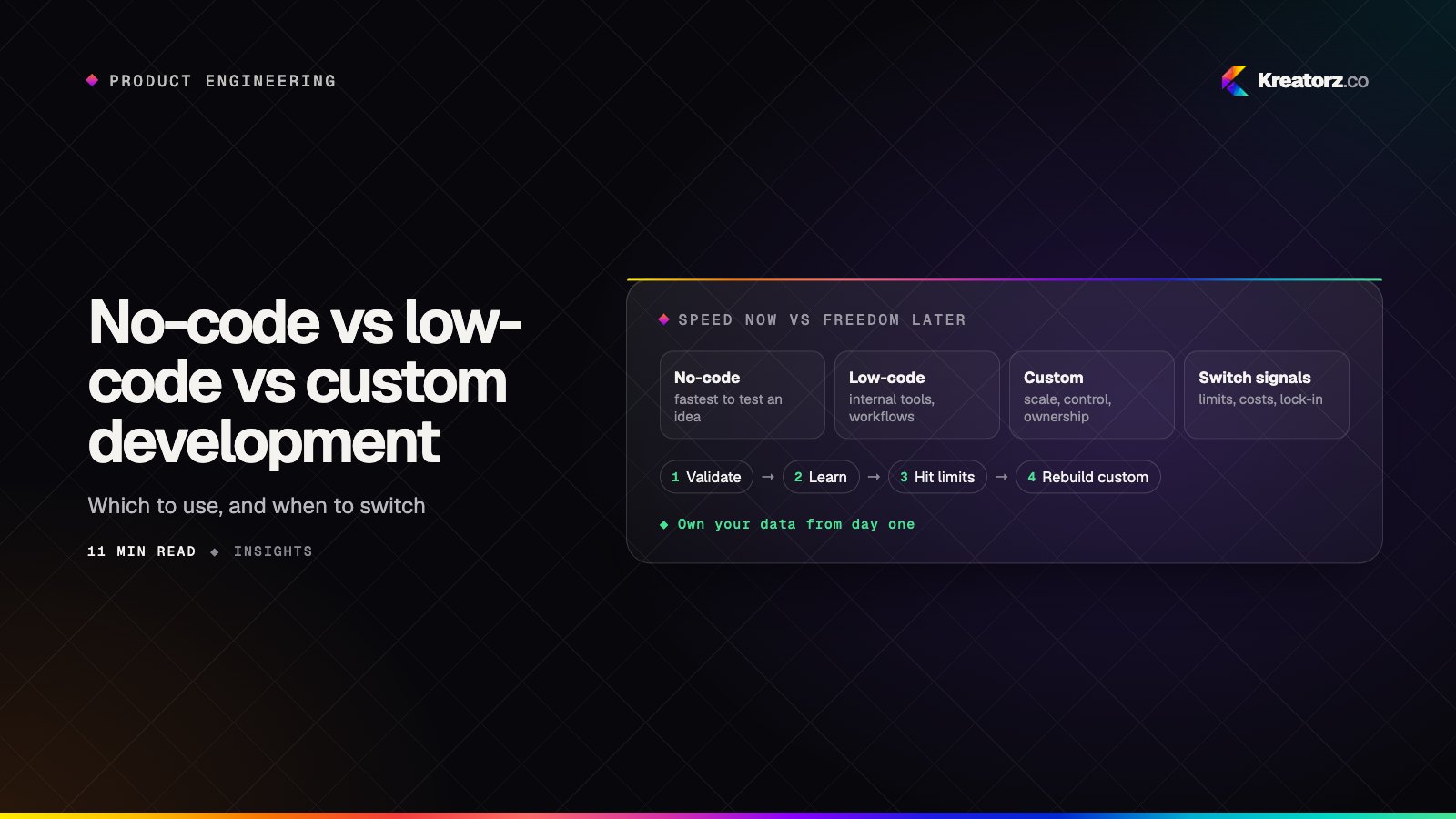
No-code vs low-code vs custom development: which should you use to build your app?
No-code builders, low-code platforms and custom code can all produce a working app, but they trade speed for control in very different ways. Here is how the three compare on cost, flexibility, scale, integrations, security and ownership, where each one genuinely wins, the hidden limits to watch for, and when to move from no-code to custom.
21 November 2026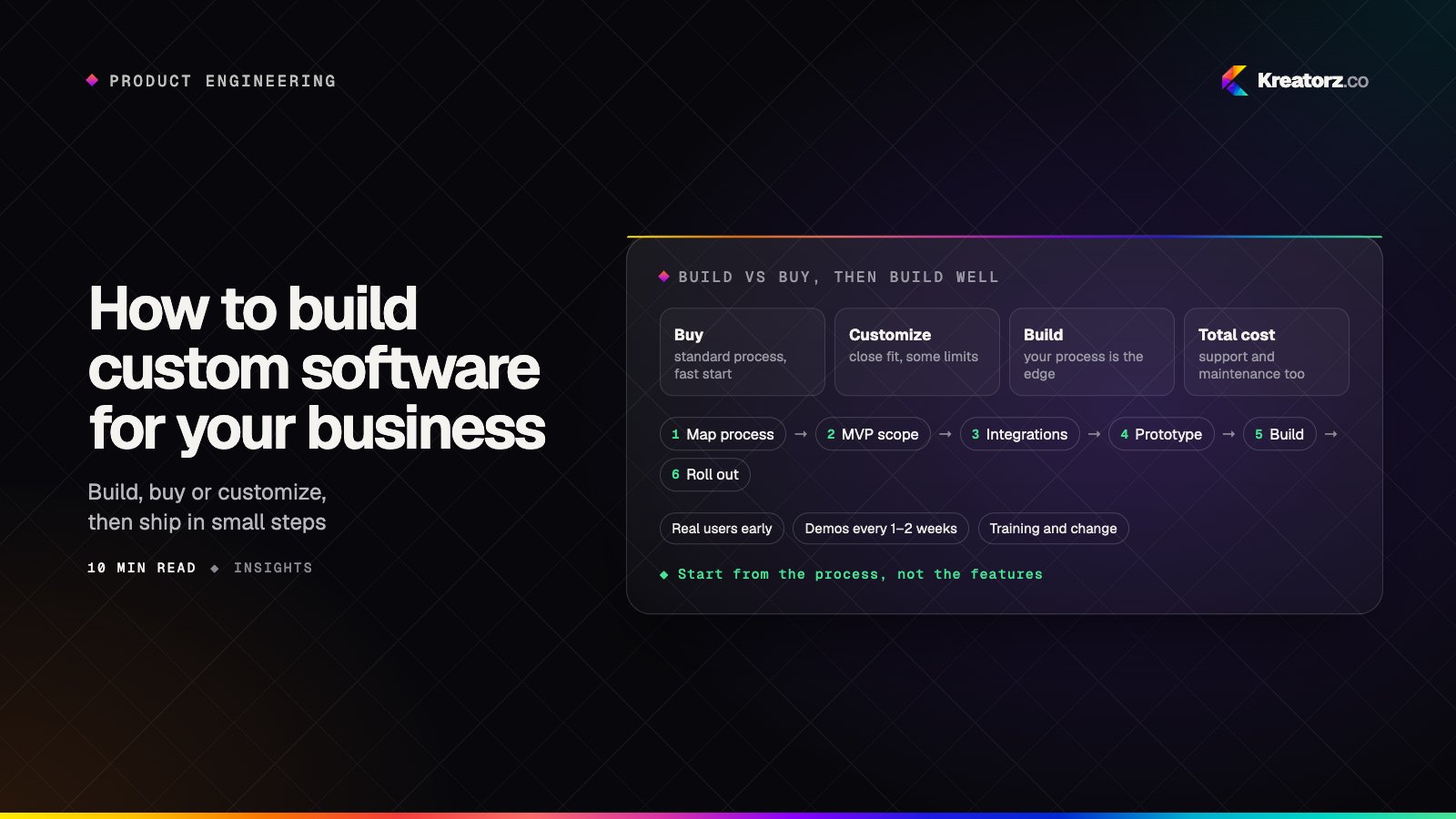
How to build custom software for your business: a step-by-step guide
Custom software can remove the spreadsheets, re-keying and workarounds that slow a business down, but only if it is planned around real processes and real users. Here is a practical way to decide whether to build, scope a first release, roll it out and keep the system healthy after launch.
18 November 2026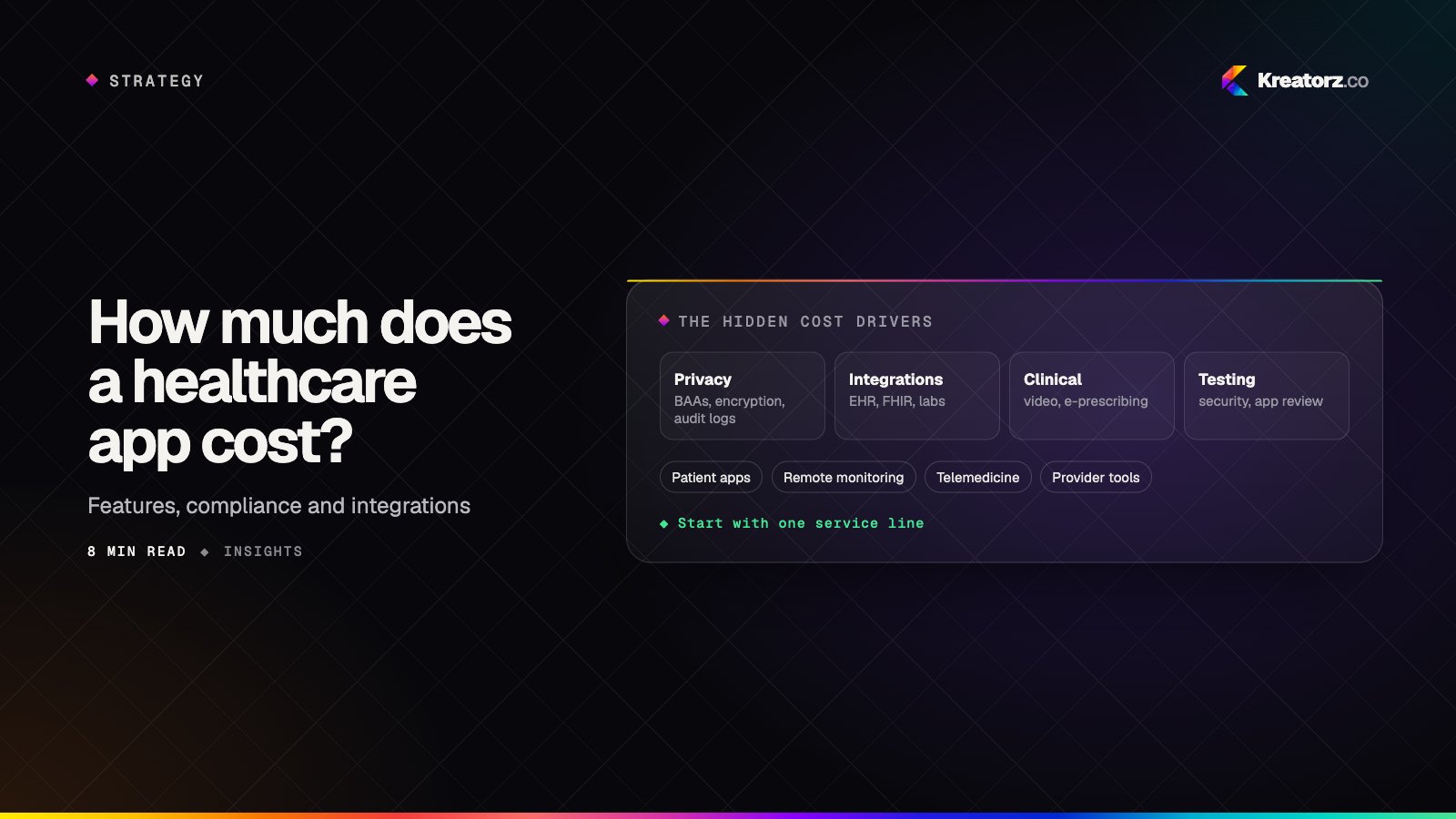
How much does it cost to build a healthcare app? A practical guide
Healthcare apps cost more than ordinary apps of the same size because privacy, security, integrations and clinical workflows add real engineering work. Here is what drives healthcare and telemedicine app development cost, from HIPAA safeguards and EHR integrations to video, e-prescribing, testing and ongoing costs, and how to start with an MVP.
26 November 2026