
How to build software with AI coding agents without losing quality
AI coding agents can now write large amounts of code and run multi-step tasks in parallel. The hard part has moved to verification, review and security. Here is a step-by-step guide for CTOs, founders and product leaders who want the speed without the hidden cost.
Short answer
To build software with AI coding agents without losing quality, delegate in proportion to how cheaply you can verify the result, and keep humans leading architecture, security and product decisions. Set up the repository with an instructions file and CI, keep tasks small, make tests the contract, review every diff like a senior engineer, sandbox agents and measure outcomes.
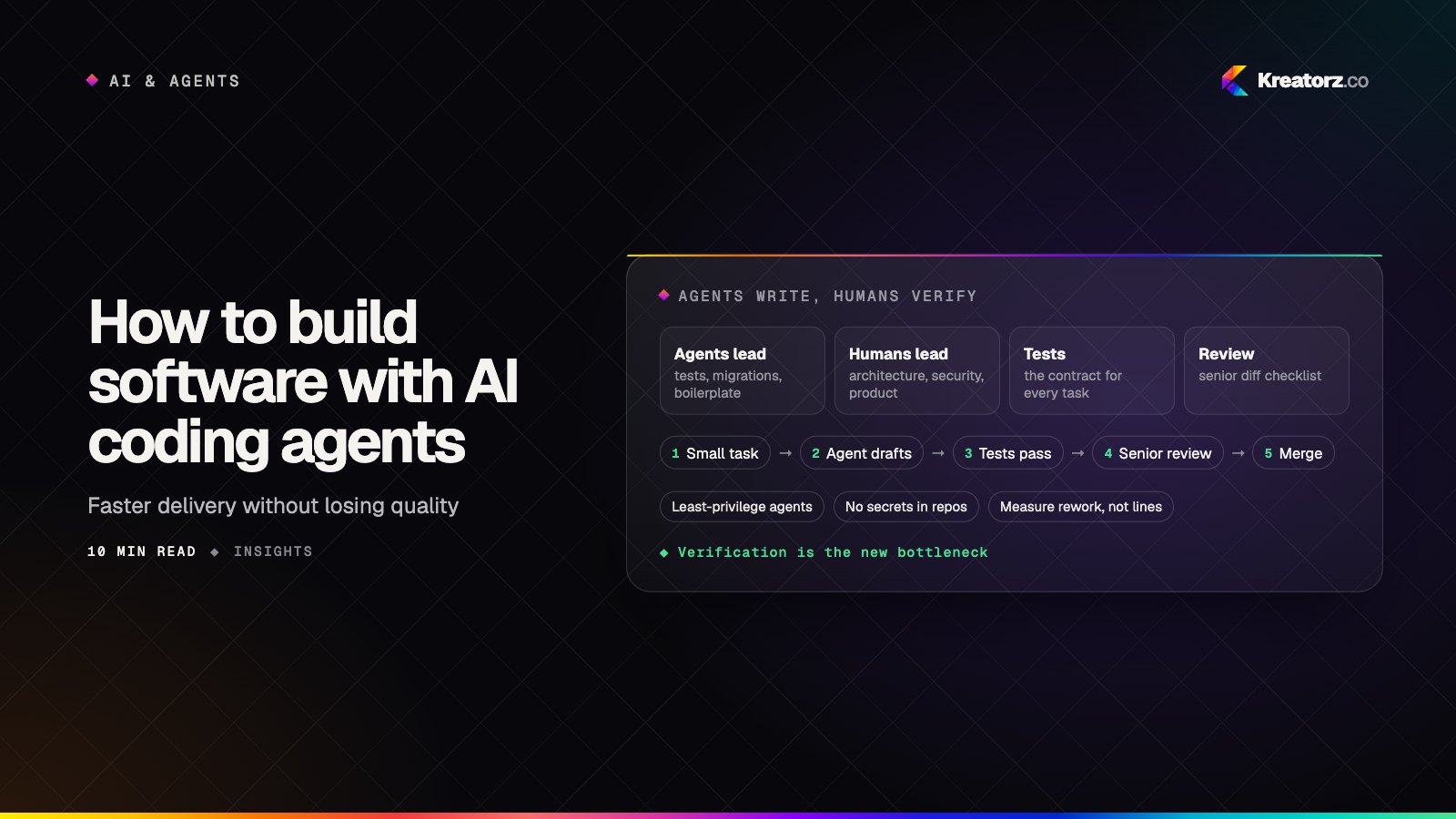
AI coding agents can now read a codebase, plan a change, edit a dozen files, run the tests and open a pull request, and several can work on separate tasks at once. Writing code is no longer the slow part.
That is exactly why quality is at risk. When code arrives faster than people can understand it, the bottleneck moves to verification, review and security. Teams that treat agents as a typing accelerator get bigger diffs and later bugs. Teams that treat agentic software development as a change to their engineering system — how work is scoped, tested, reviewed and secured — get the speed and keep the quality.
This guide is for CTOs, founders and product leaders who want the second outcome, whichever tools your team uses. If you are building an agent into your own product rather than using agents to build software, read our guide on how to build an AI agent for your business instead.
Step 1: Decide where agents help and where humans lead
Not every task is a good fit for delegation. The useful question is not "can the agent do this?" but "can we cheaply verify that it did this correctly?"
| Work type | Agent role | Human role |
|---|---|---|
| Boilerplate, CRUD endpoints, forms | Writes it end to end | Spot-checks against conventions |
| Tests for existing behavior | Drafts broad coverage | Reviews the assertions first |
| Migrations and dependency upgrades | Does the mechanical edits across many files | Plans the rollout and rollback |
| Refactors with good test coverage | Executes the change | Defines the target shape and checks the boundaries |
| Architecture and data models | Suggests options, explores trade-offs | Makes the decision and owns it |
| Authentication, payments, permissions, cryptography | Assists under close supervision | Leads, writes or line-reviews every change |
| Product decisions and UX trade-offs | Generates variants to compare | Chooses, based on users and strategy |
Agents are strongest where the work is well specified and the result is easy to check. Humans need to lead where a subtle mistake is costly, or where the right answer depends on context the agent lacks — your customers, your roadmap, your risk appetite.
Step 2: Set up the repository for agents
A repository that confuses a new hire confuses an agent, which fills the gaps with guesses. The same investments help both.
- Write an instructions file. Many teams now keep a file such as
AGENTS.mdat the repository root (and sometimes per package) that explains how to build, test and lint the project, which patterns to follow, which directories are off limits and what "done" means. Keep it short and current, and review changes to it like code. - Make conventions explicit and enforced. Formatters, linters and type checks catch style drift automatically, so reviewers do not have to.
- Make the test suite fast and reliable. Agents iterate by running tests. Slow or flaky suites teach everyone to ignore them.
- Run CI on every change. Build, lint, type-check, test and scan on every pull request, whoever opened it.
- Keep modules small and boundaries clear. Tangled legacy code is where agents make their most confident mistakes; if that describes your system, our article on modernizing legacy software is a sensible first read.
Step 3: Keep tasks small and reviewable
The biggest quality risk with AI-assisted software development is not bad code; it is unreviewable code. A diff touching forty files gets skimmed, not reviewed.
Break work down as a strong tech lead would:
- One intent per task. "Add pagination to the orders endpoint" is a task. "Improve the orders module" is not.
- Write acceptance criteria up front. State expected behavior and edge cases. This doubles as the agent's prompt and the reviewer's checklist.
- Cap the diff size. Agree a soft limit per pull request; split work that exceeds it.
- Separate mechanical from behavioral changes. A rename across the codebase and a logic change should never share a pull request.
- Run parallel agents on independent work only. Two agents editing the same module produce conflicts and inconsistent designs.
Step 4: Make tests the contract
When an agent writes both code and tests, the tests may simply confirm whatever the code does. Make tests the contract between your team and the agent.
- Every behavioral change must add or update tests. Put it in your instructions file and check it in review.
- Review tests first. Before reading the implementation, read the tests and ask: do these assertions describe the behavior we actually want, including edge cases and failure paths?
- Write the key tests yourself for critical paths. For security-sensitive or business-critical behavior, have a human write or specify the tests, then let the agent make them pass.
- Watch for weakened tests. Agents chasing a green build sometimes loosen assertions, add skips or mock away the thing being tested.
- Go beyond unit tests where it matters. Integration, API contract and a few end-to-end tests catch problems between components, where generated code often goes wrong.
Step 5: Review like a senior engineer
Reviewing agent-written code is a different skill from reviewing a colleague's. The code is usually clean and confident, which makes problems easier to miss.
Diff review checklist for agent-written changes:
- Intent: Does the change do what the task asked, and only that? Look for unrequested "improvements" and scope creep.
- Tests: Were tests added or updated, and do they assert meaningful behavior? Were any tests removed, skipped or weakened?
- Correctness at the edges: Empty inputs, nulls, time zones, concurrency, retries, large data sets and error handling.
- Consistency: Does it reuse existing helpers and patterns, or introduce a parallel way of doing the same thing?
- Dependencies: Were new packages added? Are they necessary, maintained and correctly named?
- Security: Input validation, authorization checks, injection risks, logging of sensitive data and any hard-coded values.
- Data and migrations: Are schema changes reversible and safe to run on production data?
- Readability: Could someone on the team maintain this in six months without the agent's help?
Two habits help: ask reviewers to explain the change in their own words before approving, and rotate review of agent-heavy areas so codebase knowledge stays spread across the team.
Step 6: Secure the agent, the repo and the supply chain
Coding agents read files, run commands and sometimes reach the network, so treat them like any automated system with access to your code. Our broader guide to securing AI products covers the underlying threats; here is how they apply to development workflows.
- Keep secrets out of repositories. API keys, database passwords and tokens belong in a secrets manager, never in code, config files or instructions files. Run secret scanning in CI and pre-commit hooks.
- Grant least-privilege permissions. Give agents only the access a task needs: read-write to the working branch, not admin on the repository; test credentials, not production ones. Require human approval for pushes to protected branches, deployments and anything that touches infrastructure.
- Sandbox execution. Run agents in isolated environments such as containers or disposable development machines, with restricted network access and no standing access to production systems.
- Check dependencies and the supply chain. Agents can suggest packages that are unmaintained or confusingly similar to legitimate ones. Use lockfiles, dependency and license scanning, and review every new dependency by hand.
- Treat repository content as data, not instructions. This is the risk most teams miss. README files, comments, issues and third-party code can all contain text written to manipulate an agent, such as an instruction to disable a check or send data somewhere. This is prompt injection through the repository. Treat only your reviewed instructions file as authoritative, be careful with agents that read external issues or pull requests, and rely on permissions and sandboxing so a manipulated agent cannot do serious damage.
- Keep an audit trail. Log what agents ran and changed, and label agent-authored commits or pull requests so you can trace issues back later.
Step 7: Measure outcomes, not lines of code
Lines of code, pull request counts and "percentage of code written by AI" all rise with agents, whether or not your software improves. Measure outcomes instead:
- Cycle time: how long from starting a task to it running in production.
- Defect rate: bugs found after release, and especially escaped defects in critical paths.
- Rework: how often recent changes are reverted, patched or rewritten shortly after merging.
- Review load: how long pull requests wait for review and how large they are. If this climbs, review is your constraint.
- Change failure rate and recovery time: how often deployments cause incidents and how quickly you recover.
Take a baseline before rolling agents out widely. If cycle time drops but rework rises, you have moved the cost downstream, not removed it.
Step 8: Evolve team skills and roles
Agents change what good engineers spend their time on:
- More time specifying and reviewing, less time typing.
- Senior judgment matters more, not less. Architecture, security and spotting subtly wrong code are where experience pays.
- Junior engineers need deliberate growth paths. If agents do the routine work, newer engineers miss practice. Pair them on reviews and give them well-scoped features to own.
- Product and engineering work closer together. Cheap prototypes mean faster decisions about what to keep.
- Someone owns the agent setup. Instructions files, permissions and CI checks need a clear owner.
Step 9: Ask your software development partner how they use AI agents
If an outside team builds your product, their use of AI coding agents directly affects your code, your data and your risk. Any credible AI software development company should answer these questions plainly:
- Ownership and IP: Do we own all the code, including agent-generated code, from day one? How do you handle licenses of generated code and dependencies?
- Confidentiality: Which tools can see our code and data? Are they configured so our code is not retained or used for training? Can we restrict this further?
- Review: Is every change reviewed by a named senior engineer before it merges? What does your review checklist include?
- Testing: What test coverage do you commit to, and how do you stop tests being weakened?
- Security: How are agent permissions, sandboxing and secrets handled? Do agents ever have access to our production systems?
- Accountability: When something breaks, who on your team understands the code well enough to fix it?
For a fuller vendor checklist, see our guide on how to choose a software development company in the USA.
Putting it together
The gains from AI coding agents go to teams with strong engineering discipline. Done well, agentic software development lets a small, senior team move much faster without trading away quality.
Kreatorz builds software this way. We use AI coding agents where they speed up delivery, with senior engineers owning architecture, review and security. One senior, cross-functional team covers the work end to end, from offices in Sheridan, Wyoming (USA), Brantford, Ontario (on Eastern Time) and Lahore, Pakistan. You see weekly demos and you own your code. If you need custom software development or AI agent development, tell us about your project.
Frequently asked questions
How do AI coding agents differ from AI code completion?
Code completion suggests the next few lines while a developer types. AI coding agents take a task, plan the steps, edit multiple files, run commands and tests, and iterate until the task is done or they need help. That autonomy is why they need scoping, tests, permissions and review.
What tasks are AI coding agents best at?
They do best on well-specified work that is easy to verify: boilerplate, writing tests for existing behavior, mechanical migrations and dependency upgrades, refactors backed by good tests, and quick prototypes. Architecture, security-critical code and product decisions should stay human-led, with agents assisting.
How do you keep code quality high when using AI coding agents?
Keep tasks small, require agents to add or update tests, review the tests before the implementation, use a consistent review checklist, and run CI on every change. Measure cycle time, defect rate and rework rather than lines of code, so you notice if quality is slipping.
Is it safe to let AI coding agents access our codebase?
It can be, with the right controls. Keep secrets out of the repository, give agents least-privilege permissions, run them in sandboxed environments, review every new dependency and treat repository content such as comments and issues as untrusted data that could contain prompt injection. Never give agents standing access to production.
What should I ask an AI software development company about its use of AI agents?
Ask who owns agent-generated code, which tools can see your code and data, whether every change is reviewed by a senior engineer, how tests and security are handled, and who is accountable when something breaks.
- Custom software developmentWe design and build web platforms, internal tools, customer portals, mobile apps and AI-powered systems that fit your business — instead of bending your business to…Explore
- AI agent developmentWe build custom AI agents that read, decide and act across your business systems — with clear limits, human approval where it matters and evaluation you can trust.Explore
- SaaS developmentWe design and engineer SaaS platforms — from a focused first release to a multi-tenant product with billing, roles, integrations and the operations to run it.Explore


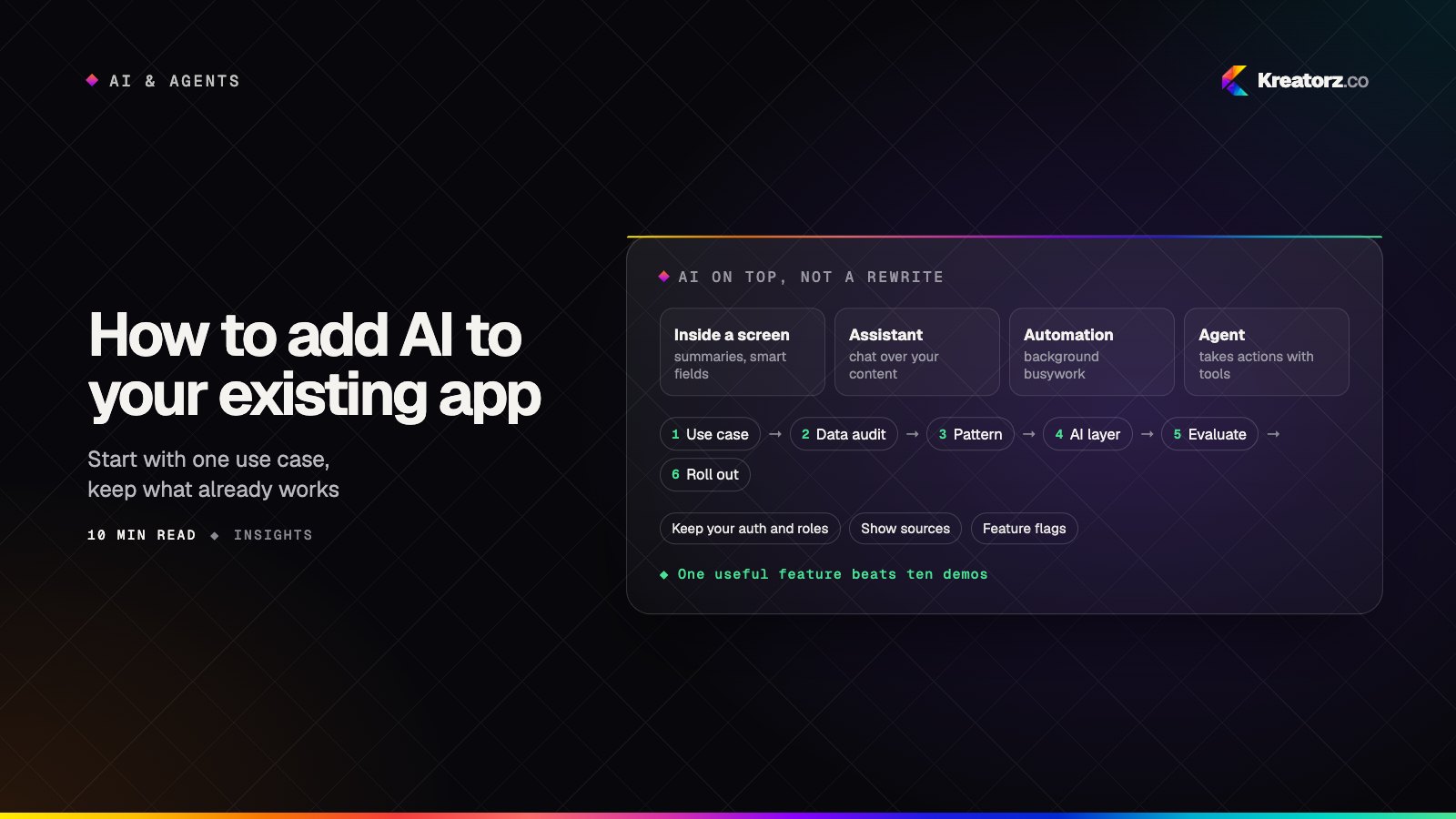
How to add AI to your existing app or software: a step-by-step guide
You do not need to rebuild your product to give it useful AI features. Here is a practical, step-by-step guide to choosing the first use case, auditing your data, picking the right pattern, adding an AI layer without a rewrite, and rolling it out safely.
21 November 2026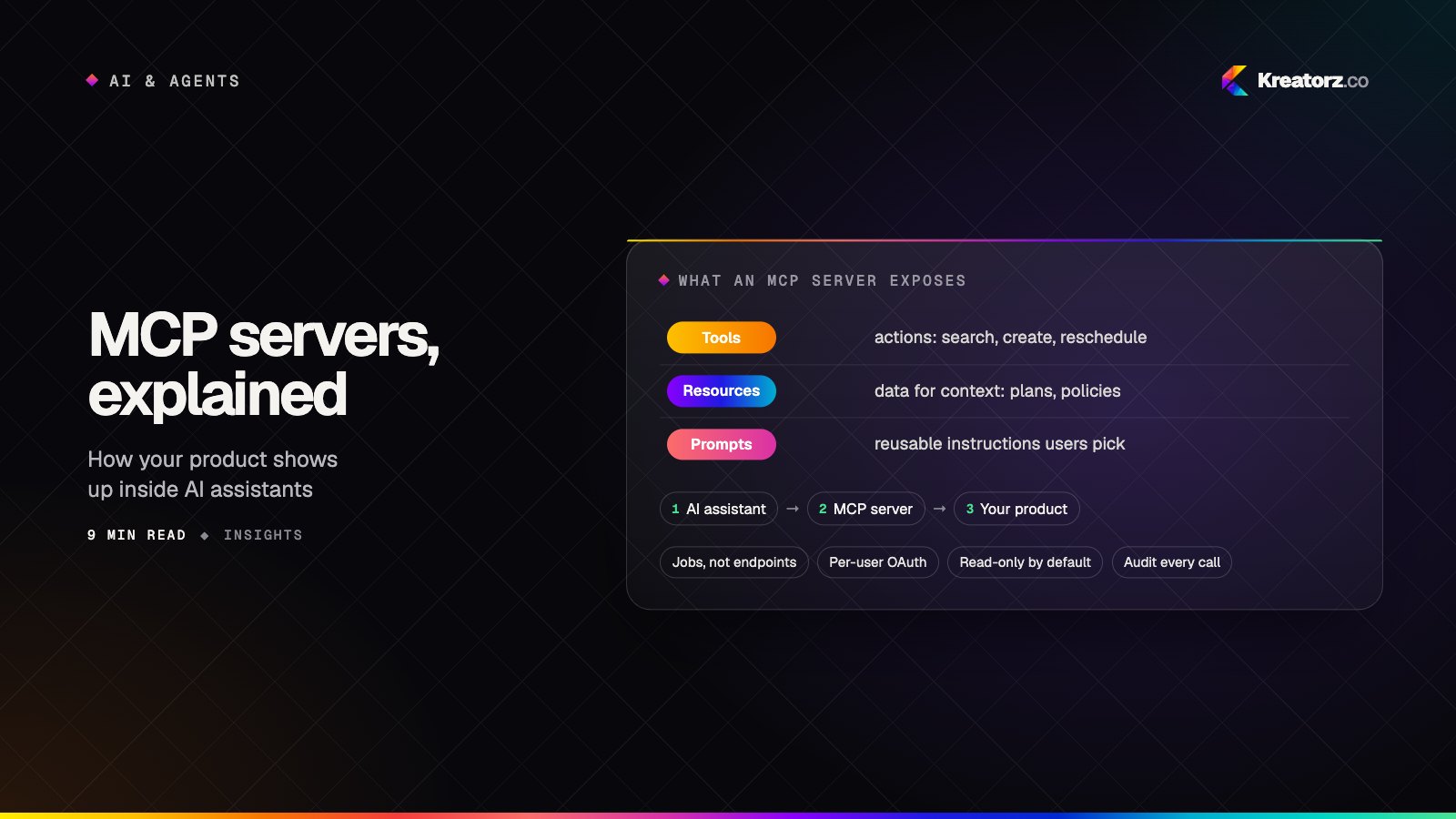
MCP servers explained: why your product needs one for the AI-assistant era
Your customers are starting to work inside AI assistants rather than inside your app. The Model Context Protocol (MCP) is how your product shows up there. Here is what MCP is, what to expose, and how to ship an MCP server that is safe to switch on.
16 November 2026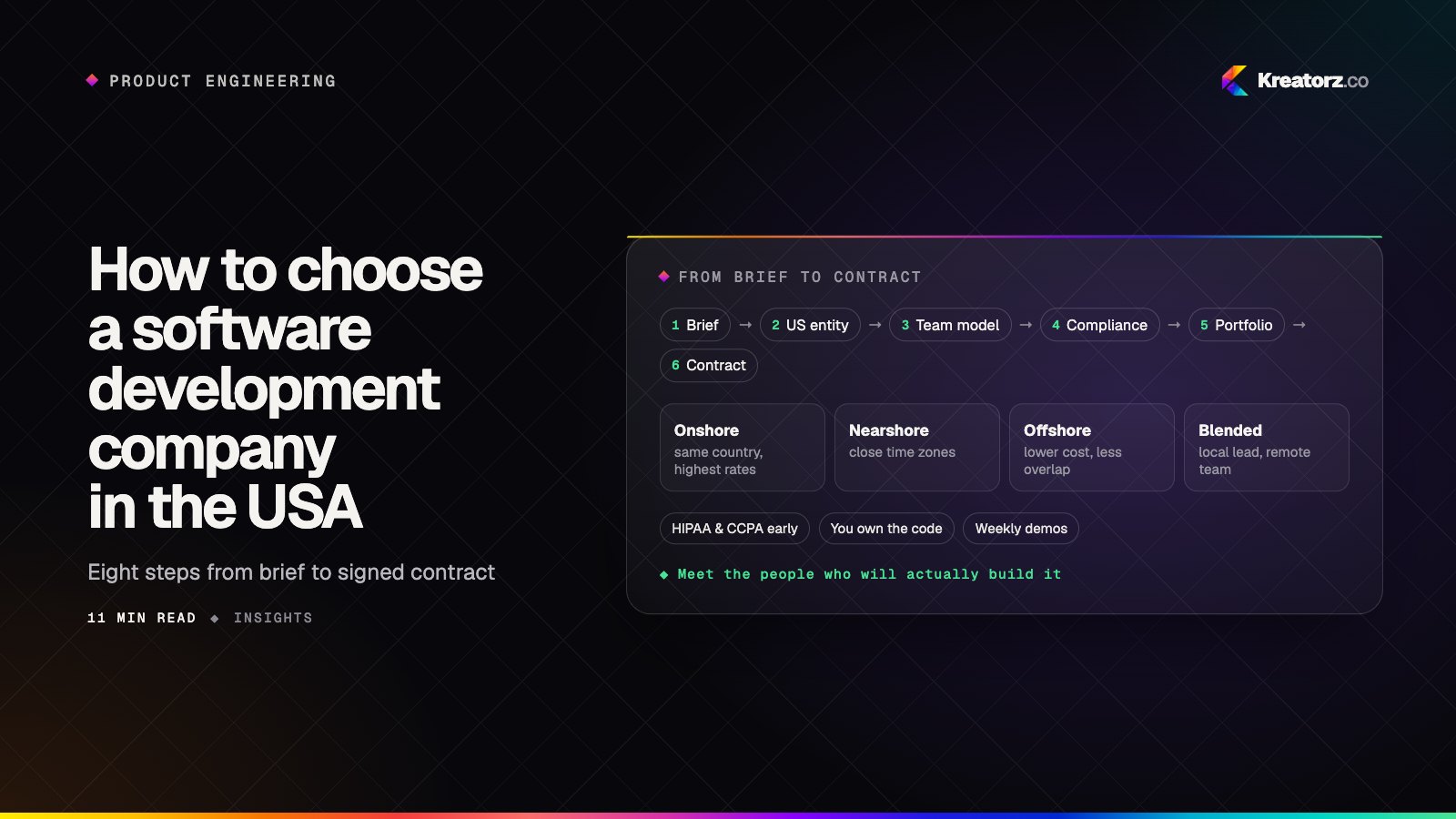
How to choose a software development company in the USA: a step-by-step guide
Hiring a company to build your app, SaaS platform or AI product is a big decision. Here is a practical, step-by-step way for US founders and businesses to compare software development companies, from contracts, time zones and compliance to pricing models, portfolios and red flags.
17 November 2026