AI voice agents for business: where they work, where they fail, and how to launch one
AI voice agents can now hold natural phone conversations, book appointments and resolve requests around the clock. But a voice agent that sounds great in a demo can still frustrate real callers. Here is how to pick the right use case, engineer for latency and trust, and roll one out safely.
Short answer
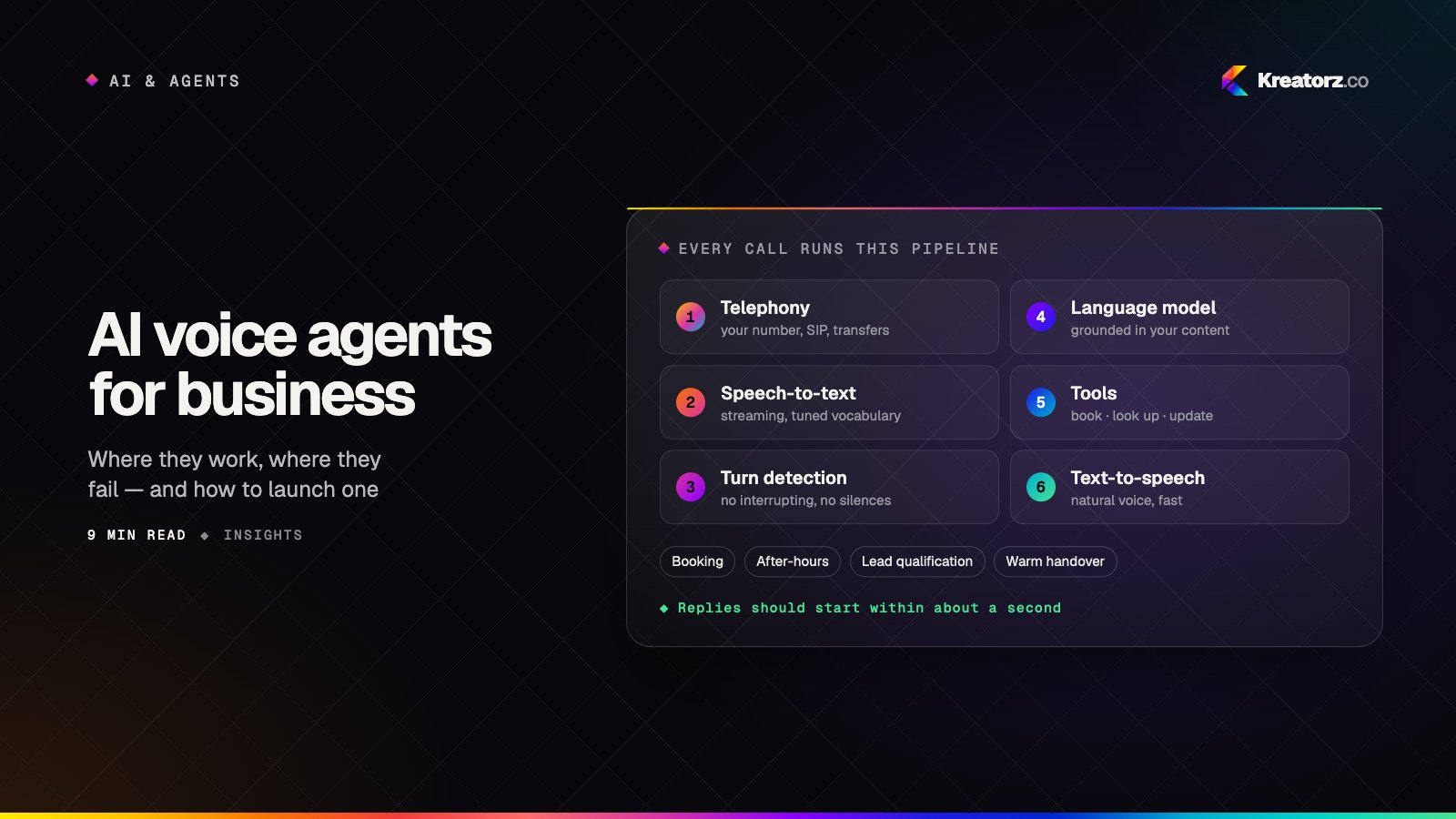
AI voice agents work best on frequent, predictable calls with checkable outcomes, such as appointment booking, after-hours answering, lead qualification and order status, and struggle with emotional, high-stakes or open-ended conversations. To launch, pick one call type, make replies start within about a second, ground answers in your content, disclose the AI, provide a warm handover and expand in stages.
The phone is still where many businesses win or lose customers. A patient calling to book an appointment, a homeowner with a burst pipe, a buyer asking about a listing — they call because they want an answer now. When nobody picks up, many of them simply call the next business on the list.
AI voice agents promise to answer every one of those calls, at any hour, in a natural conversation. Over the last two years the technology has moved from robotic phone menus to agents that understand free-form speech, respond in a natural voice within moments and take real actions in business systems.
But voice is unforgiving. A chatbot that takes three seconds to answer is fine; a phone agent that pauses for three seconds sounds broken. A chatbot that misreads a word can show its working; a voice agent that mishears a date books the wrong appointment. This guide covers what separates voice agents that callers like from the ones they hang up on.
How a voice agent works
Under the hood, a voice agent is a pipeline that runs many times per second during a call:
| Stage | What it does | What can go wrong |
|---|---|---|
| Telephony | Connects the call to your phone number or system | Poor audio, dropped calls, transfer failures |
| Speech-to-text | Turns the caller's speech into text as they talk | Accents, noise, names, numbers and addresses |
| Turn detection | Decides when the caller has finished speaking | Interrupting people, or awkward silences |
| Language model | Understands the request and decides what to say or do | Wrong answers, made-up policies, off-topic drift |
| Tools | Looks up or changes data — calendars, CRM, orders | Slow systems, missing permissions |
| Text-to-speech | Speaks the reply in a natural voice | Robotic tone, mispronounced names |
Newer speech-to-speech models collapse some of these stages into one, which can reduce delay and sound more natural. Pipelines that keep the stages separate give more control over each step — useful when accuracy on names and numbers matters. Many production systems use a mix, and the right choice depends on the use case.
Where voice agents work well today
The best first use cases share three traits: the calls are frequent, the conversations follow a recognizable pattern, and success is easy to check.
- Appointment booking and rescheduling. Clinics, salons, home services and auto repair shops get many calls that end in the same action: find a slot, book it, confirm by text. This is the classic sweet spot.
- After-hours and overflow answering. Instead of voicemail, an agent answers questions, takes structured messages and books callbacks — so no lead waits until morning.
- Lead qualification. An agent can call or answer new inquiries within seconds, ask a handful of qualifying questions, and book a meeting with the right salesperson.
- Order and status questions. "Where's my order?", "Is my car ready?", "Has my claim been received?" — high volume, simple lookups.
- Front-desk routing. Understanding why someone is calling and sending them to the right person with a summary beats a nine-option phone menu.
- Reminders and confirmations. Outbound calls that confirm appointments or collect a simple response, where the rules allow.
Where they still struggle
Being honest about limits is what keeps a launch from becoming a support problem.
- Emotional or high-stakes conversations. Complaints, bereavement, medical concerns, financial hardship. Route these to people, quickly.
- Long, open-ended problem solving. Complex technical support with many branches is better handled by a person, with the agent gathering details first.
- Spelling-heavy data capture. Email addresses, unusual names and long reference numbers are hard over the phone for humans and machines alike. Confirm by text message where possible.
- Noisy environments. Callers on a construction site or a busy road are harder to understand. Good agents ask to repeat rather than guess.
- Anything you cannot verify afterward. If you would not let a new hire do it unsupervised in week one, do not give it to a voice agent in month one.
The engineering that makes calls feel natural
Latency is the product
In conversation, people expect a reply within about a second. Longer pauses feel like the line has dropped. Getting there takes work at every stage: streaming speech recognition that transcribes while the caller talks, fast turn detection, a model that starts speaking before it has finished thinking, quick text-to-speech, and servers close to your telephony provider. When the agent needs to call a slow system, it should say so naturally — "Let me check the calendar for you" — instead of going silent.
Turn-taking and interruptions
Real callers interrupt, change their minds and pause mid-sentence. A good agent stops talking when interrupted, does not jump in during a thinking pause, and recovers gracefully: "Sorry — go ahead." Tuning this is one of the biggest differences between an agent that feels human and one that feels like a machine.
Grounding, so it does not make things up
A voice agent should answer from your content, not from general knowledge. We connect agents to your policies, prices, service lists and FAQs through retrieval, instruct them to say when they do not know, and keep factual answers short and specific. For prices and availability, the agent should look them up live rather than rely on anything it was told in advance.
Real actions, with limits
The agent becomes valuable when it can do things: check availability, book, reschedule, create a ticket, update a CRM record. Each action should be a narrow, well-tested tool with permission checks in code — the same principles behind AI agents in production. The agent reads back what it is about to do ("I'll book you in for Tuesday at 3 p.m. with Dr. Patel — shall I confirm?") before committing.
Names, numbers and dates
These cause most errors. We use speech recognition tuned with your vocabulary (staff names, products, street names), read critical details back for confirmation, and send a text confirmation so callers can catch mistakes.
Warm handover
Every voice agent needs an exit. When a caller asks for a person, gets frustrated, or the conversation goes beyond the agent's scope, it should transfer — passing along a summary so the caller does not have to start again. Measuring how often and why handovers happen is one of the best ways to improve the agent.
Trust, disclosure and compliance
Voice agents talk to the public and handle personal information, so the rules matter. Requirements depend on your country, state and industry, and you should confirm them with your legal advisors, but the main areas are consistent:
- Disclose that callers are speaking with an AI. It is increasingly expected, sometimes required, and it builds trust rather than eroding it. A simple, friendly line at the start works.
- Call recording consent. Many places require telling callers a call is recorded, and some require all parties to consent. Build the notice into the greeting.
- Outbound calling rules. In the US, regulators have made clear that AI-generated voices are covered by the rules on artificial and prerecorded calls, which generally require prior consent for many kinds of outbound calls. Treat outbound AI calling with extra care and get legal sign-off.
- Sensitive data. Health information, payment details and identity data need special handling. For healthcare, design for HIPAA from the start, as we describe in our HIPAA-compliant app guide. Avoid having the agent read or record full card numbers; hand payments to a compliant payment flow instead.
- Security. Callers can attempt to manipulate an agent just as users can with a chatbot. Keep authorization in code, verify identity before discussing account details, and log every action. See securing AI products.
How to measure success
Decide the numbers before launch, and measure against how calls are handled today:
| Metric | What it tells you |
|---|---|
| Answer rate | How many calls are now answered that previously were not |
| Containment rate | Share of calls fully resolved by the agent |
| Task success | Appointments booked, leads qualified, questions answered correctly |
| Handover rate and reasons | Where the agent's scope or quality falls short |
| Caller satisfaction | Short post-call survey or text rating |
| Error rate | Wrong bookings, wrong answers, failed actions — found by reviewing transcripts |
| Cost per resolved call | Telephony, AI usage and maintenance, against staff time saved |
Reviewing a sample of transcripts every week, especially failed or transferred calls, is the single most effective improvement habit. Our guide to measuring the ROI of AI projects covers how to set baselines and compare fairly.
A staged launch plan
- Pick one call type. Booking, or after-hours answering, is usually the best start. Write down what "done" looks like.
- Design the conversation. Greeting, disclosure, the questions to ask, the actions to take, confirmations and the handover path. Decide the voice and personality to match your brand.
- Prototype on a test number. Run it against dozens of realistic scenarios, including difficult ones: accents, background noise, interruptions, unusual requests.
- Launch where risk is lowest. After-hours calls, or a percentage of overflow calls, with transcripts reviewed daily at first.
- Expand deliberately. Add call types, hours and actions one at a time as the metrics hold.
- Keep improving. Update content, tune recognition for new names and products, and adjust prompts based on transcript reviews.
Build or buy?
Off-the-shelf voice agent platforms are a fast way to try a simple receptionist. Custom development makes sense when the agent needs to work with your specific systems, follow complex business rules, meet compliance requirements, or represent your brand precisely — and when you want to own the data, the prompts and the roadmap rather than renting them. Many businesses start with a platform for one use case and move to a custom build as calls become a core part of how they operate.
The bottom line
AI voice agents are ready for real work — when they are pointed at the right calls, engineered for speed and accuracy, connected to your systems with sensible limits, and launched in stages with honest measurement. Done that way, they answer the calls you are missing today and free your team for the conversations that need a person.
If you are considering a voice agent for bookings, support or sales, see our AI voice agent development service or book a free consultation.
Frequently asked questions
What is an AI voice agent?
An AI voice agent is software that holds phone or voice conversations using speech recognition, a language model and natural text-to-speech. It understands what callers say, answers questions, takes actions such as booking appointments, and transfers to a person when needed.
Will callers know they are talking to an AI?
They should. We recommend a short, friendly disclosure at the start of every call. It is increasingly expected and sometimes legally required, and in practice callers respond well when the agent is helpful and transfers easily on request.
How fast does a voice agent need to respond?
Natural conversation leaves little room for delay; replies should start within about a second. That requires streaming speech recognition, fast models and text-to-speech, and infrastructure located close to the telephony provider.
Can a voice agent use our existing phone number and calendar?
Yes. Voice agents connect to existing numbers through telephony providers or SIP, and to calendars, booking systems and CRMs through their APIs, so they can check availability and book in real time.
What is the best first use case for a voice agent?
Usually appointment booking or after-hours answering: frequent, predictable calls with a clear, checkable outcome. Start there, measure results, and expand to other call types once the agent performs well.
- AI voice agent developmentWe build custom AI voice agents that answer and make phone calls, book appointments, qualify leads and resolve support requests in natural conversation — connected to…Explore
- AI agent developmentWe build custom AI agents that read, decide and act across your business systems — with clear limits, human approval where it matters and evaluation you can trust.Explore
- AI chatbot developmentWe build custom AI chatbots and conversational AI assistants — for support, sales, onboarding and internal teams — trained on your content, connected to your systems…Explore


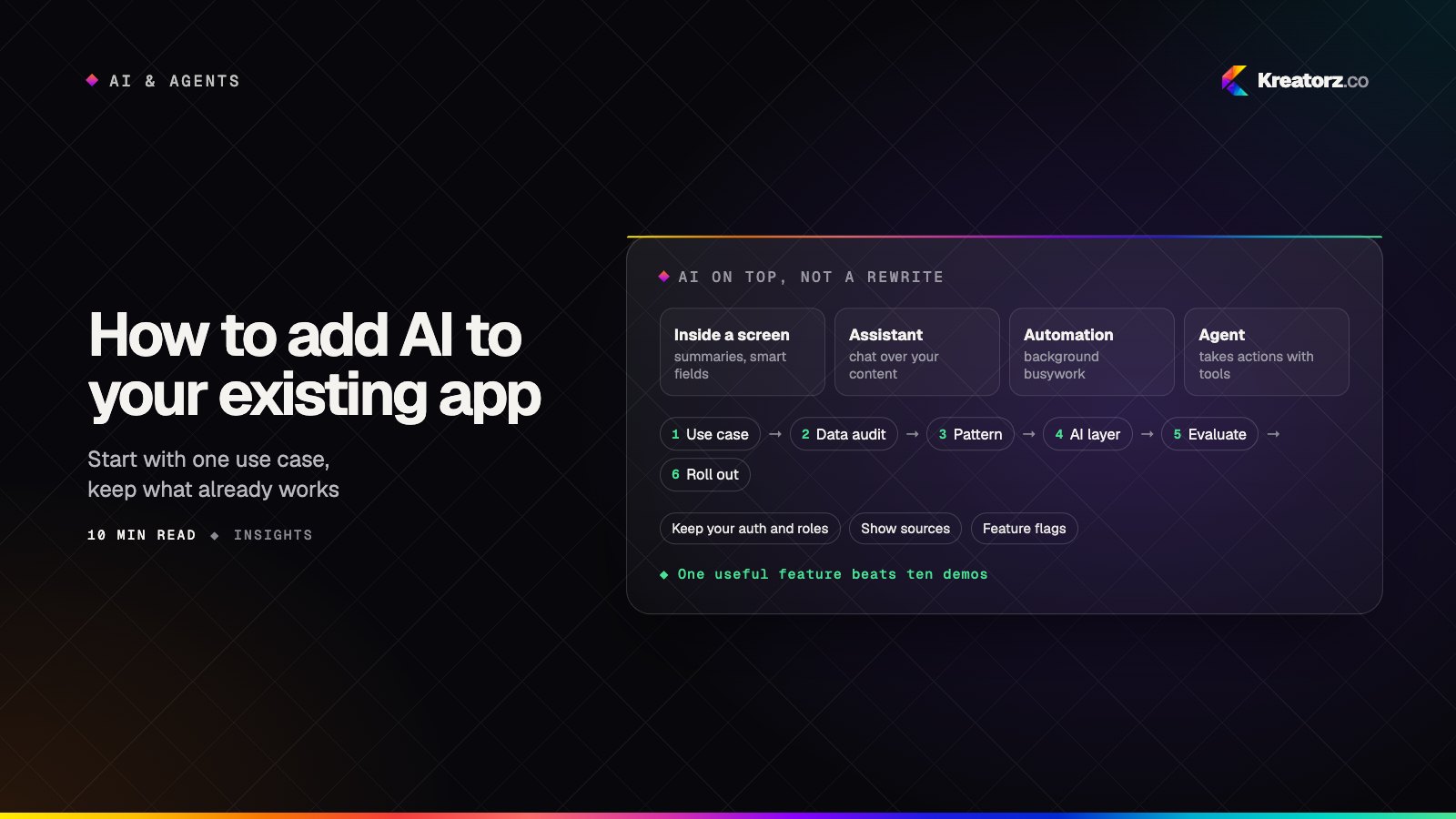
How to add AI to your existing app or software: a step-by-step guide
You do not need to rebuild your product to give it useful AI features. Here is a practical, step-by-step guide to choosing the first use case, auditing your data, picking the right pattern, adding an AI layer without a rewrite, and rolling it out safely.
21 November 2026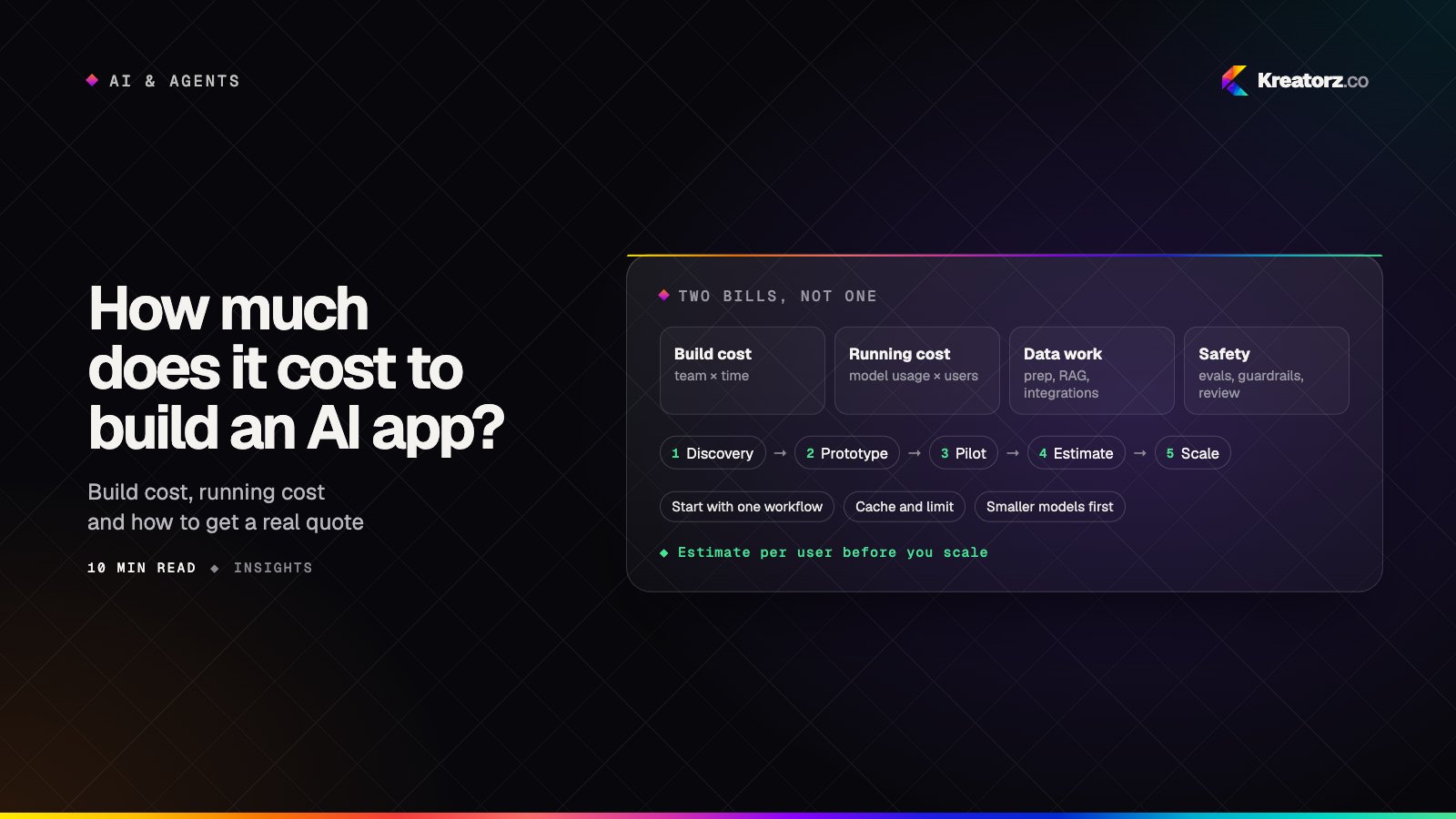
How much does it cost to build an AI app or AI agent? A buyer's guide
AI app development cost is not a mystery number. It follows from the team, the timeline and a handful of AI-specific drivers, plus a running cost that grows with every user. Here is how to estimate both, step by step, and how to keep them under control.
20 November 2026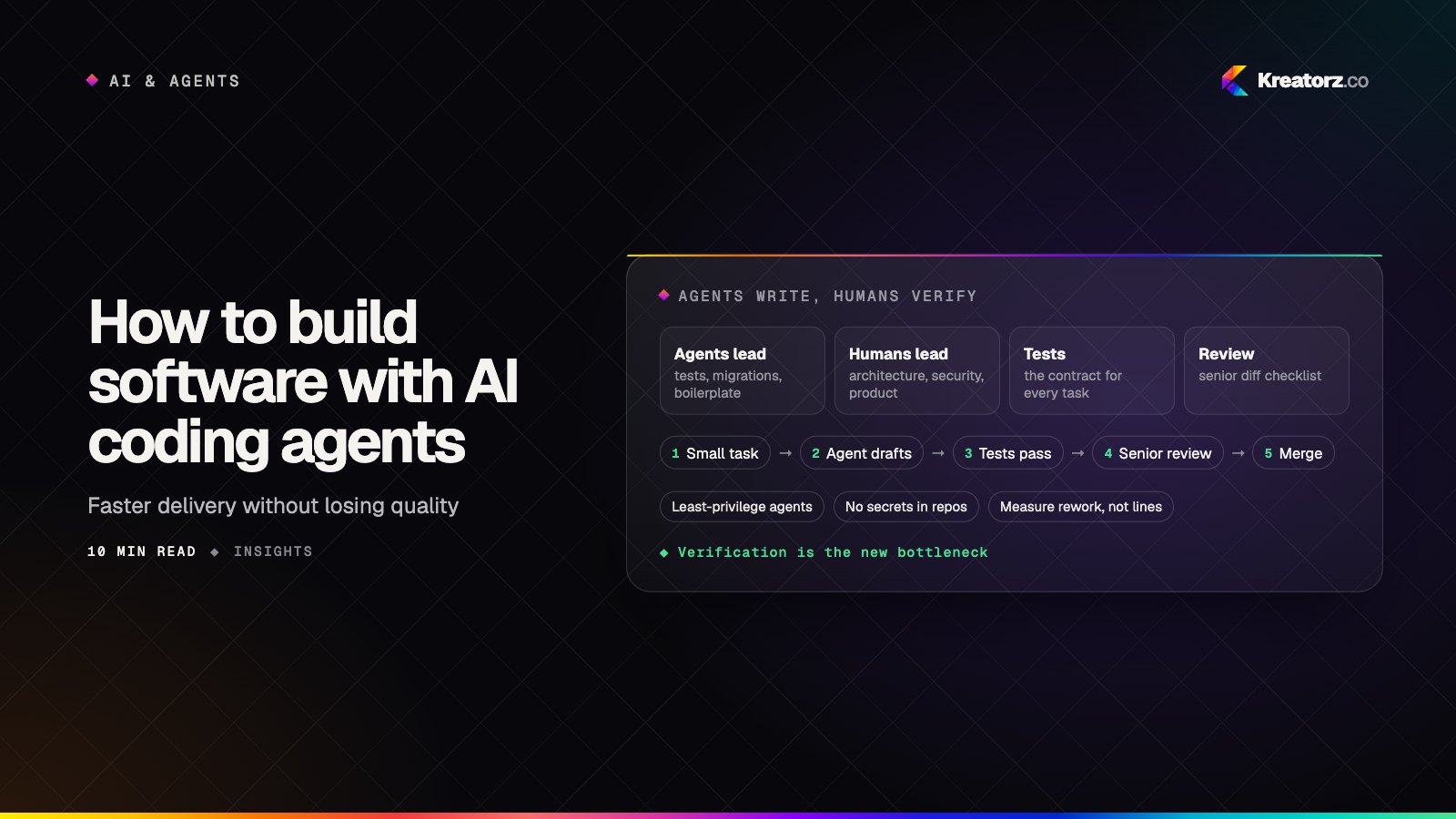
How to build software with AI coding agents without losing quality
AI coding agents can now write large amounts of code and run multi-step tasks in parallel. The hard part has moved to verification, review and security. Here is a step-by-step guide for CTOs, founders and product leaders who want the speed without the hidden cost.
19 November 2026