How to hire mobile app developers: a step-by-step guide
Hiring mobile app developers is about more than finding someone who can code. Here is a practical, step-by-step process for choosing between freelancers, in-house hires, agencies and dedicated teams, assessing developers properly, and protecting your app, code and store accounts.
Short answer
To hire mobile app developers, first choose your platforms and stack, then list every role the app needs: design, mobile, backend, QA and release. Pick a route (freelancer, in-house, agency or dedicated team), check live store apps and code samples, run a small paid trial, and keep the code and app store accounts in your name.
Finding app developers is easy. Finding the right ones, for your product, budget and timeline, is where most of the work is. A mobile app needs more than someone who can write Swift, Kotlin or Dart. It needs design, a backend, testing and a careful release process, and the people you hire either cover those skills or leave gaps you discover later.
This guide walks through how to hire mobile app developers, one step at a time, whether you are a founder hiring your first developer or a business adding a mobile product to an existing platform.
Step 1: Decide what kind of app you are building
Before you look at a single profile, decide which platforms you need and how the app will be built. This shapes which skills you hire for.
- Native iOS. Built in Swift and SwiftUI for iPhone and iPad. A good fit when your audience is mostly on Apple devices or you need deep Apple features. See iOS app development.
- Native Android. Built in Kotlin and Jetpack Compose. A good fit when your users are mostly on Android or you need tight hardware integration. See Android app development.
- Cross-platform with Flutter. One Dart codebase for both platforms, well suited to custom, brand-led interfaces. See Flutter app development.
- Cross-platform with React Native. One TypeScript codebase using native components, useful if you already have a React web team. See React Native app development.
If you are not sure which to choose, our guide to choosing a mobile stack explains the trade-offs. It matters for hiring because a strong Flutter developer and a strong Swift developer are not interchangeable. Hire for the stack you have chosen, or hire a team that can help you choose it honestly before the build starts.
Step 2: List every skill a real app needs, not just coding
A common mistake is hiring one mobile developer and assuming the app is covered. Most production apps need several roles, even if some are part-time:
| Role | What they do | Can you skip it? |
|---|---|---|
| Product lead | Owns scope, priorities and decisions; keeps the build focused on the first release | Only if you can do this yourself and have the time |
| Product designer | User journeys, wireframes, interface design, accessibility | Rarely; poor design is one of the fastest ways to lose users |
| Mobile developer(s) | Builds the app itself on iOS, Android or a cross-platform framework | No |
| Backend developer | APIs, database, authentication, payments, notifications, admin panel | Only if the app needs no server, which is unusual |
| QA / tester | Tests on real devices and OS versions, checks edge cases, regression testing | Not safely; developers testing their own work miss things |
| DevOps / release | Build pipelines, environments, crash monitoring, store submission | Sometimes folded into a senior developer's role |
When you compare options later, check which of these roles each one actually covers. A low price that covers only mobile coding can become expensive once you add the missing pieces.
Step 3: Choose your hiring route
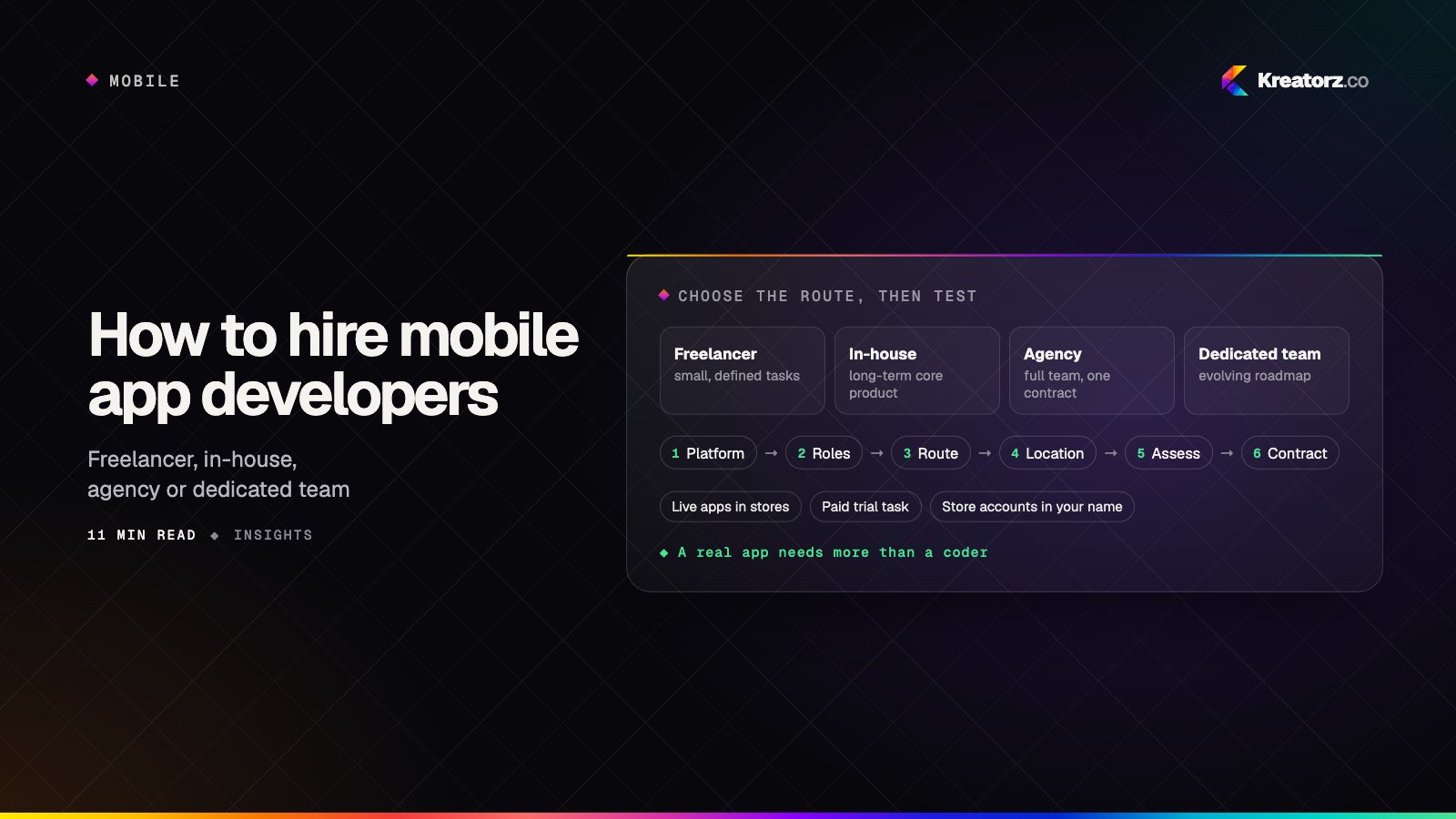
There are four common ways to hire mobile app developers. Each one suits a different situation.
| Route | Best for | Strengths | Watch out for |
|---|---|---|---|
| Freelancer | Small, well-defined tasks, prototypes, or adding capacity to an existing team | Flexible, quick to start, pay only for what you need | You manage the project; one person rarely covers design, backend and QA; availability can change |
| In-house hire | Companies with a long-term mobile roadmap and someone to lead engineering | Full-time focus, product knowledge stays in the company | Hiring takes time; you need several hires to cover all roles; management overhead |
| Agency or development company | Building a complete app from scratch, or a major new version | A full team from day one, established process, accountability for delivery | Quality varies widely; check who actually does the work |
| Dedicated team | Ongoing product development without building an internal team | A stable team that works only on your product, scales up or down | You still need to own product decisions; clarify who manages the team |
Many businesses combine routes: an agency builds the first release, then a dedicated team or in-house developers take over. If you go that way, plan the handover from the start so documentation, code and accounts are ready.
Step 4: Decide where your team should be
Location affects cost, communication and how quickly questions get answered. Broadly, there are three options.
- Onshore. A team in your own country. If you are looking for mobile app developers in the USA, an onshore team means shared business context, easy contracts and the same working hours, usually at higher rates.
- Nearshore. A team in a nearby time zone. For US companies, mobile app development in Canada is a common nearshore choice, with similar working culture and strong overlap with Eastern and Pacific hours.
- Offshore. A team many time zones away. Mobile app development in Pakistan, for example, gives access to a large pool of experienced engineers, usually at lower rates, with less overlap in working hours.
Rates vary a great deal by region and model, but a lower rate is not automatically cheaper. A team that needs fewer weeks and less rework can cost less overall. Our guide to how much it costs to build an app explains how to estimate a budget as team size times weeks times a blended rate, so you can compare options on more than the hourly figure.
Time zones in practice
Whatever you choose, ask these questions:
- How many hours will the team overlap with ours each day?
- Who can join a same-day call if something urgent comes up?
- When will demos and planning meetings happen in our local time?
A blended model, with a lead in or near your time zone and a wider team elsewhere, can combine good communication with a reasonable budget.
Step 5: Assess individual developers properly
Resumes and confident interviews tell you little on their own. Look for evidence.
Check live apps in the stores
Ask for apps the developer has worked on that are live on the App Store or Google Play. Download them. Check how fast they open, how they handle a poor connection, and whether they feel at home on the platform. Then ask exactly what the developer built: the whole app, a few screens, or a specific feature.
Review code samples
Ask for a code sample, ideally from a real project they are allowed to share, or a public repository. If you are not technical, ask a trusted engineer to review it. Look for clear structure, sensible naming, tests, and how errors and edge cases are handled.
Run a small paid trial task
A short, paid trial task is one of the most reliable ways to assess a developer. Keep it small and realistic: build one screen against a sample API, fix a known bug, or add a feature to a small existing codebase. Pay for the time. You learn how they communicate, ask questions, estimate and finish work, which matters as much as the code itself.
Ask practical technical questions
Useful questions for mobile developers include:
- How do you structure an app so it stays maintainable as it grows?
- How do you handle offline use, slow networks and failed requests?
- How do you manage app state, and why did you choose that approach?
- What do you test automatically, and what do you test by hand on real devices?
- How do you handle push notifications, deep links and background tasks?
- How do you keep secrets and user data secure on the device?
- What has gone wrong in an app store review, and how did you fix it?
- How do you approach upgrading to a new OS version or framework release?
Good developers answer with specific examples and trade-offs. Vague, textbook answers are a signal to dig deeper.
Step 6: Assess a development company
If you are hiring an agency or dedicated team, you are assessing a group, not a person. Focus on:
- Who will actually work on your app. Ask to meet the people, not just the sales team. Confirm their roles and seniority.
- Which roles are included. Design, backend, QA and release, as listed in Step 2.
- How they start. For anything beyond a small project, a short paid discovery phase to clarify scope, users and architecture is a good sign.
- How you will see progress. Regular demos of working software, a shared backlog and installable test builds on a predictable schedule.
- Engineering habits. Code review, automated testing, crash monitoring and a defined release process.
- References. Speak to past clients and ask how the team handled a problem or a change in scope, not only whether the client was happy.
If location matters to you, our pages on working with an app development company in the USA, an app development company in Canada and a software house in Lahore cover the local questions in more detail.
Step 7: Get contracts, IP and accounts in your name
Contracts are where many app projects run into trouble, usually because important details were never written down. Have a lawyer review the agreement, and make sure it covers:
- Intellectual property. Code, designs and content created for you should belong to you, with ownership clearly transferred.
- App store accounts. Your Apple Developer and Google Play Console accounts should be registered to your business, with developers added as team members. If a developer publishes your app under their own account, moving it later can be slow and difficult.
- Code and infrastructure. Your code repository, cloud hosting, domains, analytics and third-party services should be in your name from day one.
- Confidentiality and data protection. Especially if developers will handle customer data.
- Payment and changes. How work is billed, how scope changes are approved, and a budget cap for time-based work.
- Exit and handover. What you receive if you part ways, including documentation and access, and the notice period.
For the release side, our guide to launching an app on the App Store and Google Play explains the accounts, reviews and assets you will need.
Step 8: Onboard well and set a working rhythm
The first two weeks set the tone for the whole project. Give your developers:
- a clear brief and the list of features for the first release;
- access to designs, the repository, test accounts and any existing systems;
- one person on your side who can make product decisions quickly;
- a shared place for the backlog, questions and decisions.
Then agree on a rhythm: a weekly demo of working software, installable builds every one to two weeks, short written updates on progress and risks, and a regular planning session to set priorities. This rhythm makes problems visible early, when they are cheapest to fix.
Red flags when hiring app developers
- No live apps you can download, or vague answers about what they personally built.
- A detailed fixed quote with no questions about your users or scope.
- Reluctance to share code samples or do a small paid trial.
- No plan for testing on real devices, or "we test at the end."
- Insisting on publishing your app under their own store account.
- The repository or cloud hosting owned by the developer instead of you.
- Long gaps between updates, or progress you can only see in screenshots.
- A price far below every other option with no clear explanation of the team behind it.
How Kreatorz approaches mobile app development
Kreatorz is a mobile app development company with offices in Sheridan, Wyoming (USA), Brantford, Ontario (on Eastern Time) and Lahore, Pakistan. One senior cross-functional team covers product, design, mobile, backend, QA and release, so you are not stitching roles together yourself. Clients own their code, and we work in the open with weekly demos and working builds every one to two weeks.
If you are planning to hire app developers and want a team to compare against this checklist, tell us about your app. We are happy to answer every question on it.
Frequently asked questions
How do I hire mobile app developers for my startup?
Start by deciding your platforms and stack, then list the roles your app needs: design, mobile, backend, QA and release. Choose a route (freelancer, in-house, agency or dedicated team), check live apps and code samples, and run a small paid trial or discovery phase before committing to a full build.
Is it better to hire a freelancer or an app development company?
A freelancer can work well for small, well-defined tasks or for adding capacity to an existing team. For a complete app built from scratch, a development company or dedicated team usually covers more of the skills you need, including design, backend, testing and release, with one point of accountability.
What should I ask app developers in an interview?
Ask about apps they have shipped and what they personally built, how they structure apps for growth, how they handle offline use and failed requests, what they test and how, and how they deal with app store review issues. Specific examples and trade-offs are a better sign than textbook answers.
How much does it cost to hire mobile app developers?
It depends on scope, platforms, the roles you need, the hiring route and where the team is based. Rates vary widely by region, but total cost is driven by team size and the number of weeks, so speed and rework matter as much as the rate. Start with a rough estimate of team size and weeks, then compare options on the same scope.
Who should own the app store accounts and code?
You should. Register your Apple Developer and Google Play Console accounts to your business, keep the code repository and cloud hosting in your name, and add developers as team members. Make sure your contract transfers ownership of the code and designs to you.
- Mobile app developmentWe plan, design, build and grow mobile apps for iPhone and Android — choosing the right technology for your product, not the one we happen to prefer.Explore
- iOS app developmentWe build iPhone, iPad and Apple Watch apps in Swift and SwiftUI that feel unmistakably Apple — fast, private by design and ready for App Store review.Explore
- Android app developmentWe build native Android apps in Kotlin and Jetpack Compose that perform on flagship phones and budget handsets alike — then ship them confidently through Google Play.Explore


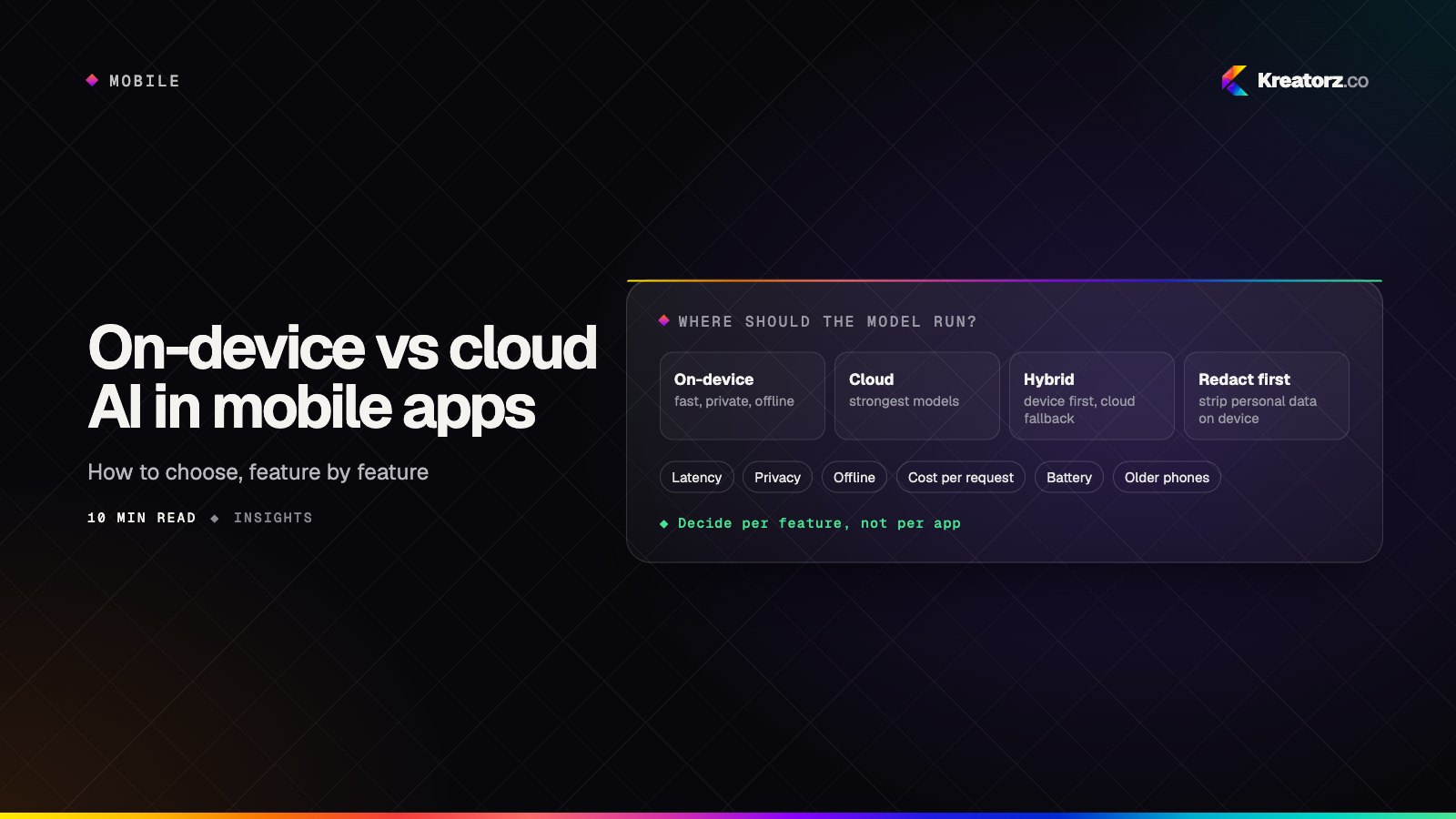
On-device vs cloud vs hybrid AI in mobile apps: how to choose
Phones can now run capable small models, and both Apple and Google offer on-device AI frameworks. That does not make the cloud obsolete. Here is a step-by-step guide to deciding, feature by feature, where the AI in your mobile app should run.
19 November 2026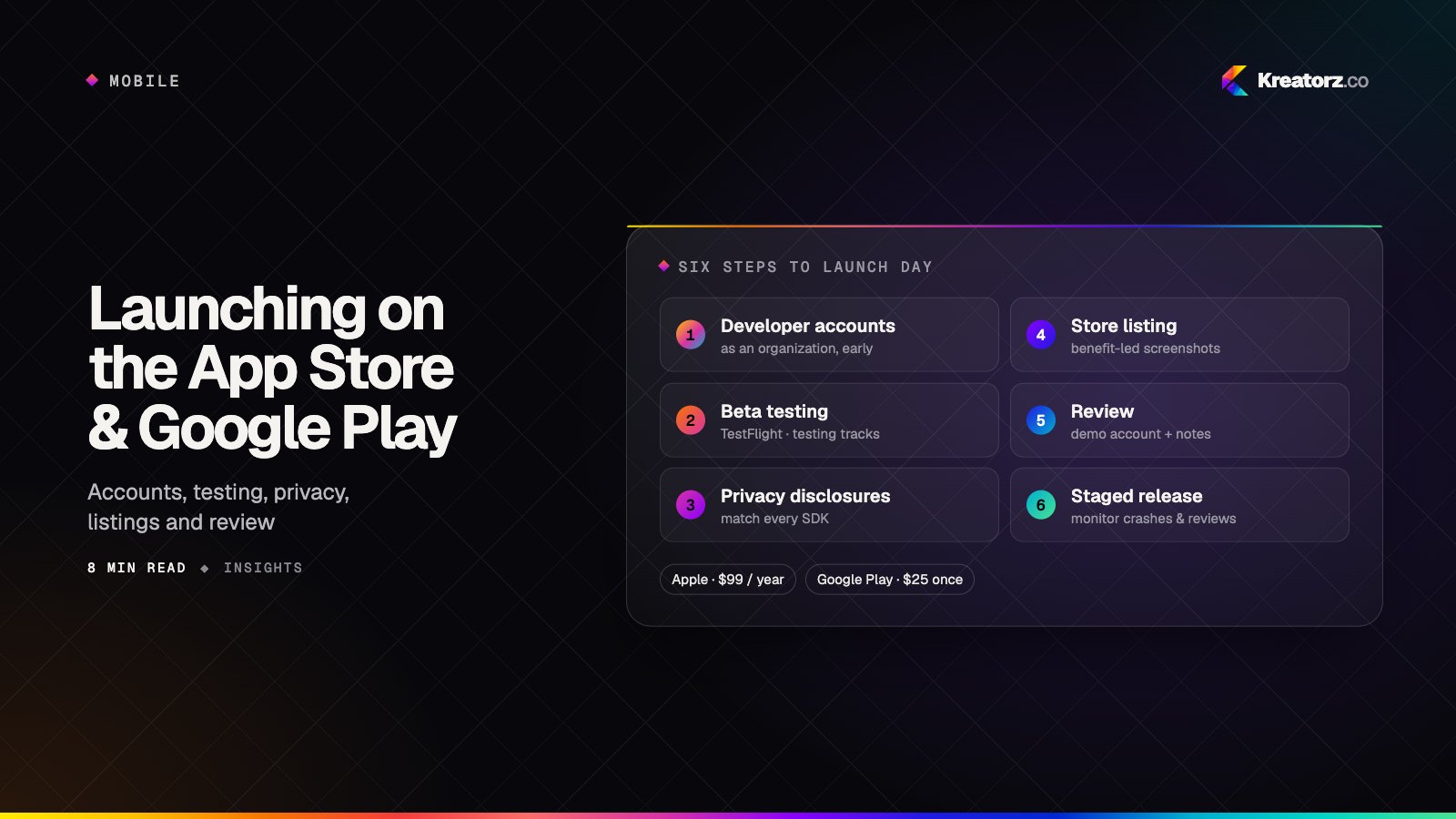
How to launch an app on the App Store and Google Play: a step-by-step guide
Getting an app approved and in front of users is a project of its own — developer accounts, testing tracks, privacy disclosures, store listings and review. Here is the launch process for both stores, the common reasons apps get rejected, and how to plan a calm launch day.
16 November 2026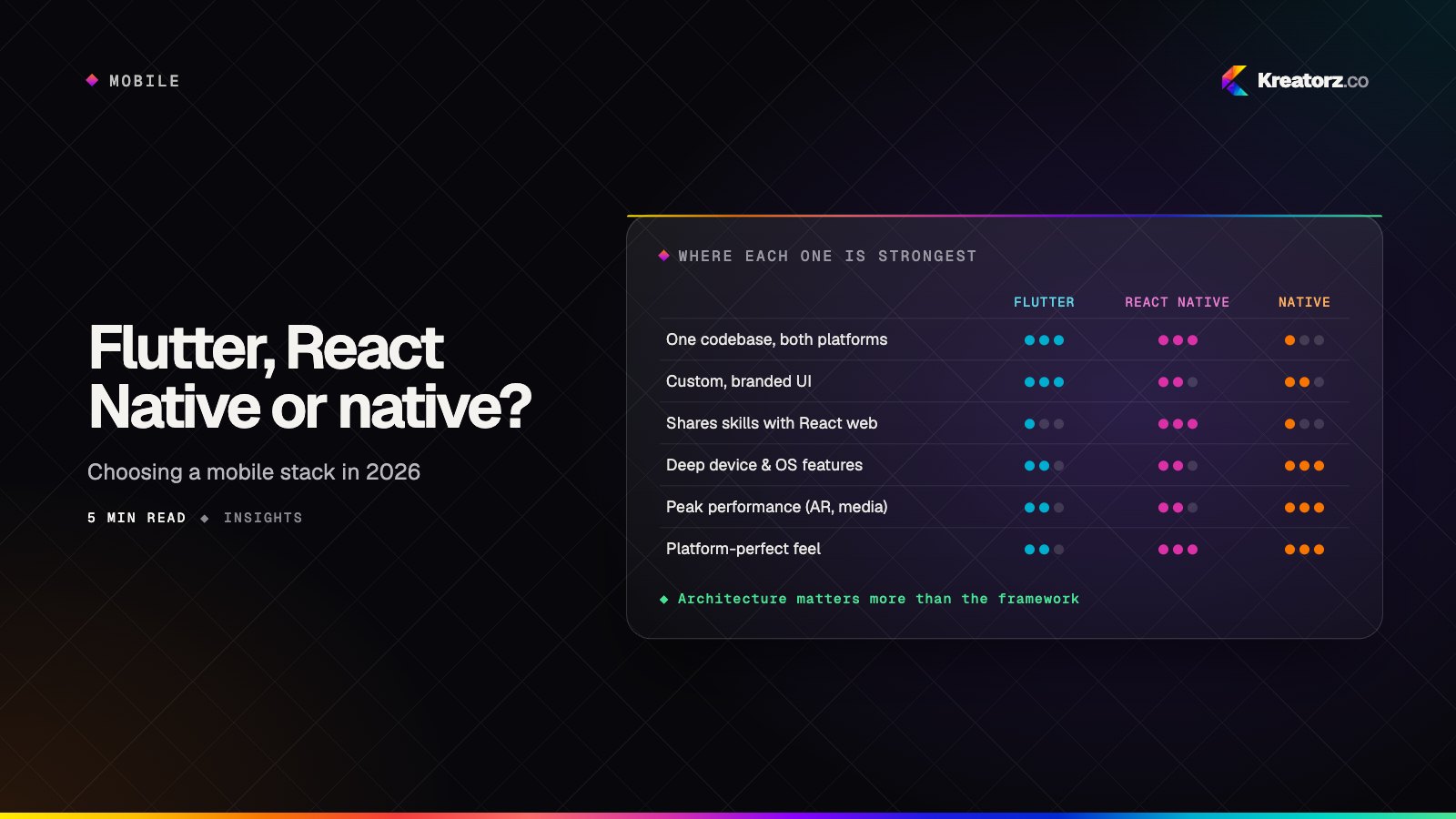
Flutter, React Native or native? Choosing a mobile stack in 2026
The cross-platform versus native debate has matured. The right answer now depends less on raw performance and more on your team, your product's demands and your plans for the next three years.
30 September 2026