Beyond the match: how to build relationship and couples apps people trust
Dating apps stop at the match. Relationship and couples apps have to handle what comes after: linking partners, keeping private things private, sharing everyday life in real time, explaining assessments clearly and using AI coaching responsibly. Here is how to build one.
Short answer
To build a relationship or couples app people trust, decide whether it is individual-first or couple-first, then get partner linking and graceful unlinking right. Keep each partner’s private space truly private, enforced on the server, sync shared tasks and calendars in real time, explain assessments in plain language, and design AI coaching that supports reflection without diagnosing or taking sides.
Most relationship products end at the match. A dating app counts its win when two people start talking, and then they leave. But most of a relationship happens after that: understanding each other, talking through hard things, sharing the weight of everyday life and growing together over years.
Relationship and couples apps are built for that longer stretch, and they raise questions most apps never face. Two people share a space, but each also needs privacy from the other. An AI may be talking to someone on one of the hardest days of their life. And sooner or later, some couples will break up inside your product.
We have built in this space. Rayna is a private, AI-powered relationship coach for women, with message analysis, hard-conversation preparation, an attachment style assessment, daily reflection and personalized growth tracking. Revelita is a couples app that combines shared task management, partner collaboration and a shared calendar with values-based assessments, relationship insights and personalized growth tracking. This guide covers what we have learned about building products like these properly.
Two kinds of relationship app
Before designing anything, decide who your user is. It shapes the data model, privacy rules and business model.
| Individual-first | Couple-first | |
|---|---|---|
| Primary user | One person thinking about their relationships | Two linked partners |
| Example | Rayna, a private AI relationship coach | Revelita, a shared couples app |
| Core value | Reflection, clarity, preparation | Shared life admin, mutual understanding |
| Privacy model | Everything is private to the user | Shared spaces plus private spaces per partner |
| Hardest problem | Responsible, supportive AI | Linking, sync and boundaries between partners |
| Business model | Individual subscription | Couples plan covering both partners |
Individual-first apps can serve someone whether or not their partner is willing to take part, which matters: many people want help with a relationship precisely because the conversation with their partner is difficult. Couple-first apps create value from both people participating, but they depend on the second person actually joining.
Some products do both. If you go that way, make the solo experience complete in its own right, not a waiting room.
Couple linking and invite flows
For a couple-first app, the invite is the most important flow you will build. If the second partner never joins, the product doesn't work.
A good linking flow:
- Lets either partner start. Whoever downloads first creates a couple space and invites the other by link, code or contact.
- Gives the inviter something to do while they wait. Let them set up their profile, add a few shared tasks or take an assessment, so the space isn't empty when their partner arrives.
- Explains itself to the invitee. The person receiving the invite didn't choose the app. Tell them who invited them, what is shared and what stays private, before they create an account.
- Expires and can be revoked. Invite links should time out, work once, and be cancelable by the person who sent them.
- Confirms on both sides. Linking happens only when both people agree. Nobody should be able to attach themselves to someone else's account.
Treat linking as a security feature: it grants access to shared data.
Unlinking, gracefully
Relationships end, and your app has to handle that kindly. Unlinking should be available to either partner, without needing the other's permission, and without a confrontational confirmation screen.
Decide in advance what happens to the data:
- Private content always stays with the person who created it.
- Shared content such as tasks, plans and calendar events needs a clear rule. Common options are giving each person a copy, keeping items with whoever created them, or letting each person export before the split.
- Notifications to the other partner should be minimal and neutral. Don't announce a breakup with a cheerful push notification.
- Subscriptions on a couples plan need to keep working for whoever is paying, with a fair path for the other partner to continue alone.
Decide these rules during discovery and test the flow as carefully as onboarding.
Shared spaces and private spaces
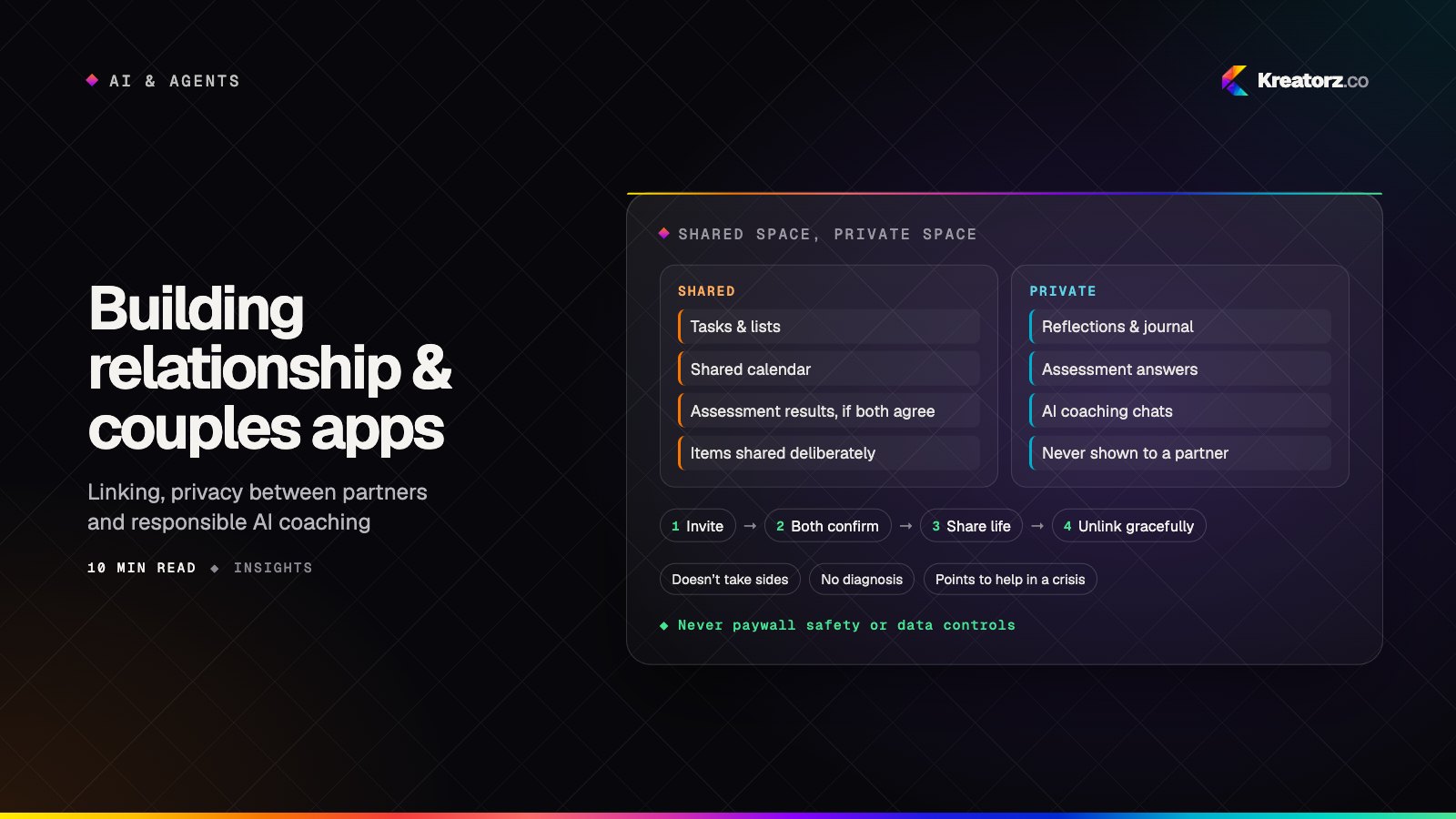
This is the defining design problem of couples apps: privacy between partners, not just from the world. Two people share part of the app, but each needs a space the other can never see.
The rules we follow:
- Make the boundary visible. Every screen should make it obvious whether you are in a shared space or a private one. Labels, colors and icons all help.
- Default to private for anything personal. Reflections, journal entries, assessment answers and AI coaching conversations start private. Sharing is a deliberate act, item by item.
- Never surface one partner's private reflections or AI chats to the other. Not in summaries, not in insights, not in notifications, and not through an AI feature that has access to both people's data. If an AI insight draws on both partners, it should use only what each has chosen to share.
- Share results, not raw answers, unless both agree. For assessments, many couples are comfortable comparing outcomes but not individual responses.
- Keep sensitive data out of logs and analytics. Relationship content is deeply personal. Encrypt it, keep it out of crash reports and analytics events, and let people export or delete it at any time.
Enforce these rules on the server for every request, so a bug in one screen can't leak a partner's private space. Our guide to securing AI products covers how to keep AI features inside the same boundaries.
Shared tasks, calendars and real-time sync
Shared life admin is where couples apps earn daily use. Revelita, for example, brings shared tasks, plans and a shared calendar into one place, so household admin stops being a source of friction.
The engineering matters more than it looks:
- Real-time sync. When one partner ticks off the shopping, the other should see it right away. Use a backend with live updates and design for both people editing at once.
- Offline first. People add tasks in the supermarket and on the train. Changes should save locally and sync when the connection returns, with sensible conflict handling.
- Assignment and fairness. Let tasks belong to one partner, the other or both. Making the load visible is often the point.
- Calendar integration. Many couples already live in their phone calendars. Decide early whether you sync with them or keep a separate shared calendar, and handle time zones for couples who travel or live apart.
- Gentle reminders. Let each partner control their own notifications, and avoid reminders that read like one partner scolding the other.
If you are also serving families or households, many of the same patterns apply. See our post on AI apps for families.
Assessments and insights, explained clearly
Assessments are often the most loved part of a relationship app. Values, attachment styles, communication preferences and similar frameworks give people language for patterns they have felt but never named. Rayna includes an attachment style assessment; Revelita uses values-based assessments to reveal what each partner cares about.
To make them genuinely useful:
- Ground them in established frameworks. Be clear about where an assessment comes from, and avoid presenting a fun quiz as a clinical instrument.
- Explain results in plain language. A label alone isn't an insight. Say what it means, how it might show up day to day and what someone could try.
- Avoid fixed verdicts. Present results as tendencies that can change, not as permanent truths about a person or a couple.
- Turn insight into action. The value is in the next step: a conversation prompt, an exercise or a small goal. Revelita turns findings into practical steps and tracks growth over time.
- Respect privacy in comparisons. Showing where partners align and differ can be powerful, but only with both people's consent.
Responsible AI relationship coaching
AI makes relationship apps far more personal. Rayna, for example, it offers personalized guidance, analyzes the tone and patterns in messages, and helps users prepare for hard conversations.
It is also where things can go most wrong, because people bring an AI coach their most vulnerable moments. The principles we build to:
- Supportive, not directive. The coach helps people think, not tells them what to do with their relationship.
- Encourage reflection. Good coaching asks questions, reflects feelings back and helps people notice patterns themselves.
- Don't take sides. The AI hears only one side of every story. It should acknowledge feelings without declaring the absent partner the villain.
- No diagnosis. The coach should never label a partner with a personality disorder or a user with a condition. It is not a clinician.
- Recognize abuse and crisis. Signs of abuse, coercive control, self-harm or immediate danger change the conversation. The AI should respond with care, stop coaching as usual and point people to appropriate help, such as local emergency services, crisis lines or domestic abuse support. Build and test these paths deliberately rather than leaving them to the model.
- Recommend professional support. When a situation calls for a therapist or counselor, say so clearly.
- Keep it private. AI conversations belong to the user. They should never be shared with a partner, and data sent to model providers should be minimized and protected.
Test tone with real users and treat safety behavior as a feature with its own test cases. Our posts on designing AI features people trust and how to build an AI app go deeper, and if your product touches emotional wellbeing more broadly, see our mental health app development work.
Monetization: couples plans, trials and premium programs
Relationship apps usually earn through subscriptions. The models that fit best:
| Model | How it works | Watch out for |
|---|---|---|
| Couples plan | One subscription covers both linked partners | Fair handling when couples unlink |
| Individual subscription | Each person pays for their own access | Asking both partners to pay can stall linking |
| Free trial | Full access for a limited time | Show value before the trial ends, not after |
| Freemium | Shared basics free, insights and AI premium | Don't paywall safety or data controls |
| Premium programs | Guided multi-week programs or courses | Programs need ongoing content investment |
Couples plans should make it obvious who is paying and what both partners get. Trials work best when the most valuable moments, such as a first assessment result, happen inside the trial. And never put safety resources, privacy controls or data deletion behind a paywall. If you are moving from dating into relationships, our guide on how to build a dating app covers the adjacent decisions around matching and trust.
The bottom line
Relationship and couples apps succeed on trust. Get linking and unlinking right, keep each partner's private space truly private, make shared life sync reliably, explain assessments in a way people can act on, and design AI coaching that supports reflection without taking sides or overstepping. Do that, and your app becomes part of how people look after their relationships, not just another download.
If you are planning a relationship app, an AI relationship coach or a couples planner, see our relationship and couples app development service, or book a free consultation.
Frequently asked questions
What features should a couples app have?
Most couples apps start with partner linking, shared and private spaces, shared tasks or a calendar, and at least one assessment or insight feature. AI coaching, guided programs and growth tracking are common additions once the core works.
How do couples apps keep things private between partners?
By defaulting personal content such as reflections, assessment answers and AI conversations to private, making sharing a deliberate choice, enforcing access rules on the server and never surfacing one partner's private data to the other through summaries, insights or AI features.
What happens to shared data when a couple unlinks?
That depends on rules you set during design. Private content always stays with its owner. Shared items are usually copied to both people, kept with whoever created them, or made available to export before the split. Either partner should be able to unlink without the other's permission.
Can an AI relationship coach replace therapy?
No. A well-designed AI coach can help people reflect, understand patterns and prepare for difficult conversations, but it should not diagnose anyone and should recommend professional support when a situation calls for it.
How should an AI coach handle signs of abuse or crisis?
It should respond with care, step out of normal coaching and point the person to appropriate help, such as emergency services, crisis lines or domestic abuse support. These responses should be designed and tested deliberately, not left to chance.
How do relationship apps make money?
Usually through subscriptions: couples plans that cover both partners, individual subscriptions, free trials, freemium tiers with premium insights or AI features, and paid guided programs.
- Relationship & couples appsKreatorz builds relationship and couples apps — AI relationship coaches, couples planners, shared calendars and tasks, assessments and guided conversations — that…Explore
- Dating app developmentWe design and build dating and matchmaking apps with thoughtful matching, real-time chat, strong safety tools and a business model that keeps the community healthy.Explore
- AI app developmentWe design, build and run AI-powered apps — assistants, copilots, knowledge tools, vision and voice features — that solve a measurable problem and hold up in production.Explore


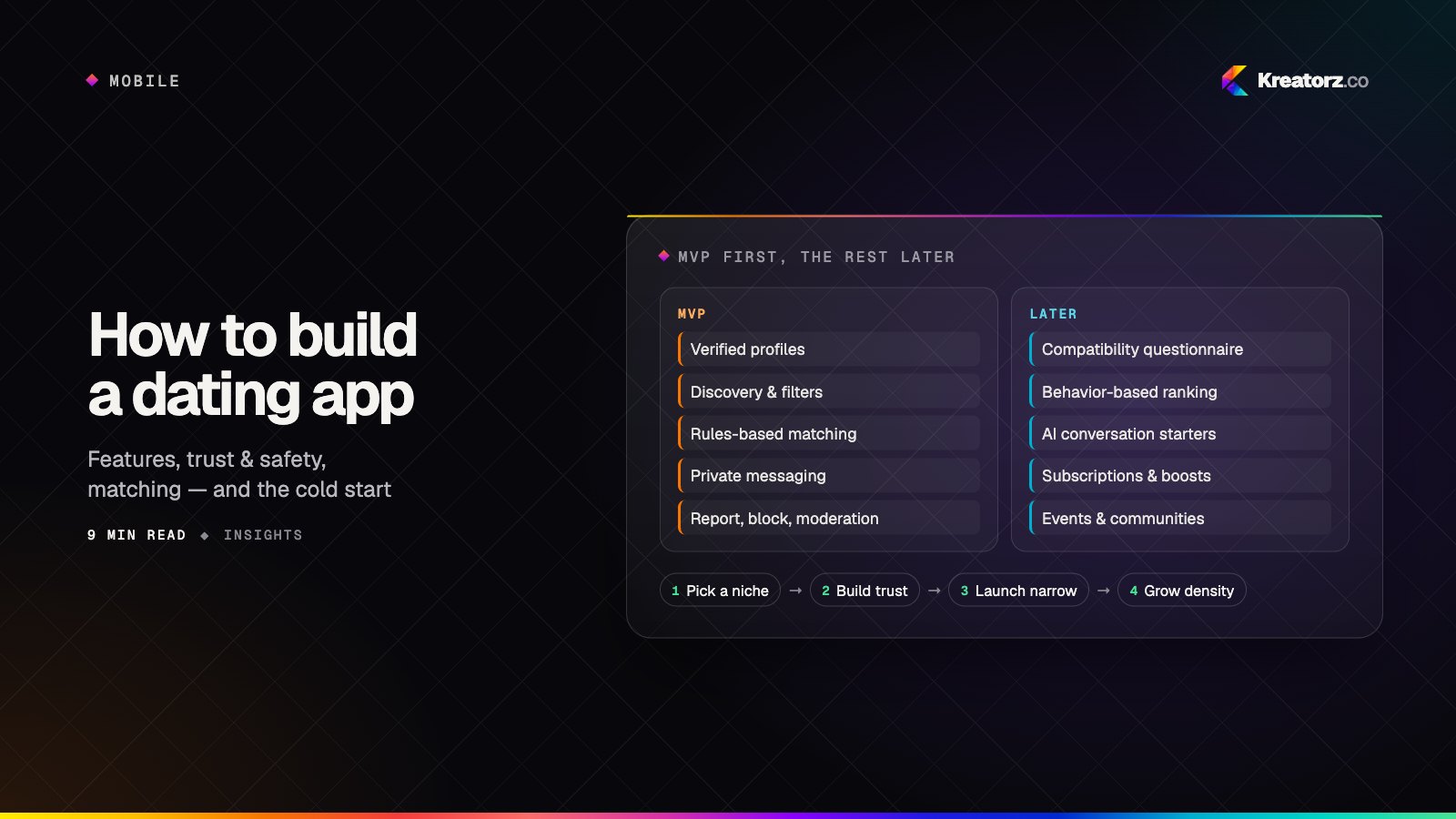
How to build a dating app: features, safety, matching and MVP scope
Building a dating app is less about copying swipe mechanics and more about trust, density and a clear audience. Here is a practical guide to features, matching, safety, privacy, monetisation and what to ship first.
15 November 2026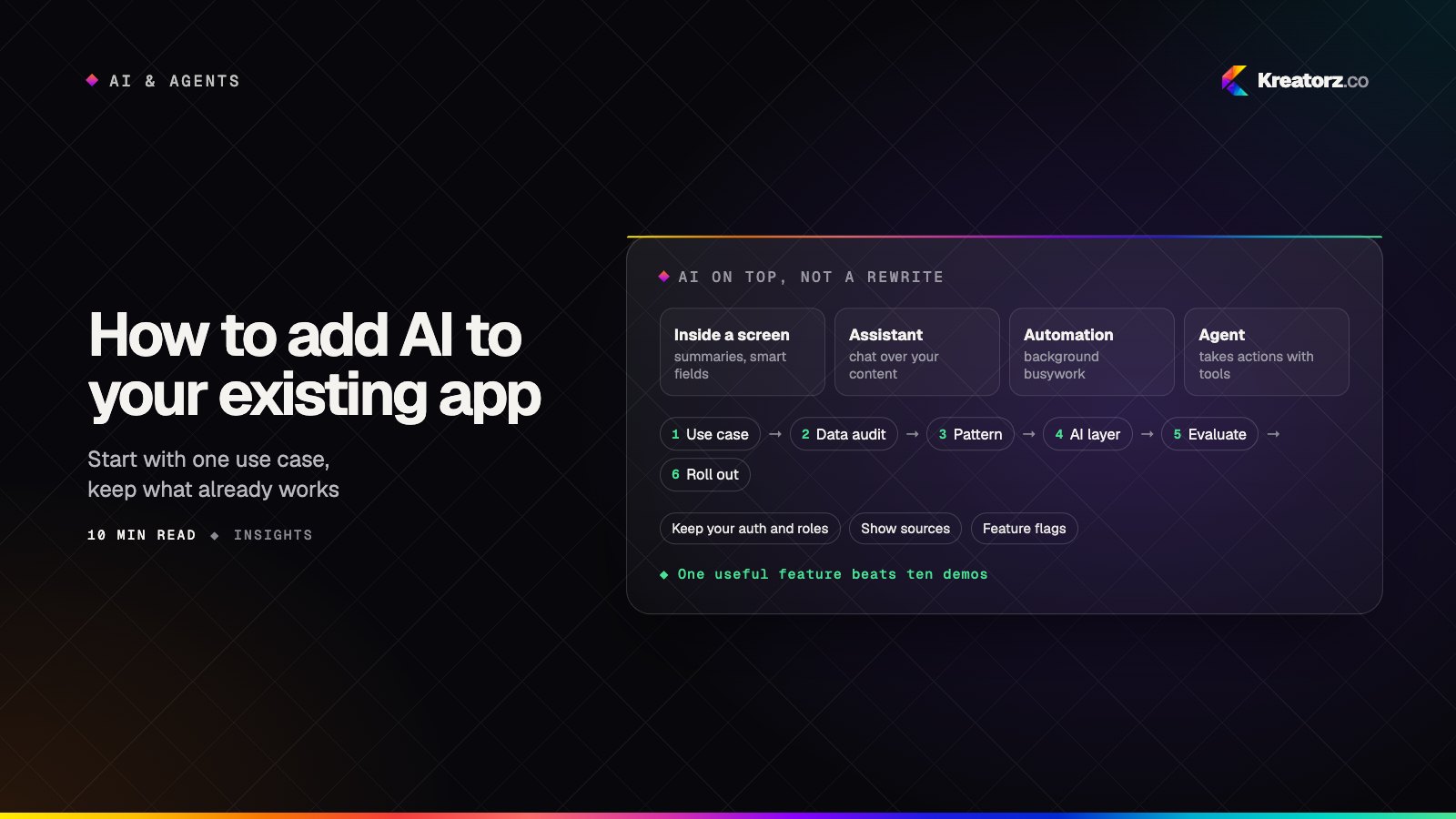
How to add AI to your existing app or software: a step-by-step guide
You do not need to rebuild your product to give it useful AI features. Here is a practical, step-by-step guide to choosing the first use case, auditing your data, picking the right pattern, adding an AI layer without a rewrite, and rolling it out safely.
21 November 2026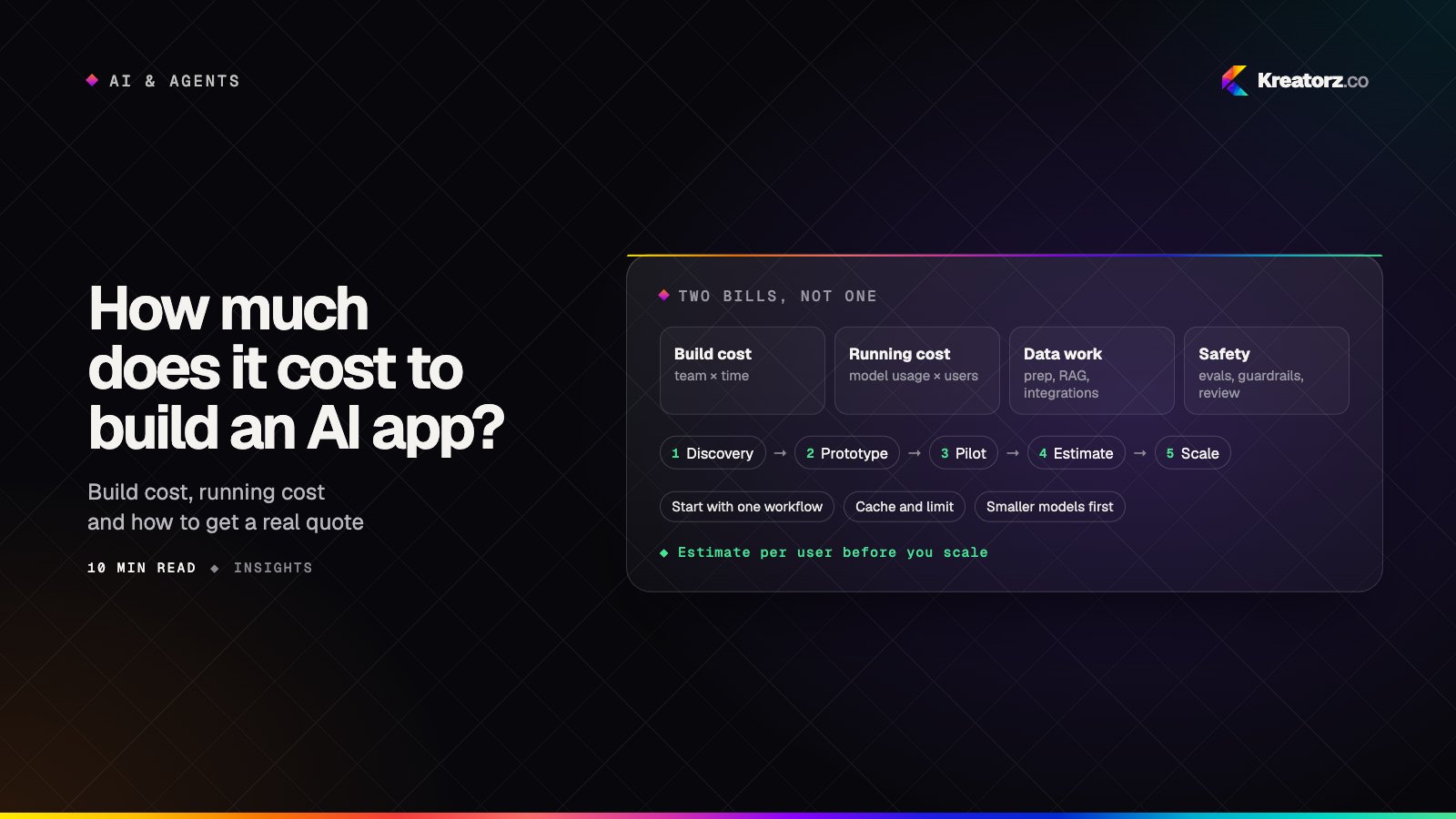
How much does it cost to build an AI app or AI agent? A buyer's guide
AI app development cost is not a mystery number. It follows from the team, the timeline and a handful of AI-specific drivers, plus a running cost that grows with every user. Here is how to estimate both, step by step, and how to keep them under control.
20 November 2026