How to get your business recommended by ChatGPT and AI search (AEO guide)
More buyers now ask ChatGPT, Perplexity, Copilot or Google's AI features which company to hire or which product to buy. Here is a practical, step-by-step answer engine optimization guide, from crawler access and indexing to answer-first content, structured data, reviews and measuring AI referrals.
Short answer
To get your business recommended by ChatGPT and AI search, let AI crawlers reach your site, get indexed in Bing Webmaster Tools and Google Search Console, write answer-first pages with FAQs, add structured data, keep your name and details consistent everywhere, earn real reviews on trusted third-party sites, keep content fresh and track AI referrals.
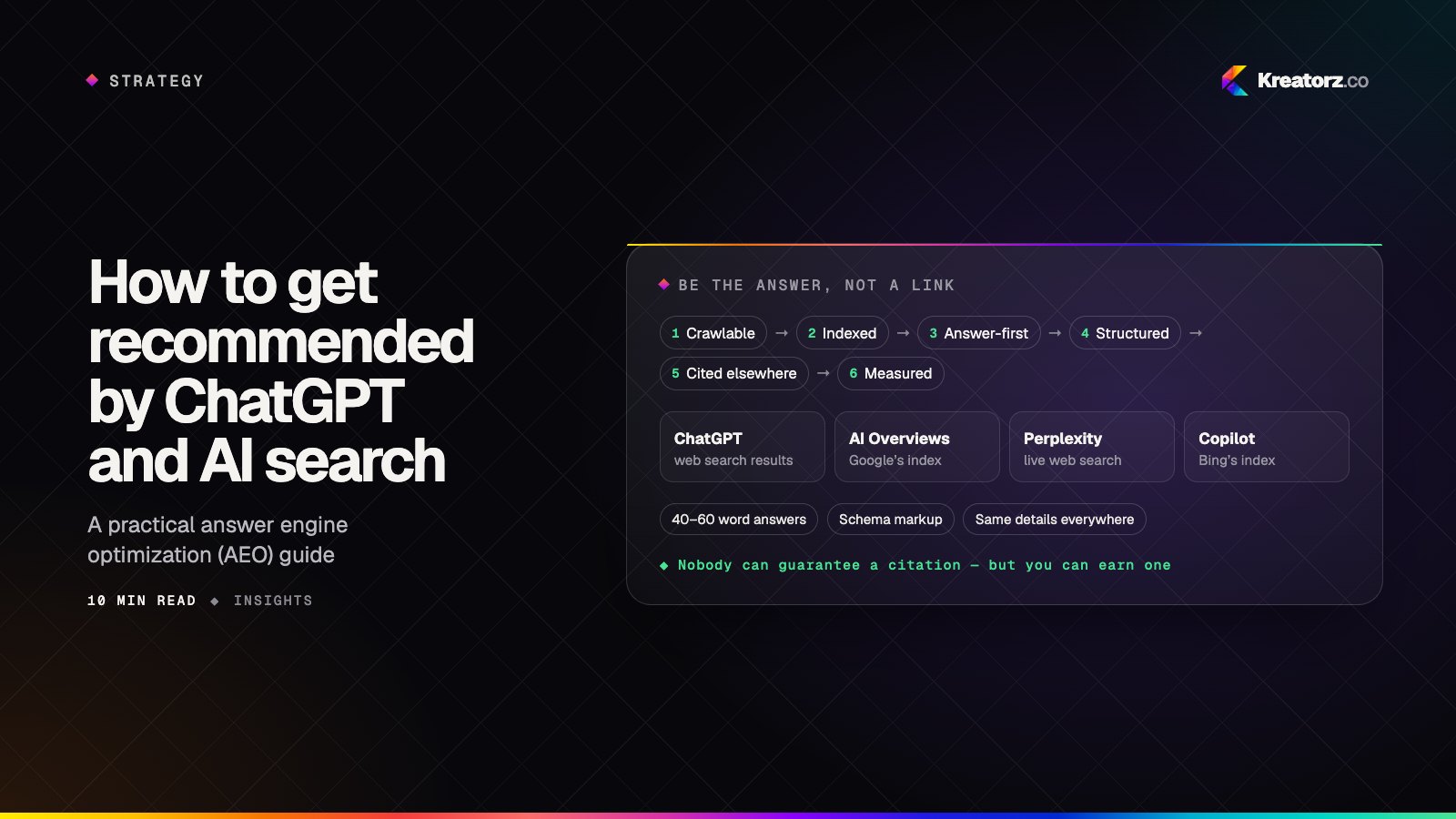
More and more buying journeys start with a question typed into an AI assistant: "What's a good bookkeeping service for a small agency?" or "Which CRM suits a ten-person sales team?". The assistant reads a handful of sources and writes an answer that names a few businesses. If yours isn't one of them, the buyer may never see a search results page at all.
Answer engine optimization (AEO), also called generative engine optimization (GEO) or AI search optimization, is the work of making your business easy for those assistants to find, understand and cite. Nobody can guarantee a mention. But a clear set of foundations makes it far more likely that an assistant gets your facts right and has good reason to include you. This guide walks through them step by step.
Step 1: Understand how AI assistants choose sources
When someone asks ChatGPT, Perplexity, Microsoft Copilot, Claude or Google's AI features for a recommendation, the answer usually draws on three things.
- Live web search. The assistant queries a search index, such as Bing, Google or the provider's own, retrieves pages and summarizes them. Pages that aren't indexed can't be retrieved.
- Well-known third-party sources. Review sites, directories, comparison articles, forums and news coverage. Your own website is one source among many.
- Training data. General knowledge learned during training, which has a cutoff and can be outdated.
Exactly how any assistant ranks and selects sources is not fully public, and it changes. So don't chase a secret formula. Make sure that wherever an assistant looks, it finds clear, accurate, consistent information about you.
Step 2: Make sure AI crawlers can access your site
Many businesses are invisible to AI search for a mundane reason: their site blocks the crawlers, through a hasty robots.txt rule or a firewall or CDN setting that challenges anything that isn't a browser.
Check your robots.txt for the user agents that matter:
- OAI-SearchBot — OpenAI's crawler for ChatGPT search features.
- GPTBot — OpenAI's crawler for model training.
- ClaudeBot — Anthropic's crawler.
- PerplexityBot — Perplexity's crawler for its answer engine.
- Google-Extended — a control token for whether Google may use your content for its Gemini models; it doesn't affect normal Google Search crawling.
- Bingbot and Googlebot — the classic search crawlers, which build the indexes many assistants rely on.
You may have good reasons to block some of these, such as keeping content out of model training. Just make the choice deliberately: blocking a training crawler is different from blocking a search crawler, and blocking search crawlers usually keeps you out of that assistant's live answers.
Then check the layers beyond robots.txt. Make sure bot protection isn't silently returning challenges to crawlers you want to allow. Render key content in the HTML, using server-side rendering or static generation, so crawlers don't see an empty page. And make sure important pages load quickly and return clean 200 responses.
Step 3: Get indexed in Bing and Google
Because many assistants retrieve pages through search indexes, ordinary indexing is the backbone of AI visibility.
- Bing Webmaster Tools. Verify your site, submit your XML sitemap and fix crawl issues. Bing's index powers Microsoft Copilot and has been used by other AI search products, so give it the same attention as Google. Bing also supports IndexNow, which lets you notify participating search engines the moment a page is published or updated.
- Google Search Console. Verify your domain, submit your sitemap and use the Pages report to see which URLs are indexed and why others are excluded.
Confirm that your home page, service or product pages, pricing, location pages and key guides are indexed. Remove accidental noindex tags, fix duplicates with canonical tags and link every important page from somewhere on your site.
Step 4: Write answer-first content
Assistants look for passages that answer a question cleanly. Pages built for busy human readers tend to work well for them too.
- Lead with a direct answer. Near the top of each important page, write a 40–60 word answer to the page's main question that still makes sense if quoted on its own. A page about bookkeeping costs should open with what drives the cost, not your founding story.
- Use question-style headings. "What does a fractional CFO do?" or "How long does onboarding take?" mirror how people phrase prompts and make each section self-contained.
- Add FAQs. Answer the questions your sales team actually hears, in two to four factual sentences each.
- State facts in text. Who you serve, where you operate, what you offer and how it's priced, not only inside images, sliders or PDFs.
- Compare honestly. A fair page on when your approach fits, and when it doesn't, is more useful than pure promotion.
Step 5: Add structured data
Structured data, using the schema.org vocabulary and usually written as JSON-LD, tells machines explicitly what a page is about. It doesn't guarantee anything, but it removes guesswork.
| Schema type | Where to use it | What it clarifies |
|---|---|---|
| Organization | Home or about page | Official name, logo, website, social profiles (sameAs), contact details |
| LocalBusiness | Location pages | Address, phone, opening hours, service area |
| Service | Service pages | What you offer, who provides it, area served |
| Article | Blog posts and guides | Headline, author, publish and update dates |
| FAQPage | Pages with a visible FAQ | Questions and answers that match the page |
Keep markup honest and consistent. Don't mark up FAQs, reviews or prices users can't see, and make sure schema details match the rest of the page. Validate with Google's Rich Results Test or the Schema Markup Validator after changes.
Step 6: Keep your entity consistent everywhere
To an AI system, your business is an entity: a name connected to a description, locations, services and links. When those details conflict across the web, assistants may confuse you with someone else or describe you incorrectly.
Choose one canonical version of your name, a one- or two-sentence description, your address and phone number, and your official links. Then use it on your website, LinkedIn company page, Google Business Profile, Bing Places, social profiles and directories. Update old addresses, retired service names and outdated descriptions, and list your official profiles in your Organization schema's sameAs property.
Step 7: Build a genuine third-party presence
Assistants rarely recommend a business based only on what it says about itself. Independent sources carry weight.
- Review sites and directories. Which ones matter depends on your industry: software companies often look at G2 and Capterra, agencies and development firms at Clutch, and local businesses at Google Business Profile and industry directories. Claim your profiles and complete them with the same facts as your website.
- Real customer reviews. Ask satisfied customers for honest reviews. Never buy, fabricate or gate them; fake reviews break platform rules and undermine the trust you're building.
- Earned mentions. Guest articles, podcasts, talks, partner pages and case studies published with client permission all create independent references.
Step 8: Consider llms.txt as an optional extra
llms.txt is an emerging, informal convention: a plain Markdown file at your site root that summarizes your business and links to your key pages for AI tools. It isn't a formal standard, and support is limited and inconsistent.
If you publish one, keep it short and accurate, and treat it as a supplement to indexable pages and structured data, never a replacement. If you're also making your product usable by AI agents, our guide on how to make your product ready for AI agents covers machine-readable content in more depth.
Step 9: Show freshness and expertise
Stale prices, old service lists or a guide dated three years ago can push an assistant toward a competitor's newer page, or lead it to repeat wrong information about you.
- Review key pages quarterly, especially services, pricing and locations.
- Show real dates, and update
dateModifiedin your Article schema only when content meaningfully changes. - Name your authors, with short bios explaining relevant experience.
- Share firsthand knowledge: your own processes, examples and lessons are harder to find elsewhere and more useful to cite.
Step 10: Measure AI referrals and visibility
Measurement is still imperfect, so combine several signals.
- AI referrals in analytics. In Google Analytics 4, create a channel group for referrals from sources such as chatgpt.com, perplexity.ai, copilot.microsoft.com, gemini.google.com and claude.ai, and track the conversions they produce.
- Bing Webmaster Tools. Where available, the AI Performance report shows how your content appears in Microsoft's AI experiences.
- Google Search Console. Watch impressions and clicks for priority pages; Google's AI features are reported within overall search performance.
- Manual answer checks. Each month, ask the main assistants the questions your buyers ask. Note whether you're mentioned, how you're described and which sources are cited. Answers vary between sessions, so look for patterns.
- Ask new customers how they found you, with an AI assistant option on your forms.
AEO checklist
| Area | Done when… |
|---|---|
| Crawler access | robots.txt, firewall and CDN rules reflect a deliberate choice per crawler |
| Indexing | Site verified in Bing Webmaster Tools and Google Search Console; key pages indexed |
| Answer-first content | Key pages open with a 40–60 word answer and use question-style headings and FAQs |
| Structured data | Organization, LocalBusiness, Service, Article and FAQPage markup valid and matching the page |
| Entity consistency | Same name, description, address and links on site, LinkedIn, Google Business Profile and directories |
| Third-party presence | Complete profiles on relevant review sites and directories; an honest review process |
| llms.txt | Optional; short, accurate and linking to key pages |
| Freshness and expertise | Key pages reviewed quarterly; dates and author bios shown |
| Measurement | AI referral segment in analytics, Bing and Google reports reviewed, monthly manual checks |
Putting it together
Getting recommended by ChatGPT and other AI search tools is less about gaming a new algorithm and more about doing the fundamentals thoroughly: be crawlable, be indexed, answer questions clearly, describe yourself consistently and earn independent trust. The same work usually helps your classic search rankings too.
If you'd like help, Kreatorz offers SEO and AEO services as part of our digital marketing agency work, with offices in Sheridan, Wyoming (USA), Brantford, Ontario and Lahore, Pakistan. One senior team handles both the marketing and the websites themselves, so fixes to rendering, schema and crawler access ship directly instead of sitting in a report. Get in touch to talk about your site.
Frequently asked questions
What is answer engine optimization (AEO)?
Answer engine optimization is the practice of making your business easy for AI assistants such as ChatGPT, Perplexity, Microsoft Copilot and Google's AI features to find, understand and cite. It combines crawler access, indexing, answer-first content, structured data, consistent business information and third-party reviews.
How do I get my business recommended by ChatGPT?
Let OpenAI's search crawler and the main search engines reach your site, get indexed in Bing and Google, write answer-first pages, add structured data, keep your details consistent and build real reviews on relevant third-party sites. No one can guarantee a recommendation, but these steps make an accurate mention more likely.
Is AEO different from SEO?
They overlap heavily, since both depend on fast, crawlable, useful pages. AEO adds emphasis on quotable answers, entity consistency, AI crawler access and third-party presence, and measures mentions and AI referrals as well as rankings.
Can I block AI crawlers and still appear in AI search?
Partly, depending on which ones. Blocking a training crawler such as GPTBot is separate from blocking search crawlers such as OAI-SearchBot or PerplexityBot. Blocking the search crawlers generally stops that assistant retrieving your pages for live answers.
How long does AEO take to show results?
It varies. Crawler and indexing fixes can take effect once pages are recrawled, while reviews, mentions and content improvements build over months. Track AI referrals and run regular manual checks to see the trend.
- SEO & AEO (AI search) servicesKreatorz provides SEO and AEO services for businesses in the USA, Canada and beyond.Explore
- Digital marketing agencyWe plan and run SEO, answer engine optimization, app store optimization, branding, content, social media and paid campaigns — and because we also build websites, apps…Explore
- Full-stack developmentWe design, build and run complete web applications — interface, APIs, database, cloud and release pipeline — with one accountable team instead of a chain of handovers.Explore


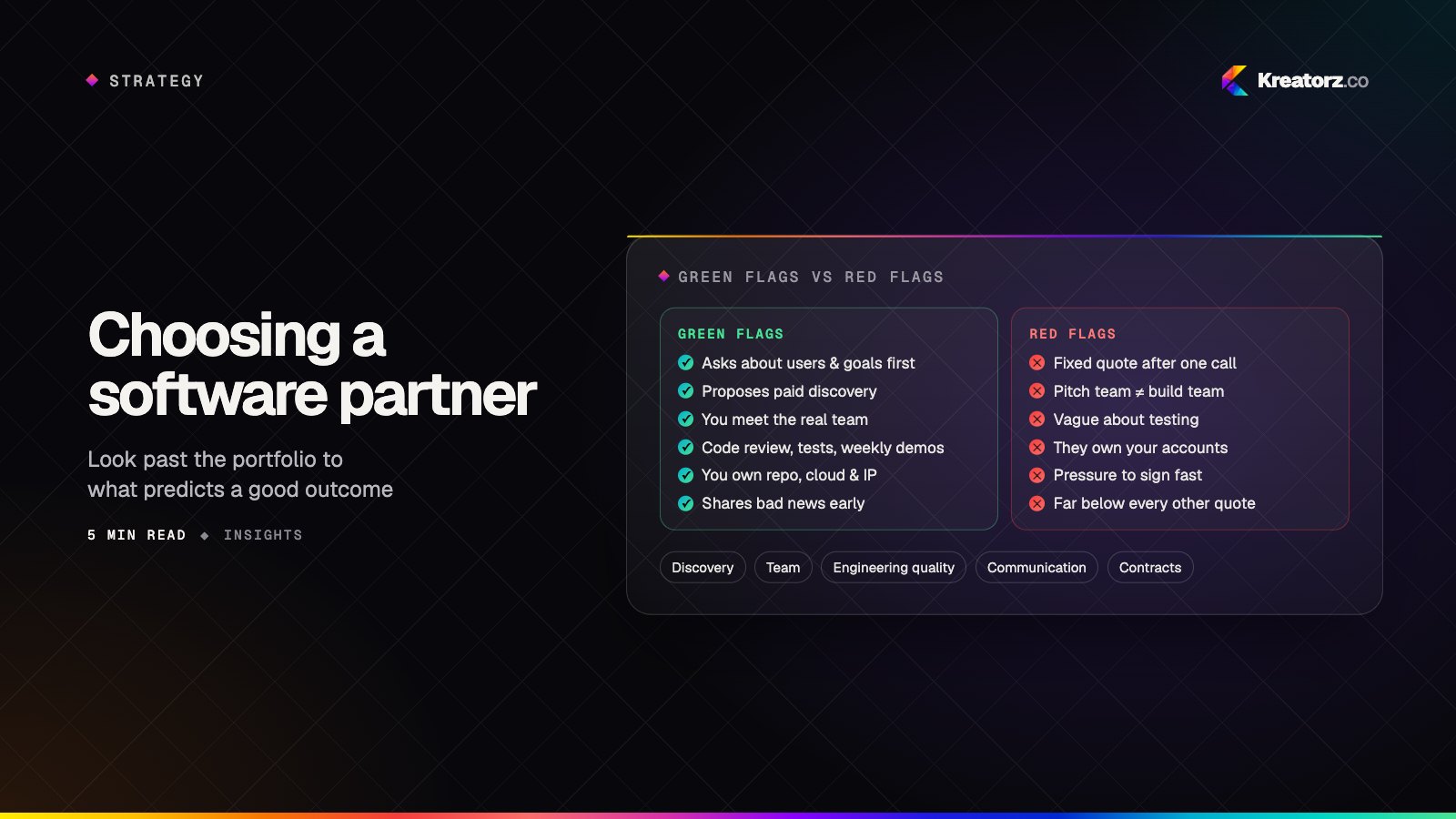
How to choose a software development partner: a buyer's guide
The partner you choose shapes your product more than any framework or tool. Here is how to evaluate agencies and studios on the things that actually predict a good outcome — and the red flags worth walking away from.
12 November 2026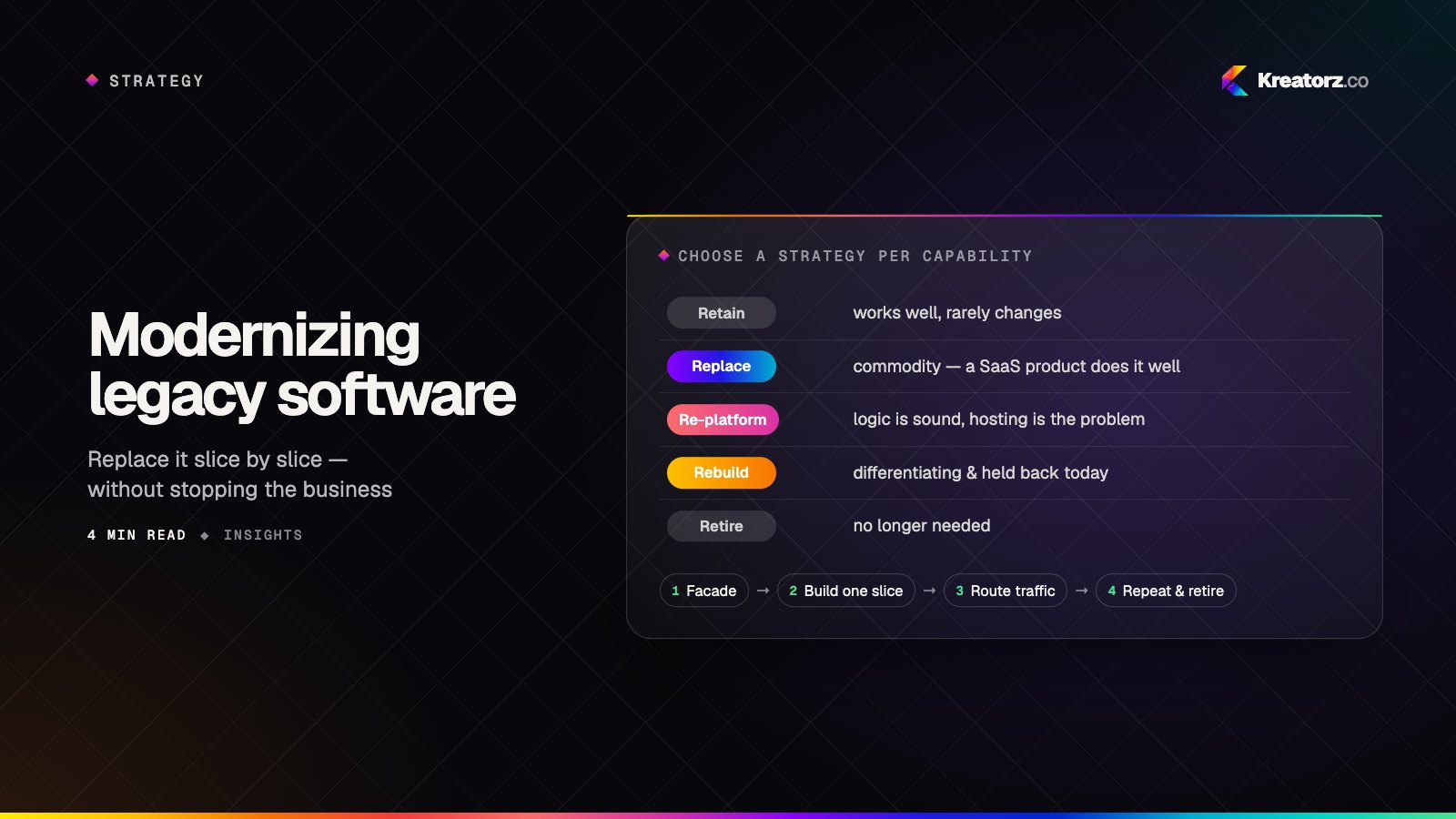
Modernizing legacy business software without stopping the business
Big-bang rewrites are one of the riskiest projects a company can take on. Incremental modernization lets you replace an aging system piece by piece — while the business keeps running and value arrives early.
19 August 2026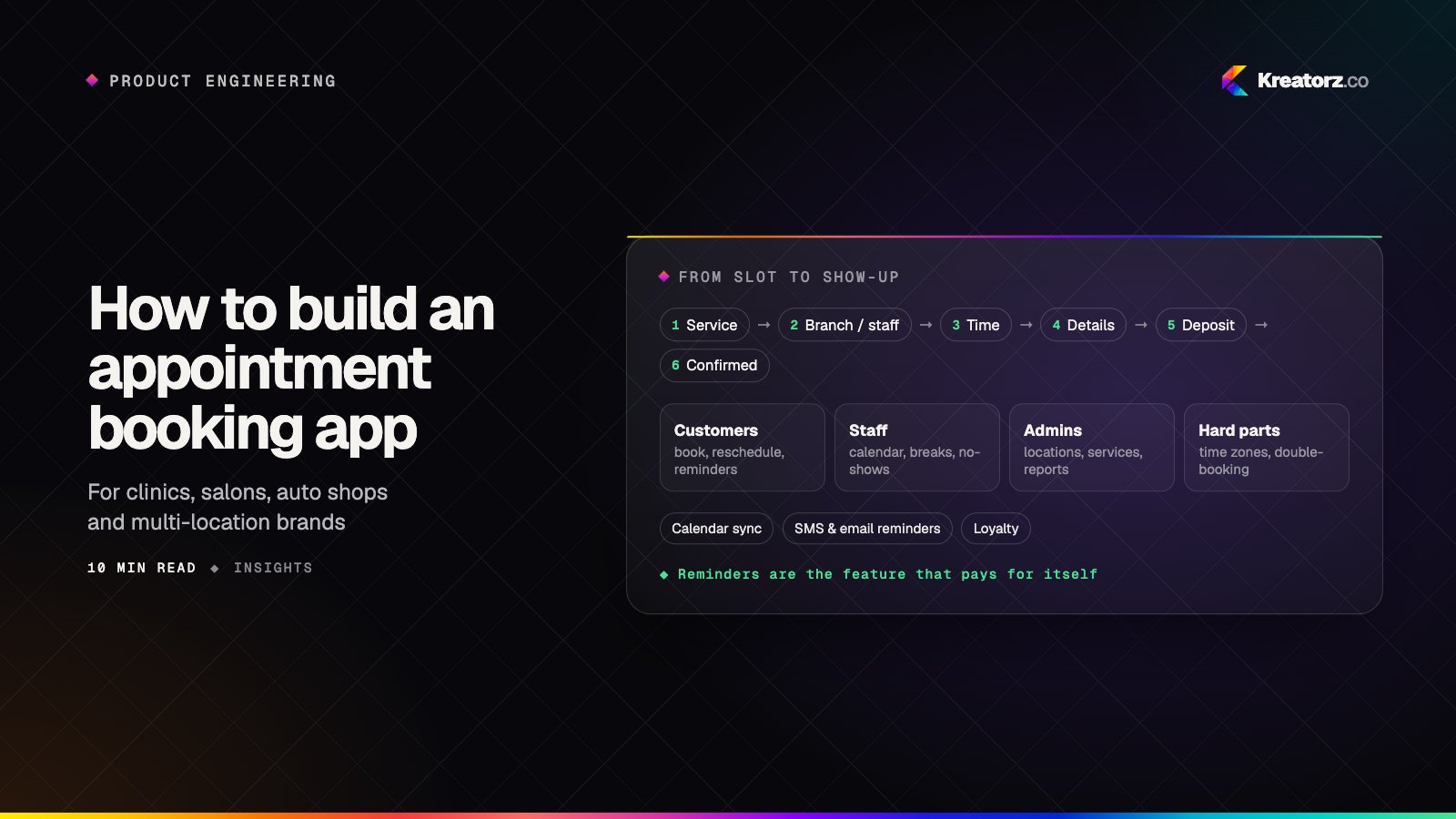
How to build an appointment booking app for your business
An appointment booking app looks simple until two customers grab the same slot, a reminder goes out in the wrong time zone or a no-show empties a chair. Here is a step-by-step guide for clinics, salons, studios and multi-location service businesses deciding whether to buy or build, and how to build it well.
21 November 2026