How to build a SaaS product: a step-by-step guide from idea to scale
Building a SaaS product means building two things at once — the product customers use and the machinery that lets you sell, bill, support and scale it. Here is the process, step by step, from validating the idea to growing beyond your first customers.
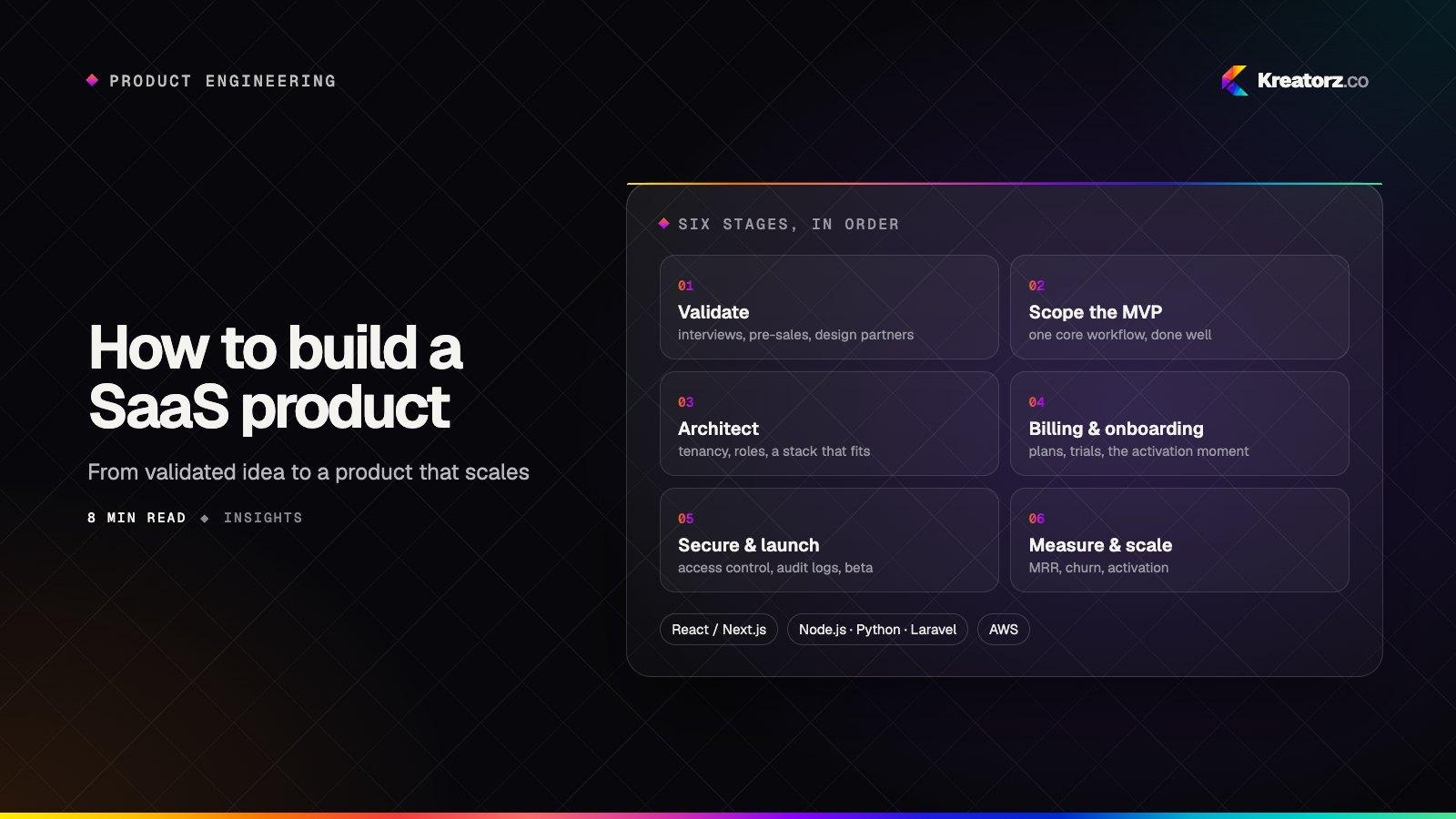
Knowing how to build a SaaS product is less about any single technology and more about sequence. Founders who struggle usually do the right things in the wrong order: they polish features before validating demand, bolt on billing at the last minute, or chase scale before they have retention. Software-as-a-service rewards a disciplined path — prove the problem, ship a focused first version, make it easy to buy and adopt, then grow on evidence.
This guide walks through that path step by step, from the first idea to a product that can scale. It is written for founders and product leaders, whether you are launching something new or turning an internal tool or service into a subscription business.
The SaaS product development process at a glance
| Step | Key question | Main output |
|---|---|---|
| 1. Validate | Do enough people have this problem, and will they pay to solve it? | Evidence from interviews, pre-sales or pilots |
| 2. Scope the MVP | What is the smallest product that delivers real value? | A prioritised first-release scope |
| 3. Architecture | Which decisions are expensive to change later? | Tenancy, identity and data model choices |
| 4. Tech stack | What will let a small team move fast and hire easily? | Front-end, back-end and cloud choices |
| 5. Billing | How will customers pay, upgrade and cancel? | Plans, entitlements and a billing integration |
| 6. Onboarding | How quickly do new users reach value? | A guided path to the first meaningful outcome |
| 7. Security | Can customers trust you with their data? | Access controls, audit logs and a compliance plan |
| 8. Launch | How do the first customers find, try and buy it? | A controlled launch with feedback loops |
| 9. Metrics | Is the business working? | MRR, churn and activation tracked from day one |
| 10. Scale | What is limiting growth now? | Targeted investment in product, performance and team |
Step 1: Validate the idea before you build
Every SaaS product rests on assumptions: that a specific group has a painful, recurring problem; that your approach solves it better than what they do today; and that they will pay a subscription for it. Test these before writing much code.
- Interview potential customers about how they handle the problem now, what it costs them and what they have already tried.
- Look for existing spend — tools, spreadsheets, contractors or staff time. If nobody spends anything on the problem, be cautious.
- Try to pre-sell. Letters of intent, paid pilots or a waitlist with a clear price are stronger signals than compliments.
B2B products benefit especially from a small group of design partners who will use early versions and give honest feedback.
Step 2: Scope a SaaS MVP
A minimum viable product is the smallest version that delivers genuine value to a specific customer and tests your riskiest assumption. For SaaS, that usually means one core workflow done well, rather than a broad platform done thinly.
Ask of every feature: does it help a first customer get the core job done, or help us learn whether this business works? If not, it waits. Our guide to going from idea to MVP in weeks covers this in depth, and our MVP development team helps founders turn a long feature list into a focused first release.
Step 3: Make the architecture decisions that matter
Most early code will change, and that is fine. But a few choices — how you separate customer data (tenancy), how users, organisations and roles work, how plans map to features, and the core data model — touch everything and are expensive to reverse. We cover these, and the decisions you can safely defer, in SaaS architecture decisions to get right early.
The short version: start with a well-structured modular monolith, enforce tenant isolation automatically, use proven providers for authentication and payments, and add logging, error tracking and an automated delivery pipeline from the beginning.
Step 4: Choose a tech stack to build a SaaS app
The best stack is one your team knows well, that has a large hiring pool and mature libraries, and that will not limit you for years. Popular, proven choices include:
- Front end: React with Next.js is a common default for SaaS dashboards and marketing sites, with strong tooling and a large ecosystem. Our React and Next.js development team builds both the product interface and the public pages that need to rank.
- Back end: Node.js with TypeScript suits teams who want one language across the stack and real-time features; Python is a natural fit when data processing or AI is central; Laravel offers a productive, batteries-included framework for PHP teams. Node.js development is a frequent choice for SaaS APIs, but any of the three can carry a successful product.
- Database: a relational database such as PostgreSQL suits most SaaS data models, with good support for row-level security.
- Cloud: AWS offers managed databases, queues, storage and serverless options that let a small team run production reliably. AWS cloud development covers environments, infrastructure as code and the operational basics.
Avoid choosing technology for novelty. Boring, well-understood tools let you spend your energy on the product.
Step 5: Build billing and subscriptions properly
Billing is where many SaaS products accumulate painful shortcuts. Plan for:
- Plans, features and limits kept separate, so changing a plan is configuration rather than a code release;
- Trials, upgrades, downgrades and seats, including proration;
- Usage-based charges if your costs scale with usage — particularly relevant for AI features;
- Failed payments, invoices and tax, handled by an established billing provider;
- Entitlements in your own database, kept in sync with the billing provider through webhooks.
Your pricing will change several times. Make it cheap to do so.
Step 6: Design onboarding and activation
In SaaS, sign-ups are not success; reaching value is. Define your activation moment — the first point at which a new user experiences the product's core benefit, such as creating a first project, connecting a data source or inviting a teammate.
Then design onboarding to get people there quickly:
- ask only for what you need at sign-up;
- use sensible defaults, templates or sample data so the product never looks empty;
- guide users through the first key action rather than touring every feature;
- make inviting colleagues easy, since team adoption usually drives retention in B2B products;
- follow up with helpful, behaviour-based emails rather than a generic sequence.
Step 7: Plan security and compliance from the start
Customers trust you with their data, and larger customers will ask you to prove it. Build in:
- role-based access control checked on the server;
- encryption in transit and at rest;
- audit logs for important actions;
- secure handling of secrets and regular dependency updates;
- backups with tested restores;
- single sign-on for business customers as you move upmarket.
Depending on your market, you may also need to meet frameworks such as SOC 2, ISO 27001, GDPR or HIPAA. You do not need certification on day one, but designing with those controls in mind makes it far easier later. If your product includes AI, our article on securing AI products covers the additional risks.
Step 8: Launch in stages
Launch is a process, not a date. Start with design partners and a private beta, fix what they find, then open up gradually. Use feature flags to release safely, make sure support and feedback channels are in place, and be ready to talk to every early customer. The aim of launch is learning, not just attention.
Step 9: Track the SaaS metrics that matter
Instrument these from day one, using clear, consistent definitions:
- MRR (monthly recurring revenue): the predictable subscription revenue you expect each month, normalising annual plans to a monthly figure and excluding one-off fees.
- Churn: the rate at which customers (logo churn) or revenue (revenue churn) are lost over a period.
- Net revenue retention: revenue from an existing group of customers after a period, including expansion, contraction and churn, compared with where it started.
- Activation rate: the share of new sign-ups who reach your defined activation moment within a set time.
- CAC (customer acquisition cost): total sales and marketing spend divided by the number of new customers acquired in the same period.
- LTV (customer lifetime value): the gross margin you expect to earn from a customer over the time they stay.
Rather than chasing published benchmarks, watch the trends in your own numbers and understand what moves them.
Step 10: Scale SaaS development with evidence
Scaling is about removing whatever currently limits growth — and that changes over time. Early on, it is usually product fit and activation. Later it may be performance, enterprise features such as SSO and advanced permissions, integrations, internationalisation or team structure.
Measure before optimising: add caching, background jobs and database indexes where monitoring shows real bottlenecks, and split services out of the monolith only when a clear scaling or team boundary demands it. Products such as Ryvato, a strategic project management platform we built that connects objectives, team KPIs, project execution and performance analytics, show why: that kind of depth is best added in deliberate layers, each one justified by what customers need next.
Planning a new platform or rebuilding one that has outgrown its first version? Our SaaS development team works with founders and product leaders at every stage. Get in touch and we will be glad to talk through where you are and what comes next.
Frequently asked questions
How long does it take to build a SaaS product?
A focused SaaS MVP often takes around three to six months, depending on the core workflow, integrations, billing complexity and how quickly decisions are made. Building a mature product is an ongoing process that continues long after launch.
What is the best tech stack for SaaS development?
There is no single best stack. React with Next.js on the front end, Node.js, Python or Laravel on the back end, PostgreSQL and AWS form a proven, widely supported combination. Choose what your team knows well and can hire for.
Do I need an MVP before building a full SaaS product?
In almost all cases, yes. An MVP tests whether customers will adopt and pay for your core workflow before you invest in the full platform, and it gives you real usage data to guide what you build next.
Should I use a billing provider or build my own?
Use an established billing provider for payments, invoices and tax, and keep your own record of what each customer is entitled to. Building payments infrastructure yourself is rarely a good use of an early team's time.
What SaaS metrics should I track from launch?
Start with MRR, churn, activation rate and net revenue retention, then add CAC and LTV as your sales and marketing activity grows. Define each metric clearly and consistently so trends are meaningful.
When should a SaaS product move to microservices?
Usually later than people expect. A modular monolith is faster to build and easier to run. Consider splitting services when a specific part of the system has clearly different scaling needs, or when team size makes independent deployment worthwhile.
Related services
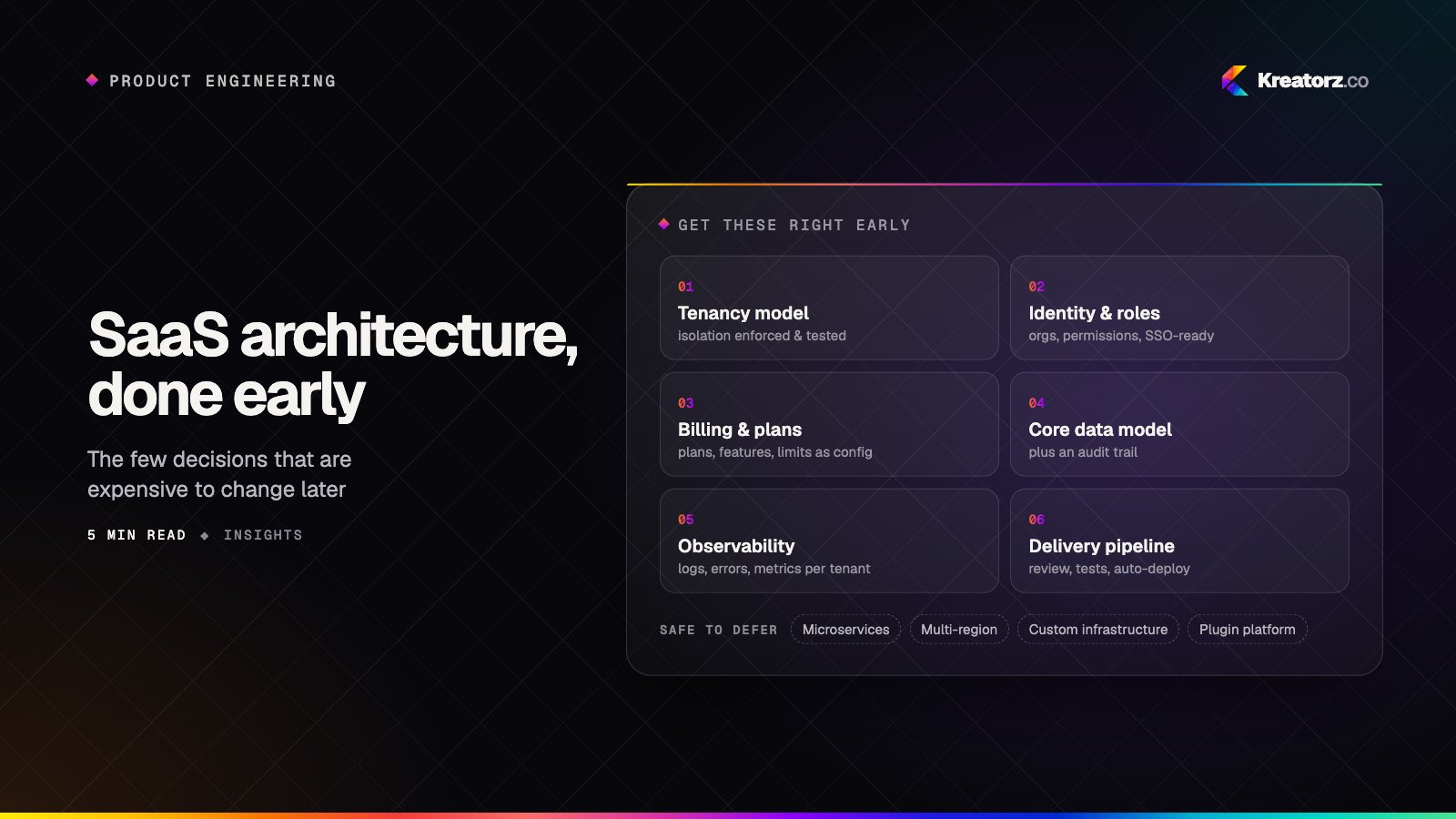
SaaS architecture decisions to get right early
Most early SaaS code will be rewritten — and that's fine. But a handful of decisions are expensive to change later. Here are the ones worth getting right in the first months, and the ones you can safely defer.
20 October 2026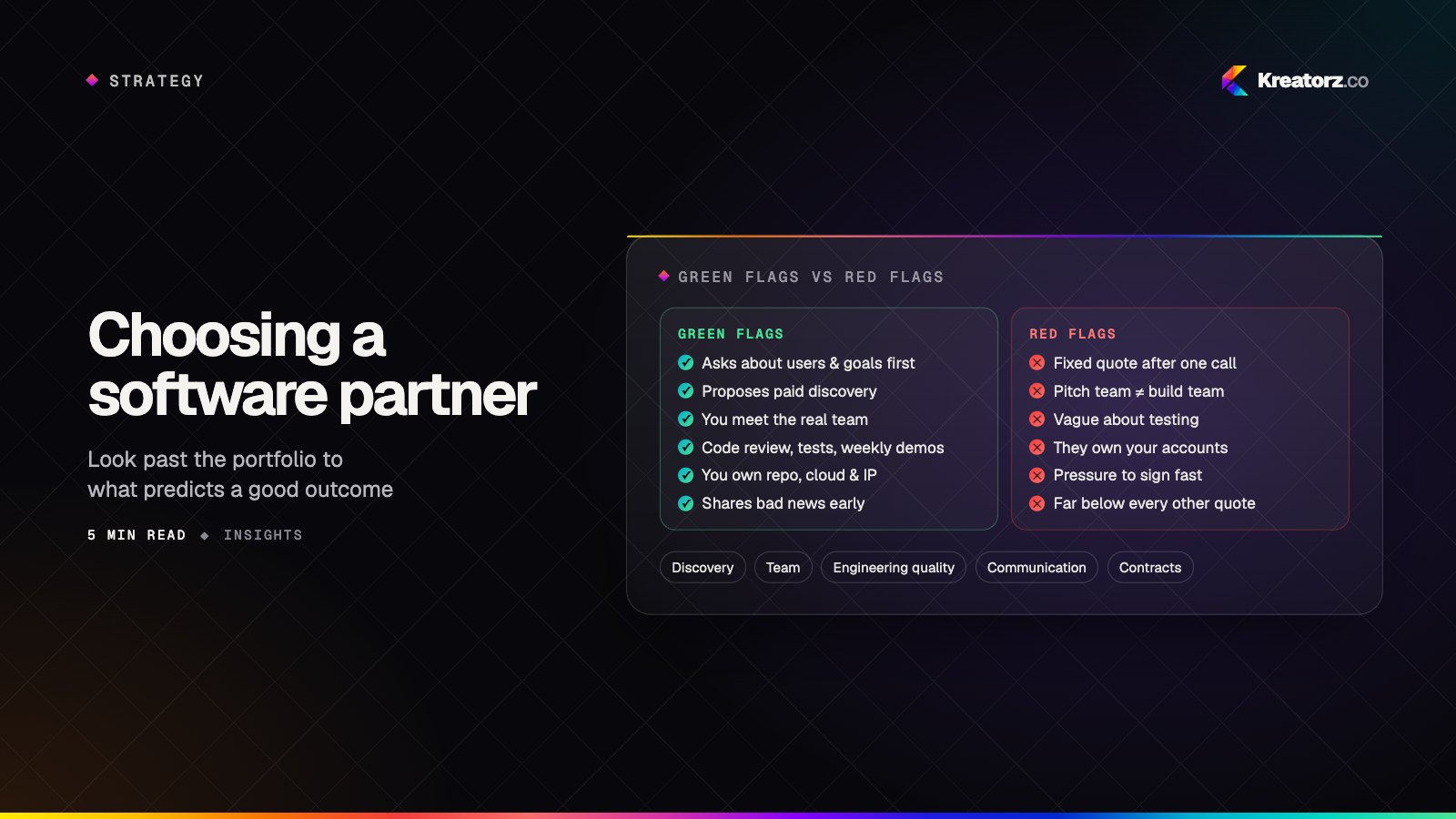
How to choose a software development partner: a buyer's guide
The partner you choose shapes your product more than any framework or tool. Here is how to evaluate agencies and studios on the things that actually predict a good outcome — and the red flags worth walking away from.
12 November 2026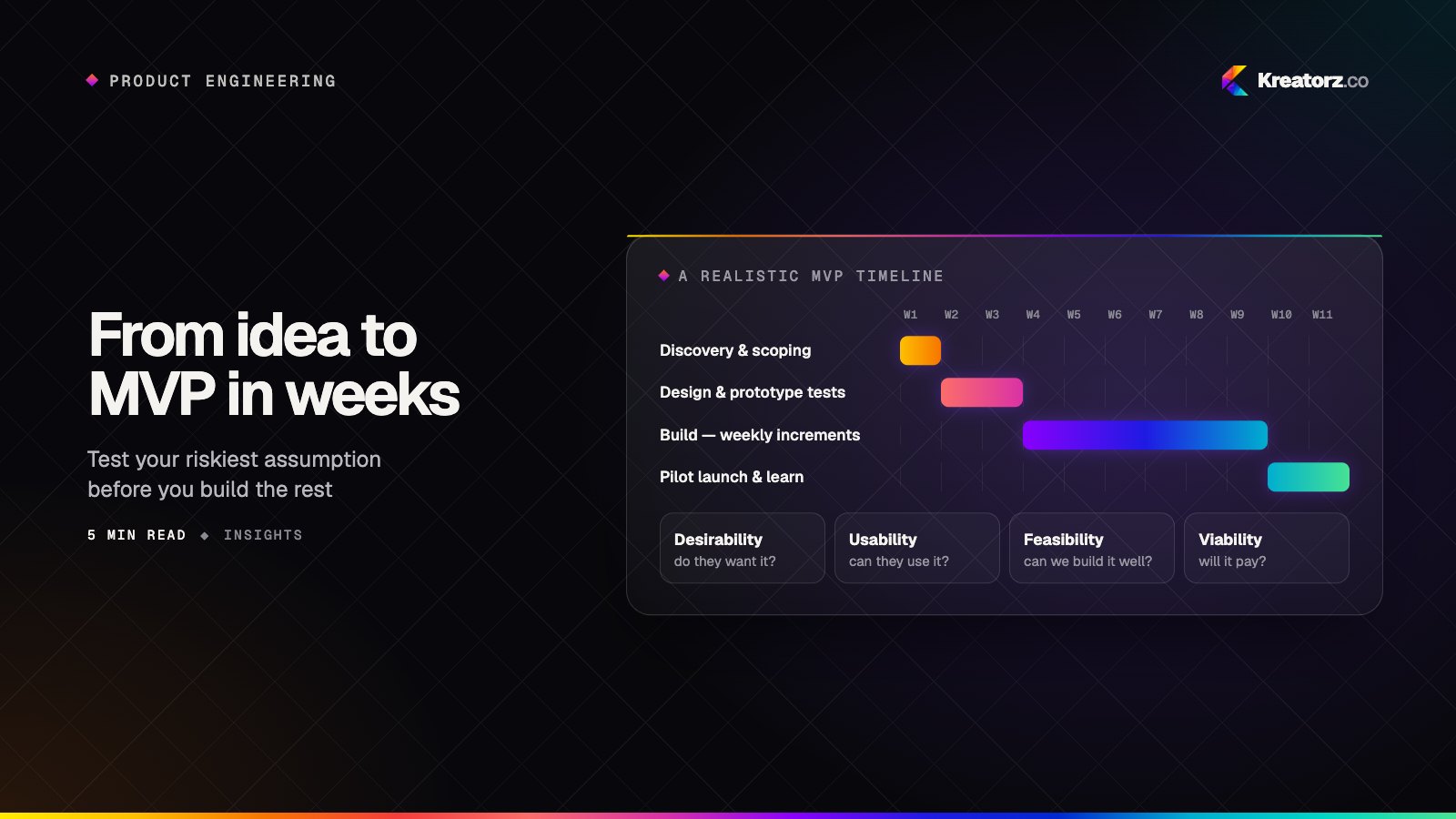
From idea to MVP in weeks: how to de-risk a new product
A minimum viable product is not a smaller version of the final product — it is the fastest honest test of your riskiest assumption. Here is the process we use to launch quickly without building the wrong thing.
14 October 2026