AWS offers hundreds of services, and that choice is both its strength and its trap. Pick the right handful and you get an application that scales smoothly, recovers from failure and costs little when it is quiet. Pick badly and you get a bill nobody understands and an architecture nobody dares change. Our AWS development services focus on the first outcome: clear, well-reasoned architecture, defined in code, that your team can understand and operate.
We build new products on AWS, migrate existing applications and fix setups that have grown expensive or brittle. The same team writes the code in Node.js or Python and the infrastructure it runs on.
What AWS cloud consulting should give you
Good cloud consulting leaves you with decisions you understand, not just resources that exist. Every engagement produces:
- An architecture you can explain — a diagram and written rationale for each major service choice.
- Infrastructure as code — every environment reproducible from version control with AWS CDK or Terraform.
- Secure defaults — least-privilege IAM, encryption at rest and in transit, private networking where appropriate and secrets kept out of code.
- Observability — logs, metrics, traces, dashboards and alerts linked to user-facing symptoms.
- Cost visibility — tagging, budgets and alerts so spend is attributed and surprises are caught early.
- Runbooks — how to deploy, roll back, restore from backup and respond to common incidents.
Designing with Well-Architected principles
We use the AWS Well-Architected Framework as a checklist for every design, not as a badge:
- Operational excellence — automated deployments, small reversible changes and learning from incidents.
- Security — identity foundations, traceability, layered defences and protected data.
- Reliability — multi-AZ deployments, automatic recovery, tested backups and graceful handling of dependency failures.
- Performance efficiency — the right compute and storage for each workload, caching and CDN delivery.
- Cost optimisation — paying for what you use, rightsizing, and choosing managed services that remove operational effort.
- Sustainability — avoiding idle capacity and over-provisioned resources.
The pillars trade off against each other — multi-region improves resilience but adds cost — so we help you decide what your stage justifies.
Serverless, containers or managed servers
| Serverless (Lambda, API Gateway, DynamoDB) | Containers (ECS / Fargate, EKS) | Managed servers (EC2, Elastic Beanstalk, Lightsail) | |
|---|---|---|---|
| Scaling | Automatic, per request | Automatic, per task or pod | Manual or auto scaling groups |
| Cost when idle | Near zero | Baseline for running tasks | Baseline for running instances |
| Operational effort | Lowest | Moderate (EKS higher) | Highest |
| Best for | Event-driven work, APIs with spiky traffic, new products | Long-running services, steady traffic, existing apps in Docker | Legacy software, special OS or licensing needs |
| Watch out for | Cold starts, execution limits, distributed debugging | Cluster and image management | Patching, capacity planning |
Many systems mix them — for example a containerised API on ECS Fargate, Lambda for events and scheduled jobs, and Aurora for relational data.
AWS development services we provide
Serverless development on AWS
APIs on API Gateway and Lambda, event-driven workflows with EventBridge, SQS and Step Functions, and data in DynamoDB or Aurora Serverless. Ideal for new products and variable workloads where paying per request keeps costs low.
Containerised applications
Dockerised services on ECS with Fargate, or EKS where Kubernetes is genuinely needed, with load balancing, autoscaling, blue-green or rolling deployments and service discovery.
Data and storage
Relational databases on RDS and Aurora, key-value data in DynamoDB, file and media storage in S3 delivered through CloudFront, and caching with ElastiCache. Backups, point-in-time recovery and restore tests are part of the setup.
AWS DevOps and CI/CD
Pipelines with GitHub Actions or AWS CodePipeline that test, build, scan and deploy every change, with separate development, staging and production accounts, preview environments and automated rollbacks.
AI on AWS
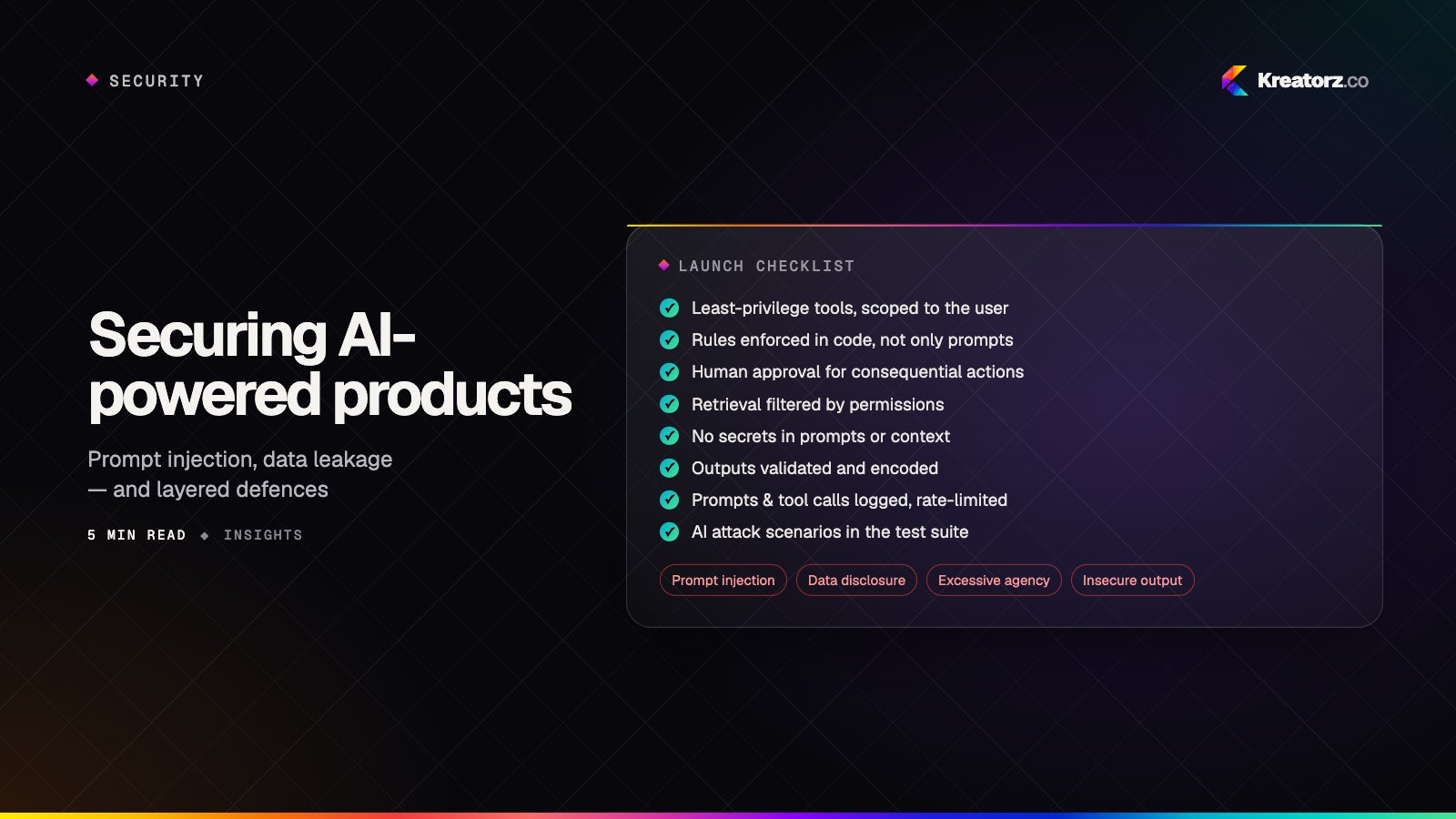
Generative AI features using Amazon Bedrock, custom model training and hosting with SageMaker, and retrieval pipelines over your own data — kept inside your AWS account with access controls and logging. Our AI app development and machine learning development teams build the application layer, and our post on securing AI products covers the safeguards.
Cost optimisation and reviews
Analysis of your current bill, rightsizing, savings plan recommendations, storage lifecycle rules, removing idle resources and redesigning the expensive parts of the architecture.
AWS migration services — our process
- Discover. Inventory applications, dependencies, data volumes, traffic patterns, compliance needs and current costs.
- Decide per workload. Rehost, replatform onto managed services, refactor, or retire — each application gets the approach that suits it.
- Build the landing zone. Multi-account structure, networking, identity, logging and guardrails, all in code.
- Pilot. Migrate a lower-risk workload first to prove the pipeline, monitoring and rollback.
- Migrate in waves. Move data and services with replication and cut-over plans that minimise downtime.
- Optimise. After traffic settles, rightsize, adopt managed services and tune costs based on real usage.
- Operate. Ongoing monitoring, patching, upgrades and improvement, by us or your team.
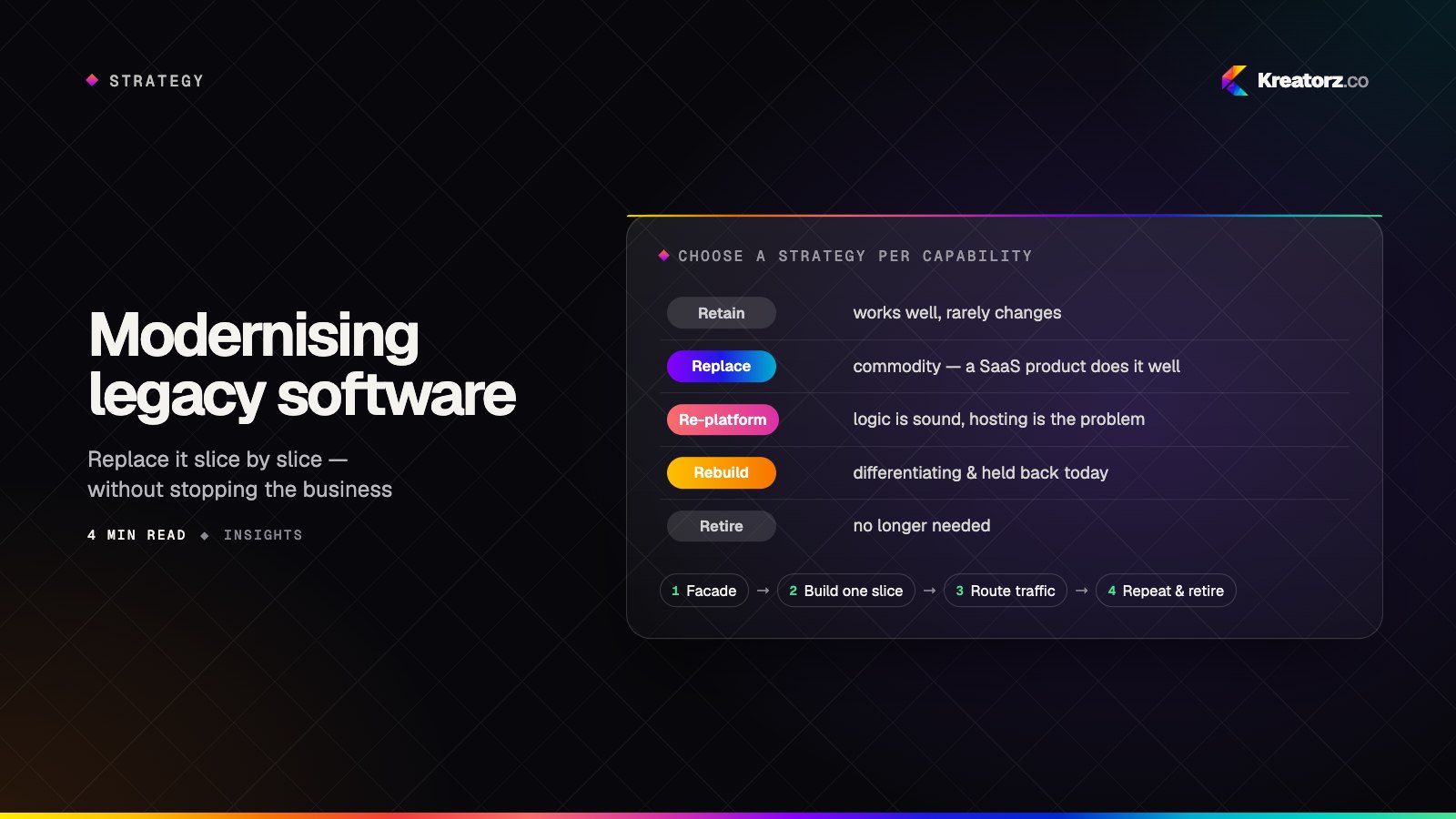
When the application itself needs modernising during migration, our guide to modernising legacy software explains how we sequence the work.
What we build on AWS
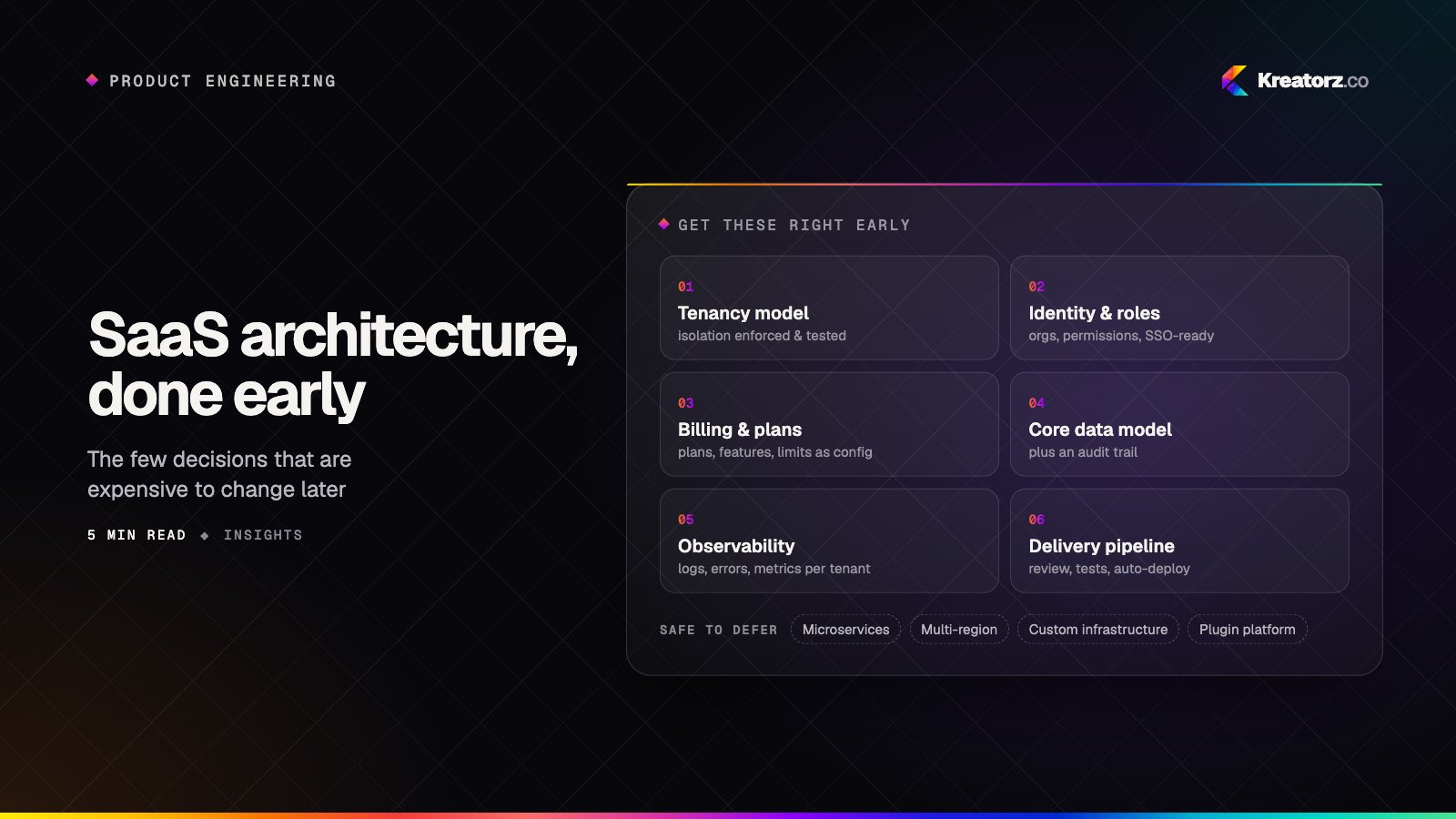
- SaaS platforms with tenant isolation, per-tenant metrics and scalable billing; see SaaS development and our article on SaaS architecture decisions. Our portfolio includes products of this kind, such as Ryvato, a strategic project management platform with OKR management, KPI reporting and project health scores.
- Backends for mobile and web apps with authentication, push notifications, media storage and APIs — the foundations behind on-demand products like YaFi, a delivery app with live order tracking, a digital wallet and in-app rider messaging.
- Event-driven processing for documents, images, payments and integrations.
- Data platforms that collect, transform and serve data for reporting and AI.
- AI-powered products using Bedrock or SageMaker within your own security boundary.
- Migrated legacy systems moved from on-premises servers or other hosts onto managed AWS services.
Why Kreatorz for AWS development
- Application and infrastructure together. The people designing your cloud also write the code that runs on it — see full stack development.
- Infrastructure as code, always. No click-built environments that nobody can reproduce.
- Cost awareness from day one. Architecture choices are discussed with their running costs, not just their features.
- AI-native. Recognised with the Global AI Impact Award at the Global Image Awards Middle East, Riyadh 2026.
- Your accounts, your control. AWS accounts, code and credentials belong to you from the start, with weekly demos and a shared backlog.
- Worldwide. Offices in the United States, Canada and Pakistan support clients across time zones.
Want a second opinion on your AWS setup or a plan for a new build? Contact us.